STARESSO Sp300 Plus Portable Coffee Maker
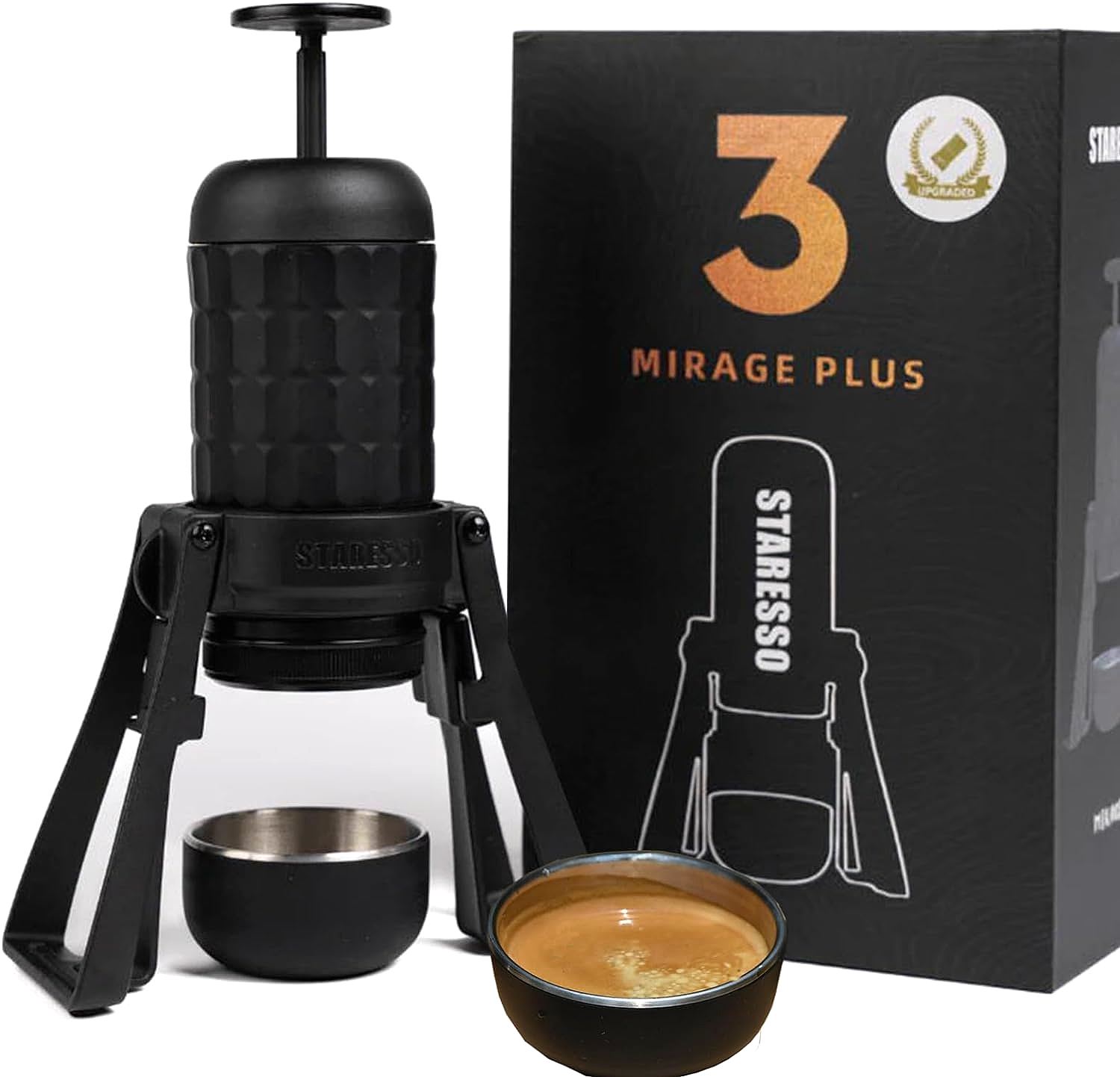
STARESSO Sp300 Plus Portable Coffee Maker
The STARESSO Sp300 Plus Portable Coffee Maker is the go-to choice for manual espresso pressure. This compact device lets you control extraction quality anywhere, turning basic ingredients into a rich shot with a declining pressure curve that pump machines simply cannot replicate. Whether you are camping, traveling, or just want better control over your daily brew, understanding the physics behind manual extraction makes all the difference.
This device is designed for you. You have a bag of freshly roasted beans, a decent grinder, and a pump machine that cost more than your first car. Yet the espresso it produces tastes thin one day, bitter the next, and occasionally - just occasionally - like something you would actually pay for. The machine applies nine bars of pressure with mechanical consistency. The water is the right temperature (manual espresso pressure). The dose is measured to a tenth of a gram. Something about the process itself is working against you.
The problem is not your technique. The problem is that flat, unyielding pressure - the kind vibratory and rotary pumps deliver - is fundamentally at odds with how coffee extracts. And the solution, paradoxically, involves removing the machine from the equation entirely.
Pressure Is Not a Number. It Is a Curve.
Walk into any coffee forum and you will see the same figure repeated like scripture: nine bars. Nine bars of pressure, the thinking goes, is what defines espresso. The Italian Espresso National Institute codified it. Machine manufacturers built to it. Baristas chase it. But treating pressure as a single number is like describing a piece of music by its loudest moment. You learn nothing about the melody.
When a pump machine activates, it hits approximately nine bars almost instantly and holds that pressure steady until the shot is done. The coffee puck - that compressed disc of ground coffee in the portafilter - experiences the same force at second one as it does at second twenty-five. But coffee extraction is not a uniform process. The first liquid to pass through the puck dissolves acids and sugars easily. As extraction continues, the remaining compounds become progressively harder to dissolve and increasingly astringent. Forcing water through spent grounds at full pressure drags out the harsh, bitter tannins that ruin a shot.
Lever machines - both the ceiling-mounted originals from 1940s Italian cafes and modern countertop versions - produce a fundamentally different pressure profile. They start high, typically between nine and eleven bars, then decline naturally over the course of the extraction to approximately six bars. This is not a deficiency. According to coffee engineering documentation from SetupBarista, that declining tail end is precisely what prevents over-extraction. The reduced pressure at the finish maintains flow without violently scouring the puck for compounds that should stay put.
This is the central insight that pump machines miss: the shape of the pressure curve matters more than its peak. This principle is exactly what makes portable manual devices special. Understanding these pressure dynamics is what separates good shots from great ones.
Pascal Law, Scaled Down to Your Palm
How does a device small enough to fit in a jacket pocket generate pressure comparable to commercial equipment? The answer sits in a principle formulated in 1653.
Blaise Pascal observed that pressure applied to an enclosed, incompressible fluid transmits equally in all directions throughout that fluid. In a sealed chamber filled with water - and espresso brewing chambers are exactly that - every pump stroke adds to the total internal pressure. The fluid cannot compress, so the force accumulates.
A manual pump espresso device exploits this with elegant simplicity. Each press of the palm forces a small volume of water into the brewing chamber. Because the chamber is sealed and the coffee puck resists flow, that small input of force translates directly into pressure. The second press adds to the first. The third builds further. Within seconds, the internal pressure reaches fifteen to twenty bars - substantially higher than the nine-bar standard that pump machines target.

The physics are straightforward. Force divided by area equals pressure. A small-diameter pump piston - say, two centimeters across - has a surface area of roughly 3.14 square centimeters. Applying ten kilograms of force to that piston generates pressure exceeding thirty atmospheres. Even accounting for friction losses and seal inefficiency, the math works: human hands can easily produce the pressures espresso demands.
This is why the chamber size is a feature, not a limitation. Smaller cross-sectional areas amplify input force. A portable manual device with a narrow brewing chamber actually requires less physical effort to reach high pressure than a large commercial group head would. The physics of confined fluids rewards miniaturization.
The Pre-Infusion Problem Nobody Talks About
Freshly roasted coffee contains trapped carbon dioxide. When hot water hits fresh grounds at full pressure, that gas expands violently, creating channels through the puck - paths of least resistance where water rushes through while bypassing most of the coffee. Channeling is the enemy of even extraction. The shot runs fast where channels form, slow everywhere else, and tastes simultaneously sour (under-extracted areas) and bitter (over-extracted areas).
Pump machines address this with a feature called pre-infusion, where the pump runs at reduced pressure for a few seconds before ramping to full power. Not all machines have it. Among those that do, the pre-infusion duration and pressure are fixed - typically two to four seconds at three bars. You get what the manufacturer decided was correct.
Manual systems handle pre-infusion differently, and the difference is consequential. Because pressure builds incrementally with each pump stroke, the operator controls the pre-infusion phase by simply pressing slowly. One gentle stroke might generate one to three bars - enough to saturate the puck, allow the carbon dioxide to bubble out through the coffee bed, and let the grounds swell and settle into a uniform matrix. No channeling. No gas explosions. Just a calm, wet puck ready for full-pressure extraction.
Research compiled by Coffee Exploration on lever machine physics and manual espresso pressure principles notes that this extended, controlled pre-infusion is one of the primary reasons manual extraction produces cleaner-tasting espresso. The puck settles under gentle pressure before the full force arrives, creating even resistance that translates to even extraction.
Feeling the Extraction
There is a dimension to manual espresso that no automated machine can replicate: tactile feedback.
When you operate a direct lever or a hand pump, you feel the coffee puck resisting the water. The resistance is firm at the start, when the grounds are dry and tightly packed. As water saturates the puck and extraction begins, you feel that resistance soften - not suddenly, but gradually, like watching a tide come in through your hands.
The Alto E Works technical paper on espresso pressure describes this phenomenon as the core advantage of manual levers. The operator senses puck erosion in real time - a principle at the heart of manual espresso pressure control. If the resistance drops too quickly, the grind was too coarse. If it barely yields, the grind was too fine. If it gives way evenly over fifteen to twenty seconds of pumping, the extraction is proceeding well. This haptic information - pressure transmitted through the lever or pump directly to your hand - allows micro-adjustments mid-shot that no machine can make because no machine can feel.
Community discussions on Home-Barista.com capture this succinctly: manual levers are the original flow profiling devices. Long before pressure-profiling pump machines existed with their programmable curves and digital readouts, lever operators were profiling shots by feel. They were adjusting pressure based on the tactile report from the puck, slowing down when the resistance suggested over-extraction, pushing harder when the flow was too restricted.

Why Higher Peak Pressure Compensates for Real-World Conditions
The nine-bar espresso standard was established under controlled conditions: professional-grade grinders producing particle distributions measured in microns, water heated to precisely 92 degrees Celsius, freshly roasted beans with known rest periods. Those conditions exist in specialty coffee shops. They rarely exist in hotel rooms, campsites, or office kitchens.
Portable manual espresso devices like the STARESSO Sp300 Plus Portable Coffee Maker operate at peak pressures of fifteen to twenty bars - considerably higher than the traditional standard. This is not a design flaw or marketing exaggeration. It is an engineering response to reality.
When you cannot grind as finely as a proper espresso grinder allows - and portable hand grinders rarely match the consistency of commercial flat burrs - the coffee puck offers less resistance to water flow. Less resistance at nine bars means water rushes through too quickly, under-extracting the coffee. Higher peak pressure forces water through the coarser bed with enough velocity to achieve adequate extraction despite the non-ideal grind.
Similarly, water temperature in portable setups is often lower than the ideal range. Without a thermoblock or boiler maintaining 92 degrees, you might be brewing with water at 80 to 85 degrees - temperatures at which many flavor compounds dissolve more slowly. Higher pressure partially compensates by increasing the thermodynamic driving force of extraction.
The physics of portable manual espresso - including these dynamics - is not about matching laboratory conditions. It is about producing excellent results when conditions are imperfect. And the higher peak pressure, combined with the operator-controlled declining profile, does exactly that.

The Analog Future
Something peculiar is happening in coffee culture. As pump machines become more sophisticated - adding pressure profiling, flow control, digital temperature stability, and app connectivity - a growing number of experienced baristas and home enthusiasts are moving in the opposite direction. They are picking up manual levers. They are packing hand pumps into backpacks.
The appeal is not nostalgia. It is control - specifically, the kind of control that only exists when a human nervous system is part of the feedback loop. The LMU Munich researchers who developed the equation for what they termed perfect percolation found that the critical variable was not pressure magnitude but uniformity of resistance within the coffee puck. Manual extraction, with its built-in pre-infusion and tactile feedback, produces exactly that uniformity more reliably than automated systems that apply force blindly.
Pump machines are excellent at repeating the same shot identically. But mastering manual espresso pressure variability is what elevates home brewing to craft level. But identical repetition of a mediocre extraction profile yields mediocre espresso every time. The manual path trades consistency for responsiveness - the ability to feel what the coffee needs right now, in this specific shot, with these specific beans at this specific freshness, and adjust accordingly.
The next time you watch someone pull a shot on a manual pump - their hands moving slowly at first, then with deliberate pressure, then easing off as the stream turns golden and thin - understand that you are watching applied physics in real time. Pascal principle multiplying force through confined fluid. A declining pressure profile that prevents the bitterness of over-extraction. Pre-infusion that settles the puck without violence. Tactile feedback that no sensor can match.
The machine does not know when the coffee is done. Your hands do.
STARESSO Sp300 Plus Portable Coffee Maker
Related Essays

Avigator 12V Portable Car Coffee Maker: Fresh Drip Coffee On the Go
The Pocket-Sized Laboratory: Deconstructing the Science of Portable Pour-Over Coffee

ELEISIOS KF440050-01 Portable Espresso Machine: Your Pocket-Sized Barista for Adventures On-the-Go
ILAVIE CM5020-UL: The Science Behind Your Perfect Home Brew

When Spinning Replaces Pressure: The Physics Inside Centrifugal Coffee Brewing

From Chaos to Order: The Physics of Particle Size and Coffee Extraction
From Chaos to Order: The Physics of Particle Size and Coffee Extraction
When Spinning Replaces Pressure: The Physics Inside Centrifugal Coffee Brewing