Thermal Architecture for Commercial Espresso: How an 11-Liter Copper Boiler and Rotary Pump Keep Extraction Stable

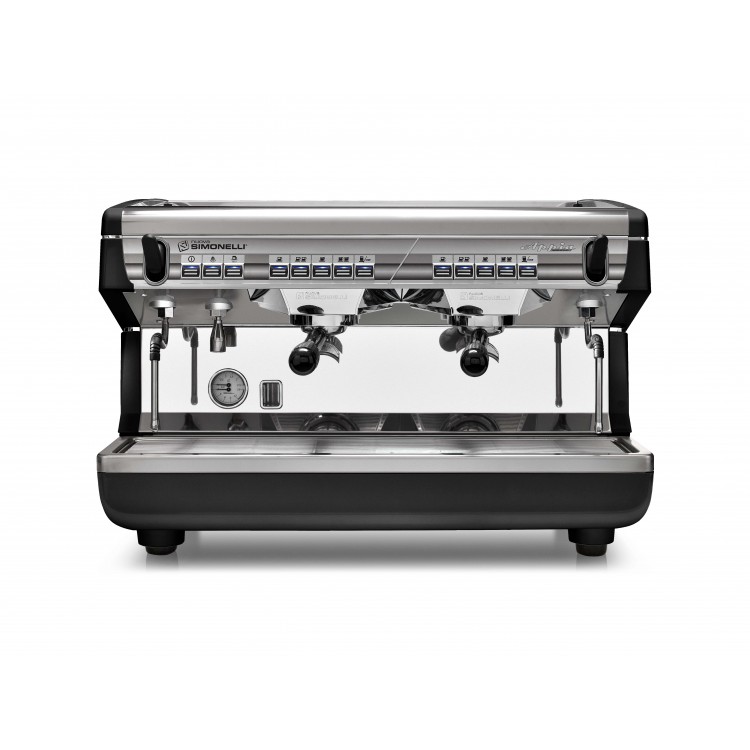
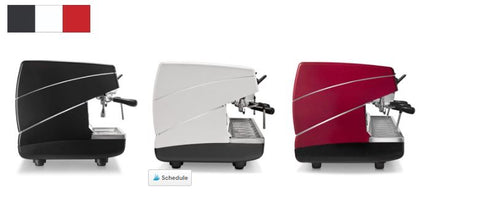
Nuova Simonelli Appia II Volumetric 2 Group Espresso Machine MAPPIA5VOL02ND001
The shot that took 27 seconds at 7:30 AM takes 34 seconds at 8:47. The milk that steamed into silk at the first ticket now hisses and spits, the gauge sagging as the barista wipes it down. The line is eight deep. Extraction times drift longer. The crema thins. Somewhere around drink twenty, the machine has quietly crossed from "in spec" to "in trouble," and nobody touched a single setting.
This is not a barista problem. It is a thermodynamics problem—one that separates workhorse commercial machines from kitchen countertop units at the level of boiler volume, material science, and pump architecture. Every espresso machine is a heat engine. It must convert electrical energy into thermal energy, store that energy in a medium, and deliver it on demand inside a narrow temperature window. When the rate of withdrawal exceeds the rate of replenishment, quality collapses. The fix is not a more clever PID tuning curve. The fix is mass: enough copper, enough water, and enough pump headroom that the physics stays forgiving even when the tickets stack up.
A production machine built squarely on these thermodynamic principles is the Nuova Simonelli Appia II, a two-group commercial espresso machine designed for sustained output of 30 to 50 cups per hour. Its architecture is a case study in the design choices that separate workhorse commercial equipment from prosumer hardware: an 11-liter copper boiler, a rotary vane pump, and a passive thermosiphon group head circuit that maintains temperature stability without a PID controller. The machine is not the most precise in its class. Its priorities are thermal headroom, mechanical longevity, and serviceability—the three variables that determine whether a commercial espresso setup remains profitable across a decade of daily operation.
Why Commercial Espresso Demands Thermal Architecture Beyond Home Machines
A prosumer heat exchanger machine with a 1.5-liter boiler can pull an excellent shot. It can pull three or four in a row without complaint. The trouble begins when pace accelerates. After every extraction, cold fresh water enters the heat exchanger to refill the lines. That cold inflow draws heat from the surrounding boiler water, dropping the boiler temperature. The heating element then works to restore the set point before the next shot.
In a home setting—one shot every few minutes—the boiler has time to recover. Recovery intervals of 4 to 8 seconds between shots are typical for well-designed prosumer HX machines, and the interval between pulls is large relative to the recovery time. The system never accumulates a deficit. The math is on the machine's side.
The equation flips when the shot interval drops below the recovery interval. At 20 cups per hour—roughly one pull every three minutes—a prosumer HX machine operates near its thermal ceiling. At 30 to 50 cups per hour, which is light commercial volume for a specialty cafe or restaurant, a 1.5-liter boiler cannot replenish thermal energy fast enough. Each shot leaves a small deficit. Those deficits accumulate. By shot fifteen or twenty, the boiler temperature has dropped far enough that the heat exchanger can no longer deliver brew water at the target temperature. Extraction quality degrades. Steam pressure falls as saturated steam condenses faster than the element can regenerate it. The gauge needle drops, and so does the cup quality.
The solution is not a more powerful heating element—though more wattage helps. The solution is thermal mass: enough stored energy that the rate of withdrawal never exceeds the rate of replenishment over any realistic service interval. An 11-liter copper boiler stores roughly seven times the thermal energy of a 1.5-liter boiler at the same temperature. That buffer is the difference between a machine that can serve thirty consecutive drinks without drifting and one that cannot serve ten. The 11-liter copper boiler occupies a specific niche: large enough to bridge prosumer and full cafe, small enough to fit under a standard counter, simple enough that a single technician can service it without proprietary diagnostic tools. That is the engineering sweet spot for 30 to 50 cups per hour sustained.
The Appia II is engineered to operate in this thermal regime—a capacity choice that the sections below examine component by component.
The 11-Liter Copper Boiler: How the Steam Source Doubles as a Heat Reservoir
Material choice in boiler construction is where engineering economics meets thermodynamics. Stainless steel boilers dominate the home and prosumer market because stainless is cheaper to form, resists corrosion well, and is adequate for small-volume thermal loads. But in a commercial machine, where every watt of heat transfer efficiency matters, copper's advantage is decisive.
Copper has a thermal conductivity of approximately 400 W/(m.K). Stainless steel, depending on grade, conducts at roughly 16 W/(m.K). That is a factor of 25. When a heating element transfers energy into a copper boiler wall, the heat propagates through the material almost instantly, distributing evenly into the water volume. A stainless steel wall of the same thickness creates a thermal bottleneck: the element-side surface runs hot while the water-side surface lags. Temperature gradients build up across the wall thickness. Effective heat transfer drops. The element works harder, cycles more often, and ages faster.
The 11-liter capacity provides a straightforward thermal buffer. Water at boiler temperature—typically 120 to 125 degrees Celsius under pressure for saturated steam production—stores roughly 4.2 kilojoules of thermal energy per liter per degree above ambient. An 11-liter volume is a substantial reservoir. When a barista pulls a shot, the cold water entering the heat exchanger draws from this reservoir. Because the reservoir is large relative to the per-shot draw, the temperature drop is small and recovery is fast. Over a thirty-drink service window, the accumulated thermal debt stays inside the boiler's capacity to absorb it.
The boiler also serves a dual purpose. It generates steam for milk texturing through the same heating element and the same water volume that feed the heat exchanger. This unified architecture simplifies internal plumbing. Instead of separate boilers for brewing and steaming—each with its own heating element, temperature sensor, and control loop—a single boiler handles both functions. Fewer components means fewer failure points over a machine's service life. The tradeoff is that steam temperature and HX inlet temperature are coupled rather than independently controllable. That coupling places more engineering burden on the heat exchanger design to deliver consistent brew water despite boiler temperature fluctuations, and it is the reason the thermosiphon loop described in the next section matters so much.
In the Appia II, this unified boiler architecture serves both steam and brew through a single heat source, with the resulting temperature coupling managed by the heat exchanger and thermosiphon loop described below.
The Heat Exchanger and Thermosiphon Loop: Passively Stable Group Heads
The heat exchanger inside a commercial HX machine is conceptually simple: a sealed copper pipe runs through the boiler, immersed in the high-temperature water. When the pump activates, cold fresh water from the supply line enters one end of this pipe. As the water travels through, thermal energy from the surrounding boiler water conducts through the copper wall and into the flowing fresh water. By the time the water exits the heat exchanger and reaches the group head, it has been flash-heated to brewing temperature—approximately 92 degrees Celsius for a balanced espresso extraction.
The elegance of the design lies in what happens when the pump is not running. The thermosiphon loop is a passive circulation system driven by natural convection. A small volume of water sits inside the heat exchanger and the pipes connecting it to the group head. When the boiler is hot, this water heats and becomes less dense. It rises through the plumbing into the heavy brass group head, where it transfers some of its thermal energy to the group's thermal mass. Having cooled slightly, the denser water sinks back down toward the heat exchanger inlet, where it is reheated, and the cycle continues.
This loop runs continuously—24 hours a day while the machine is powered on—without any pump, valve, or electronic control. It is driven entirely by the density difference between hot and cold water, which is to say by gravity. The principle is identical to the one used in passive solar water heating systems, where a collector panel heats water that rises naturally into a storage tank, and in the thermosiphon cooling systems used in some industrial engines and power plants. It is a mechanism that predates electronic control by centuries and remains relevant for the same reason: no moving parts, no control logic, nothing to fail.
The practical result for espresso extraction is group head temperature stability within approximately plus or minus 0.5 degrees Celsius, achieved without a PID controller. A PID controller—standard on many dual-boiler machines—uses a temperature sensor, a microprocessor, and a solid-state relay to pulse the heating element in precise increments, holding temperature to within 0.1 degrees Celsius. It is more precise than a thermosiphon. It is also more complex: more sensors to calibrate, more firmware to maintain, more components that can fail. In a commercial environment where the machine must run reliably for years through staff turnover and variable maintenance discipline, the half-degree stability of a passive thermosiphon—achieved with no electronics at all—represents a deliberate engineering tradeoff between peak precision and long-term reliability.
In the Appia II, this thermosiphon loop circulates between the 11-liter copper boiler and each brass group head, maintaining group temperature within approximately plus or minus 0.5 degrees Celsius through passive convection alone.
The pre-infusion function adds another layer to this story. The soft infusion system ramps pressure from 0 to 9 bar over 4 seconds, gradually saturating the coffee puck before full extraction pressure engages. This controlled ramp reduces channeling in light roasts where uneven wetting produces uneven flow paths. The ramp is implemented through pump control, but the temperature of the water entering the puck during those 4 seconds comes from the same thermosiphon-stabilized group head. Stability at rest enables stability under pressure.
The Rotary Pump Engineering: Why 9 Bars of Commercial Pressure Cannot Come from a Vibratory Pump
Pressure in espresso extraction is not merely a spec to hit. It is the driving force behind dissolution. Water at 9 bars of pressure—approximately 130 pounds per square inch—forces its way through a compacted bed of finely ground coffee. The quality of the extraction depends on how uniformly that pressure is applied over the 25 to 30 seconds of a typical shot. Pressure that oscillates, spikes, or sags during extraction produces uneven flow through the coffee puck. Uneven flow means uneven extraction: some grounds over-extracted into bitterness, others under-extracted into sourness, and the finished shot carrying both flaws at once.
Two fundamentally different pump technologies serve the espresso market, and the choice between them is one of the clearest signals of a machine's intended duty cycle.
A vibratory pump uses an electromagnetic coil to drive a piston back and forth at line frequency—60 cycles per second in North America, 50 in Europe. Each cycle is a discrete pulse of pressure. The average pressure across many pulses may read 9 bars on a gauge, but the instantaneous pressure oscillates around that average, typically within a band of roughly plus or minus 1 bar. The result is a pressure delivery that is adequate for home use, where a machine pulls perhaps five to ten shots per day and where the human palate may not detect the subtle extraction artifacts of pressure ripple. Vibratory pumps have a typical mean time between failures of 5,000 to 8,000 hours. They emit an audible hum—the sound of the piston cycling at line frequency—which, while tolerable in a home kitchen, becomes fatiguing across an eight-hour cafe shift.
A rotary vane pump operates on a different principle. An electric motor spins a slotted rotor inside a cylindrical chamber. Vanes slide in and out of the slots as the rotor turns, creating chambers that expand to draw water in and contract to push water out. The motion is continuous rather than pulsed. Water flows in a smooth, uninterrupted stream, producing pressure that holds within approximately plus or minus 0.1 bar at 9 bars. The pump is quieter by 10 to 15 decibels—a difference that in perceptual terms represents roughly half the perceived loudness. Its MTBF is approximately 50,000 hours, roughly an order of magnitude greater than a vibratory pump. Over a 5-to-10-year service life in a commercial setting, the rotary pump will likely outlast the machine itself, while a vibratory pump would require one or more replacements.
The acoustic difference matters more than spec sheets suggest. In a restaurant dining room where the espresso machine sits behind the bar within earshot of guests, the 60 Hz hum of a vibratory pump becomes part of the room's background character in a way most operators would prefer to avoid. In a quiet specialty cafe, the same hum registers as a low-grade mechanical irritation that accumulates across a shift. Rotary pump operation is closer to the sound of a refrigerator compressor than to the buzz of a solenoid—present, mechanical, but unobtrusive. For venues where the machine shares a room with conversation, this is not a minor consideration.
The Appia II's rotary vane pump delivers continuous flow at 9 bars with approximately plus or minus 0.1 bar of pressure ripple, translating the pump's inherent stability into extraction consistency across consecutive shots.
Where the Appia II Sits Among Workhorse Rivals
The commercial espresso machine market between roughly $4,000 and $10,000 contains several machines that share the same basic mission—reliable high-volume extraction—but differ in how they achieve it. Understanding these differences clarifies what each engineering philosophy prioritizes.
The La Marzocco Linea PB, priced in the $7,000 to $9,000 range, uses dual boilers with independent PID control for each group head. This architecture allows per-group temperature adjustment and holds brew temperature with the precision that electronic control enables—often within plus or minus 0.1 degrees Celsius at the group head. The tradeoff is added complexity: more heating elements, more sensors, more control boards, and more diagnostic procedures when something requires service. The Linea PB is the choice when absolute per-shot temperature precision is the priority and when the cafe has access to qualified service technicians who can keep the electronics calibrated.
The Rancilio Classe 7, priced in the $4,000 to $6,000 range, uses a 10-liter boiler paired with a vibratory pump—a configuration that targets the boundary between high-end prosumer and entry-level commercial. The smaller boiler and pulse-based pump represent cost savings that make the machine accessible to businesses with tighter capital budgets. The tradeoff is reduced thermal headroom and pressure consistency under sustained load. It is the right tool for venues that occasionally hit 30 cups an hour but rarely sustain it.
The Aurelia Wave, from the same Simonelli family, sits at the high end of the range—roughly $8,000 to $10,000—and adds touchscreen controls, automated shot profiling, and IoT telemetry for data-driven cafe management. It is a machine designed for operators who want to track extraction metrics across shifts, locations, and baristas. The Appia II, by contrast, relies on manual paddles, analog pressure gauges, and the barista's judgment. The Aurelia Wave gives you data streams; the Appia II's design philosophy gives you fewer things that can break.
At $6,000 to $8,000, the Nuova Simonelli Appia II occupies the middle ground with a specific philosophy: maximize thermal capacity and mechanical durability while minimizing electronic complexity. The 11-liter copper boiler, rotary pump, and passive thermosiphon temperature control represent an approach that asks a simple question: what is the simplest system that will produce consistent commercial-grade espresso for a decade? It is not the most precise machine in its class. It is one of the most enduring.
The Long View: Why an 11-Liter Boiler and Rotary Pump Justify the Investment
A commercial espresso machine is a capital investment measured in years, not seasons. The purchase price is the first and smallest line item in the total cost of ownership. What matters over a 5-to-10-year operating horizon is maintenance cost, downtime, and whether the machine's output quality degrades as components age.
Annual maintenance for a machine in this class runs approximately $200 per year, covering routine backflushing chemicals, periodic descaling, and replacement of wear items—group gaskets, steam wand seals, and portafilter baskets. By comparison, a dual-boiler machine with dual PID controllers typically runs closer to $400 per year, largely because the additional electronic components require periodic calibration and have finite service lives. These figures are estimates based on typical service schedules reported by equipment dealers; actual costs vary with water quality and usage volume.
The warranty structure provides a window into expected service life. The standard warranty covers parts for three years on the compressor and boiler. A manufacturer willing to warranty a boiler for three years is signaling confidence that the component will not fail under normal operating conditions. Copper boilers in commercial espresso machines have a documented service record spanning decades when water treatment protocols are followed—softener or filter to manage mineral content, scheduled descaling, prompt gasket replacement at the first sign of seepage.
The machine's sweet spot in terms of use case falls between roughly 30 and 50 cups per day for a specialty cafe, or 20 to 30 espresso-based drinks per day for a restaurant where coffee is part of a broader beverage program. Below that volume—a 5-to-10-cup-per-day office pantry, for instance—the machine is over-specified; a smaller prosumer unit would deliver equivalent quality at lower cost. Above that volume—a high-traffic downtown cafe doing 200 cups per hour—the two-group configuration becomes a bottleneck. The machine also requires direct plumbing and a gravity drain, which makes it unsuitable for mobile carts, market stalls, or any venue without fixed water infrastructure.
The underlying proposition is straightforward. A rotary pump and an 11-liter copper boiler are components engineered for a decade of daily service. They represent an upfront cost that distributes across thousands of shots, hundreds of service days, and years of consistent extraction. In the economics of a commercial kitchen, the cost per shot of a machine that runs for eight years without major repair is substantially lower than the cost per shot of a cheaper machine that requires a pump replacement in year three and a control board swap in year five. The rotary pump's 50,000-hour MTBF and the copper boiler's three-year parts warranty are not marketing claims. They are actuarial statements about component longevity, priced into the machine accordingly.
The physics of commercial espresso do not change. Water must be heated, pressure must be applied, and both must remain consistent through the fourteenth shot as through the first. An 11-liter copper boiler stores enough thermal energy to absorb the cold-water draw of consecutive extractions without measurable temperature drop. A rotary pump delivers pressure that does not waver across the extraction window. A thermosiphon loop keeps the group head at temperature using gravity and natural convection, without a line of code. These are not advanced technologies. They are applied thermodynamics, executed at a scale and material quality that makes the physics forgiving. That is what the investment buys: a thermal architecture large enough and simple enough that it does what it is supposed to do, shot after shot, year after year, without asking for attention.