The Return of the Tether: Engineering Reliability with the LORELEI X8


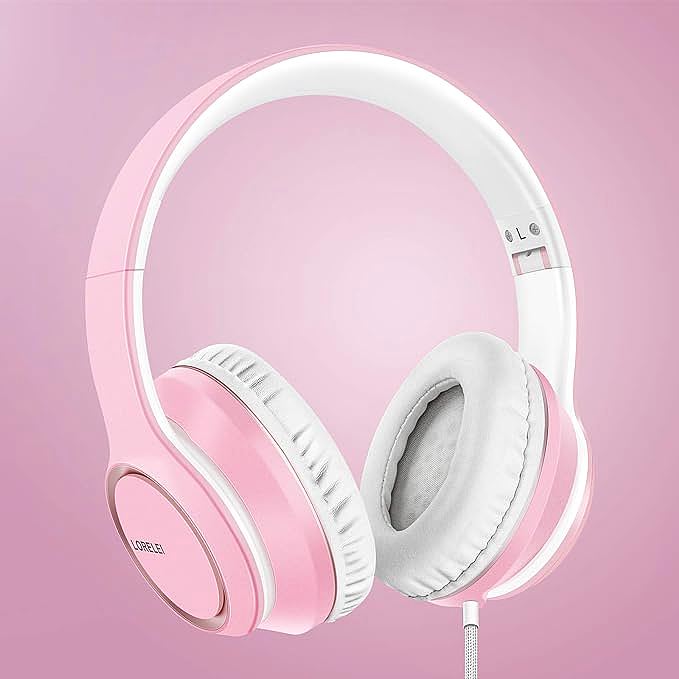
LORELEI X8 Over-Ear Wired Headphones
In an era saturated with lithium-ion batteries, Bluetooth pairing modes, and firmware updates, the wired headphone has become a quiet rebellion. It represents a return to physics over firmware. The LORELEI X8 Over-Ear Wired Headphones are a testament to this philosophy, stripping away the complexities of wireless tech to focus on the fundamentals: signal transmission, acoustic displacement, and material durability.
While marketing often chases the "latest feature," engineering chases reliability. For the student taking a critical exam, the office worker on a marathon Zoom call, or the traveler rediscovering a classic album, "features" are often less important than "function." A dead battery or a dropped connection isn't just an annoyance; it's a failure of the tool.
Let’s dissect the X8 not as a "retro" accessory, but as a purpose-built tool for uninterrupted audio, analyzing the specific design choices—from the 40mm drivers to the nylon-braided cable—that keep this form factor relevant in a wireless world.
Stratum I: The Physics of the 40mm Driver
The core specification of the X8 is its 40mm High-definition driver. In the world of headphones, driver size acts as a mechanical lever for bass response and dynamic range. To understand why an over-ear headphone often sounds "fuller" than an earbud, we must look at the physics of air displacement.
The Mechanism of Air Displacement
Sound is essentially air in motion. Low frequencies (bass notes) have long wavelengths and carry significant energy. To reproduce a 50Hz tone effectively, a speaker diaphragm must move a specific volume of air. * The Earbud Dilemma: A tiny 6mm driver in an earbud has a very small surface area. To move the same amount of air as a larger driver, it must travel much further (high excursion). This pushes the material to its physical limits, often resulting in distortion or "compression" at high volumes. * The 40mm Advantage: The X8's 40mm driver has roughly 44 times the surface area of a 6mm earbud driver. This allows it to move the required volume of air with very little excursion. The diaphragm barely has to work. This "effortless" movement results in a cleaner, deeper bass response and a more open midrange, simply because the mechanics are not being stressed.
Acoustic Impedance and Comfort
Larger drivers also interact differently with the ear. Instead of pressurizing a tiny sealed canal (like an in-ear monitor), an over-ear headphone pressurizes the entire outer ear chamber. This creates a more natural Acoustic Impedance. The sound waves hit the folds of the pinna (outer ear) before entering the canal, utilizing the body's natural Head-Related Transfer Function (HRTF) to some degree. This results in a listening experience that is often described as less "claustrophobic" and more fatiguing over long sessions compared to earbuds.

Stratum II: Material Science of the Tether (The Cable)
The Achilles' heel of any wired device is the cable. It is the point of failure. Standard PVC rubber cables are prone to "work hardening"—becoming brittle and cracking over time due to UV exposure and skin oils. They also have high surface friction, leading to the dreaded "pocket tangle."
The LORELEI X8 addresses this with a 1.5m Nylon Braiding Cord. This is not just an aesthetic choice; it is an engineering solution derived from industrial cabling.
Tensile Strength and Torsion
Nylon is a polyamide known for its high tensile strength and abrasion resistance. By weaving nylon fibers around the conductive copper core, the cable gains a structural exoskeleton.
1. Bend Radius Protection: The braid naturally limits how sharply the cable can be bent. This prevents the internal copper strands from being kinked or snapped, a common failure mode at the plug or earcup junction.
2. Tangle Resistance: The braided texture introduces microscopic roughness that reduces the surface contact area between cable loops. Physically, this lower friction coefficient makes it significantly harder for the cable to knot itself. Unlike rubber, which "grabs" itself, nylon slides.
This durability is crucial for the X8's target demographic—students and travelers—who are likely to stuff the headphones into backpacks without a protective case.
Stratum III: Zero Latency and the Speed of Light
For gamers, video editors, and language learners, wireless latency is a constant, often subconscious, enemy. Bluetooth requires audio to be digitized, compressed, packetized, transmitted, received, buffered, depacketized, and converted back to analog. This process takes time—typically 100-300 milliseconds.
The X8's wired connection operates at the speed of electricity (a significant fraction of the speed of light). * Cognitive Load: When audio and video are even slightly out of sync (lip-flap), the brain has to work harder to integrate the sensory inputs. This increases Cognitive Load, leading to faster mental fatigue during online classes or meetings. * Signal Integrity: The analog signal travels directly from the source's DAC (Digital-to-Analog Converter) to the driver coil with zero processing delay. This ensures that the phonemes in a language lesson are heard exactly as the teacher's mouth forms them, critical for learning pronunciation.
Stratum IV: Ergonomics and Kinematics
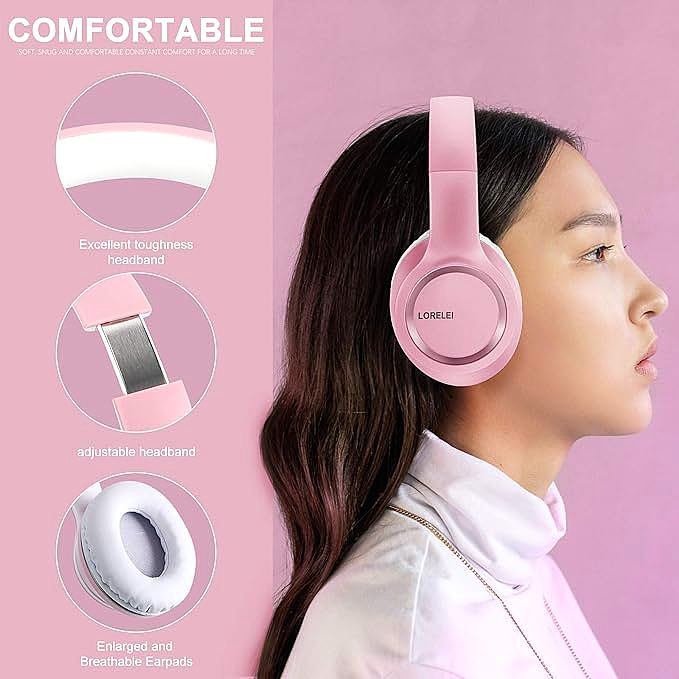
The X8 utilizes a Foldable Design, employing a hinge mechanism that allows the earcups to collapse into the headband. * Kinematic Efficiency: This transforms the headset's volume, reducing its footprint by roughly 50% for transport. It turns a bulky item into a compact package that fits in a side pocket. * Passive Noise Isolation: The over-ear (circumaural) design creates a physical seal around the ear. Using ultra-soft ear cushions, this seal blocks high-frequency environmental noise (like chatter) mechanically. This is "Passive Isolation," distinct from Active Noise Cancellation (ANC). It requires no power, introduces no electronic hiss, and works instantly.
The choice of plastics for the headband is also deliberate. While metal feels premium, high-quality industrial plastic offers a better Strength-to-Weight Ratio. At 210 grams, the X8 is light enough to be worn for hours without causing neck strain, a critical factor for younger users.
Conclusion: The Utility of Simplicity
The LORELEI X8 is not trying to compete with high-end wireless noise-cancelers. It occupies a different, vital niche: the "Always Ready" tool.
It has no battery to charge. It has no firmware to update. It has no Bluetooth pairing issues. It is a device that respects the user's time by simply working the moment it is plugged in. In a complex digital world, this mechanical simplicity is a form of luxury. It is a reminder that sometimes, the most advanced solution is a copper wire and a good pair of magnets.
