Software as the New Driver: Computational Audio and Beamforming


Soundcore A3935 Life A2 NC Wireless Earbuds
In traditional Hi-Fi, the hardware was king. The amplifier, the cable, the speaker—these defined the sound. In the era of True Wireless Stereo (TWS), hardware is merely the canvas; software is the paint. The Soundcore Life A2 NC is a prime example of Computational Audio, where algorithms play as big a role as magnets.
From the 6-microphone array used for calls to the Soundcore App that reshapes the frequency response, this device relies on digital brains to overcome physical limitations. This article explores the mathematics of beamforming and the psychoacoustics of personalization.
Beamforming: The Mathematics of the Microphone Array
The Life A2 NC features "6-Mic Handsfree Calls." Why six? It’s not just for redundancy; it’s for geometry.
* Spatial Filtering: With multiple microphones spaced apart, sound waves arrive at each mic at slightly different times. The DSP can use these time delays to calculate the direction of the sound source.
* The Beam: By mathematically combining the signals from the mics, the DSP can create a virtual "beam" of sensitivity that points directly at the user's mouth. Sounds coming from outside this beam (like traffic or wind) are attenuated.
$$Output = \sum (w_i \times x_i)$$
Where $x_i$ is the signal from mic $i$ and $w_i$ is the weight (delay/gain) applied to steer the beam.
* Noise Reduction Algorithm: Once the voice is isolated spatially, a secondary algorithm analyzes the frequency content. It identifies non-vocal patterns (stationary noise) and subtracts them. This ensures "Super-Clear Calls" even in hostile acoustic environments.
The App Ecosystem: Firmware-Defined Hardware
The Soundcore App is not a gimmick; it is the control center for the DSP. * EQ Customization: Hardware drivers have a fixed frequency response. However, the DSP can alter the digital signal before it hits the DAC (Digital-to-Analog Converter). By boosting or cutting specific frequency bands (EQ), the user can fundamentally change the character of the headphone—from "Bass Booster" to "Podcast" (vocal enhancement). This allows one hardware platform to serve multiple audiophile tastes. * HearID (Implied): While the A2 NC might use a simplified version, Soundcore's technology often involves mapping the user's hearing sensitivity and creating a custom compensation curve. This is the future of audio—personalized to the biological reality of the listener.
Transparency Mode: Augmented Hearing
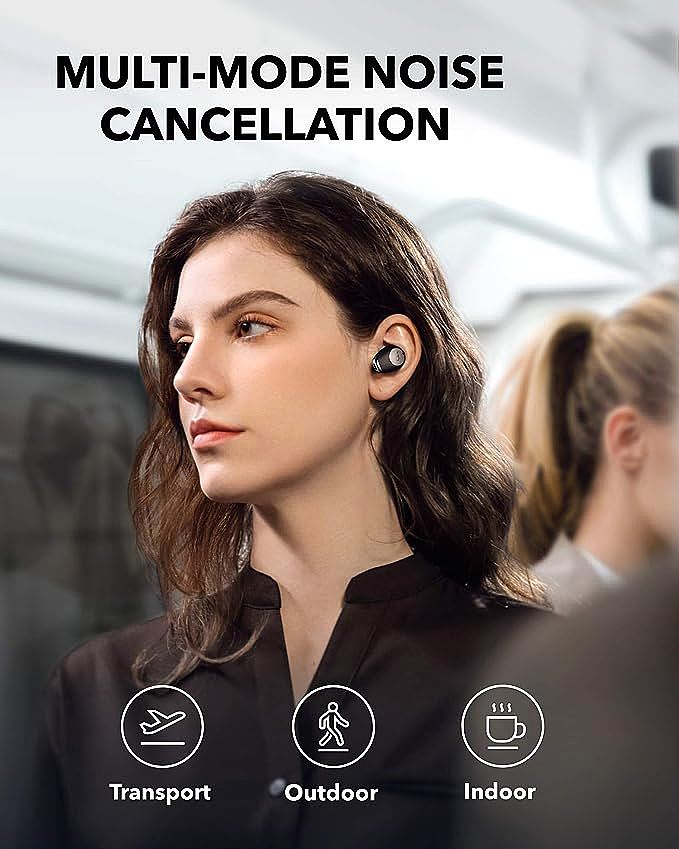
Transparency Mode is the inverse of ANC. Instead of cancelling noise, the microphones capture the outside world and pump it into the ear. * The Challenge: The challenge is to make this sound natural. If the latency is too high, the user hears an echo (the bone-conducted voice vs the delayed headphone voice). If the frequency response is wrong, the world sounds robotic. * The Solution: The DSP must process this pass-through audio with ultra-low latency (<10ms) and apply EQ correction to compensate for the acoustic isolation of the ear tip. When done right, it provides "situational awareness" that feels like not wearing headphones at all.
Conclusion: The Software Upgrade
The Soundcore Life A2 NC proves that in modern audio, the software is as important as the hardware. The 11mm drivers provide the potential, but the DSP algorithms—beamforming, ANC, EQ—unlock the performance.
This shift means that headphones can actually improve over time with firmware updates. It transforms the device from a static object into a dynamic platform, adapting to the user's environment and preferences through the power of computation.
