The Engineering Behind Induction Compatible Stovetop Espresso Brewing
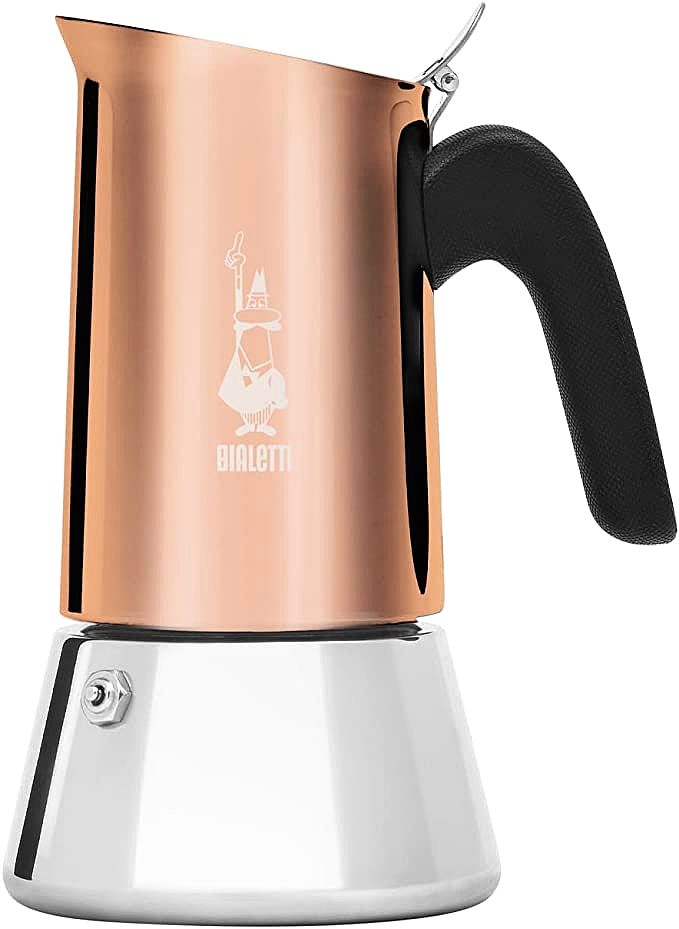
Bialetti New Venus Induction Stainless Steel Stovetop Espresso Coffee Maker
Gas cooktops are quietly leaving the modern kitchen. Induction hobs, with their precise temperature control, energy efficiency, and safer cooking surfaces, have been steadily replacing open-flame burners across Europe, North America, and parts of Asia. For coffee drinkers who rely on traditional stovetop brewers, this shift raises a practical engineering question: what happens when a vessel designed for flame heating must instead respond to oscillating magnetic fields? The answer involves metallurgy, electromagnetic physics, and a careful rethinking of how energy moves through materials. The Bialetti New Venus Induction, one of the most widely distributed induction-ready stovetop brewers, serves as the reference design for this exploration. This article examines the engineering principles that make induction compatible stovetop espresso brewing possible, treating the coffee maker not as a kitchen utensil but as a thermodynamic system whose materials, geometry, and energy pathway determine what ends up in the cup.
The Physics of Magnetic Induction Heating
When an alternating electric current flows through a copper coil beneath a glass-ceramic cooktop surface, it generates a rapidly oscillating magnetic field. This field, flipping polarity thousands of times per second, extends a few millimeters above the cooktop. When a vessel constructed from a ferromagnetic material sits within this field, the oscillating magnetic flux penetrates the metal and induces circulating electric currents. These are called eddy currents, named for their swirling flow pattern through the conductive material. Because the base metal has electrical resistance, these induced currents dissipate energy as heat, following the same Joule heating principle that makes an electric heating element glow.
The key physical relationship is Faraday's law of induction: the electromotive force induced in a conductor is proportional to the rate of change of the magnetic flux passing through it. Higher-frequency oscillation produces stronger induced currents and faster heating. This is why an induction cooktop rated at a given wattage can bring water to a boil faster than a gas burner of equivalent thermal output. The energy is deposited directly into the metal itself, bypassing the intermediate step of heating air that then transfers heat to the pot through convection and conduction.
For an induction compatible stovetop espresso maker, this direct-in-metal heating creates a fundamentally different thermal environment from gas-flame heating. On a gas burner, flame licks up the sides of the vessel. Heat enters through the bottom and side walls, and much of the energy is lost to the surrounding air before it ever reaches the water. Induction heating deposits nearly all of its energy within the ferromagnetic base layer, achieving thermal transfer efficiencies above eighty-five percent compared to roughly forty percent for an open gas flame. But efficiency is only one variable that matters for brewing. The spatial distribution of heat within the vessel changes the entire extraction dynamic.

Eddy Currents and Bottom-Up Thermal Gradients
The spatial pattern of heat generation inside an induction-heated vessel is unlike anything produced by a flame. Eddy currents concentrate near the surface of the metal through the skin effect, so the outermost layer of the base plate heats first. From there, thermal conduction carries energy upward through the thickness of the base and into the water reservoir above. The result is a steep thermal gradient: the bottom of the water chamber receives intense, localized heating while the upper portions of the vessel, including the coffee funnel and collection chamber, remain relatively cool during the early phase of heating.
This bottom-up gradient is a structural advantage for coffee extraction. In a gas-heated stovetop brewer, radiant and convective heat can warm the entire vessel, including the upper chamber that holds the coffee grounds. When the grounds heat up before water begins its upward journey through the funnel, volatile aromatic compounds escape prematurely. The coffee bed can experience what roasters call baking, a slow low-temperature degradation that produces flat, papery flavors. With induction heating, the grounds remain at ambient temperature until the water below reaches its boiling point and steam pressure begins pushing liquid up through the funnel stem. The coffee bed meets hot water only at the moment extraction begins, preserving more of the bean's volatile aromatic profile.
Engineers designing an induction compatible stovetop espresso system must account for this gradient carefully. Base plate thickness, the diameter of the ferromagnetic insert, and the thermal mass of the water reservoir all interact to determine how quickly the temperature gradient equalizes and how long the water spends at each temperature on its way to boiling. A base plate that is too thin will produce a gradient so steep that localized boiling near the bottom creates chaotic steam bubbles, disrupting the steady upward flow needed for even extraction. A base that is too thick stores excessive thermal energy and can overshoot the target extraction temperature even after the power is cut from the induction coil.
Thermal Conductivity in Brewing Vessel Materials
Every material transfers heat at its own characteristic rate, measured as thermal conductivity in watts per meter-kelvin. Pure aluminum conducts heat at approximately 237 W/mK. Pure copper is faster still, around 400 W/mK. Stainless steel, by contrast, manages only about 16 W/mK. At first glance this looks like a disadvantage. Why would anyone choose a material that is nearly fifteen times slower at moving heat than aluminum?
The answer lies in what happens after the heat arrives. Aluminum's high conductivity means that heat spreads quickly and evenly across the base of the pot. On a gas flame this is desirable because the flame is uneven and aluminum smooths out the hot spots. But aluminum also loses heat rapidly when the energy source is removed. It has low thermal inertia. The moment a gas flame goes out, an aluminum vessel begins cooling quickly, and the extraction process in a stovetop coffee maker does not stop the instant the heat is removed. Residual pressure continues pushing water through the coffee bed for several seconds.
Stainless steel's lower thermal conductivity means it heats more slowly, but it also means that heat does not rush out of the metal when the power is cut. This thermal inertia, combined with the higher density and different heat capacity of steel, gives the brewer a wider window for heat management. For induction compatible stovetop espresso preparation, this translates into more forgiving timing. The brewer has an extra few seconds to recognize the gurgling sound that signals the end of extraction and to move the pot off the cooktop before bitter over-extracted compounds leach into the cup. Induction cooktops add another layer of control here because they cut power almost instantly when the pot is lifted, whereas gas burners leave behind a hot grate that continues radiating heat.
Heat Capacity, Thermal Mass, and Extraction Stability
Heat capacity, measured in joules per kilogram-kelvin, describes how much energy a material stores before its temperature rises by one degree. Stainless steel has a specific heat capacity of roughly 500 J/kgK. Aluminum sits at about 900 J/kgK. At first this appears to favor aluminum. It takes nearly twice as much energy to raise the temperature of a kilogram of aluminum by one degree. But this comparison is misleading if we look only at specific heat capacity without accounting for the total thermal mass of the vessel.
The total thermal mass is the product of mass and specific heat capacity. A typical six-cup aluminum stovetop brewer weighs approximately four hundred grams. A stainless steel equivalent of the same capacity weighs closer to five hundred forty grams, owing to steel's higher density of nearly eight grams per cubic centimeter compared to aluminum's two-point-seven. Multiplying mass by specific heat capacity, the aluminum pot stores roughly 360 kJ/K of thermal energy while the stainless steel pot stores about 270 kJ/K. The steel pot stores less thermal energy overall, which means it reaches its target temperature faster and also sheds its stored heat faster after the power is removed. This lower total thermal mass, combined with the precision of induction power control, makes it easier to hit and hold the narrow temperature window needed for balanced extraction.
The thermal mass calculations that matter for an induction compatible stovetop espresso brewer differ from those for a gas-heated aluminum equivalent. With gas, the brewer must manage not only the vessel's own thermal mass but also the heat radiating from the burner assembly after shutdown. With induction, only the vessel's stored energy is relevant, so the target thermal mass can be lower while still maintaining adequate temperature stability during the brewing phase. Engineers balance these competing requirements to arrive at a base thickness that provides enough thermal ballast to smooth out temperature fluctuations without creating so much stored energy that the pot overshoots after removal.

Ferromagnetic Permeability and Induction Base Engineering
Not all stainless steel works on an induction cooktop. The property that determines induction compatibility is magnetic permeability, denoted by the Greek letter mu and measured relative to the permeability of free space. Materials with relative permeability significantly greater than one concentrate magnetic flux lines and allow eddy currents to form efficiently. Most induction cooktops require a relative permeability of at least one hundred for reliable operation.
The eighteen ten stainless steel used in premium food-grade applications belongs to the austenitic family of stainless steels. In its standard annealed state, austenitic stainless steel is non-magnetic, with a relative permeability close to one. This presents an obvious problem. How can the same material be both corrosion-resistant enough for food contact and magnetic enough for induction heating?
The answer involves cold working. When austenitic stainless steel undergoes mechanical deformation through rolling, stamping, or drawing, portions of its crystalline structure transform from the face-centered cubic austenite phase into the body-centered tetragonal martensite phase. Martensite is strongly ferromagnetic. The base of an induction-ready brewing vessel typically receives additional cold working during manufacturing to increase the martensite fraction in the base layer. Some manufacturers bond a separate disk of ferritic stainless steel, which is inherently magnetic, to the bottom of an otherwise austenitic vessel. Either approach creates a base that attracts a magnet firmly, which is the quickest field test for induction compatibility. This simple magnetic verification is the most practical screening method for confirming whether a pot will function on a modern induction cooktop before first use.
For an induction compatible stovetop espresso maker, the ferromagnetic base must be thick enough to couple efficiently with the cooktop's magnetic field but not so thick that it dominates the thermal behavior of the vessel. A base that is excessively thick stores too much heat and creates a delayed thermal response that frustrates precise brewing control. The engineering tradeoff sits at the intersection of magnetic coupling efficiency, thermal mass, and manufacturing economy. A magnet test on the base of the pot quickly confirms whether the ferromagnetic treatment is sufficient: a strong, firm attraction means the pot will work reliably on induction.
Chromium Oxide Passivation and Corrosion Resistance
The defining characteristic of stainless steel, the property that earns it the name, is its resistance to rust. This resistance comes not from being chemically inert but from being chemically clever. When chromium, present at a minimum of ten and a half percent by mass in the alloy, encounters oxygen, it forms a layer of chromium oxide on the metal surface. This oxide layer is only a few nanometers thick, invisible to the naked eye, yet it is dense, adherent, and self-healing. If the surface is scratched and fresh metal is exposed, the chromium in the newly exposed surface immediately reacts with atmospheric oxygen to re-form the protective oxide.
In a coffee brewing context, this passivation layer matters for two reasons. First, the hot, mildly acidic environment inside a coffee maker is exactly the kind of condition that attacks unprotected metals. Coffee has a pH between 4.5 and 5.5, acidic enough to slowly leach metallic ions from reactive materials. Aluminum lacks a self-healing passive layer of this quality and can react with coffee acids over repeated use, potentially imparting metallic notes to the brew. The chromium oxide layer on stainless steel prevents this interaction entirely. The coffee never touches reactive metal, only the stable oxide barrier.
Second, the passive layer makes the surface non-porous at a microscopic level. Aluminum develops a natural oxide layer too, but it is more porous and can trap coffee oils that oxidize and turn rancid between uses. These trapped residues contribute off-flavors to subsequent brews. Stainless steel's denser oxide film sheds oils more completely during rinsing, so each brewing session starts with a genuinely clean surface. These material properties are especially relevant for an induction compatible stovetop espresso vessel, where the brewing chamber experiences repeated thermal cycling from room temperature to near-boiling and back. Each cycle tests the integrity of the passive oxide film against acidic coffee compounds, and the film's self-healing mechanism must function reliably across hundreds or thousands of brew cycles.
eighteen ten Stainless Steel Metallurgy and Flavor Neutrality
The designation eighteen ten specifies the weight percentages of chromium and nickel in the alloy. Eighteen percent chromium trains the material to form its protective oxide, and ten percent nickel stabilizes the austenitic crystal structure, adding ductility, luster, and resistance to acidic attack. The remaining seventy-two percent is primarily iron, with trace amounts of carbon, manganese, and silicon. This specific composition, standardized as AISI 304 in the American Iron and Steel Institute classification, is the workhorse of the food industry. It lines commercial kitchen counters, forms brewing tanks in breweries, and shapes the vessels used in dairy processing.
For coffee brewing, the key property of eighteen ten steel is what can be called flavor neutrality. The material does not donate ions, compounds, or flavors to the liquid it contacts. It does not absorb and later release coffee oils. It does not develop a patina or seasoning layer the way cast iron or aluminum can. Every brew starts from the same material baseline. This consistency is valuable in a domain where small variations in extraction parameters produce perceptible differences in the cup. If the brewer changes one variable at a time such as grind size, water temperature, or dose weight, the results are attributable to that variable rather than to an unknown interaction between the coffee and a progressively changing metal surface.
In an induction compatible stovetop espresso brewer, the eighteen ten material must meet two sets of requirements simultaneously. The food-contact requirements demand passivity and non-reactivity for the upper chamber and funnel. The electromagnetic requirements demand permeability and coupling efficiency for the base. This dual role explains why the base often receives different metallurgical treatment from the rest of the vessel, even when both carry the eighteen ten label. The upper portions remain in their fully austenitic, non-magnetic, maximally corrosion-resistant state, while the base is selectively cold-worked or supplemented to achieve the magnetic properties induction requires. The Bialetti New Venus exemplifies this dual-requirement engineering, with its upper chamber in the standard eighteen ten austenitic state and its base receiving the additional magnetic treatment to satisfy both the food-contact and electromagnetic specifications.
Steam Pressure Generation and Extraction Mechanics
A stovetop coffee brewer operates on a principle distinct from both drip brewing and pump-driven espresso. Water is sealed in a lower chamber with a small air gap above it. As heat is applied, the water temperature rises toward its boiling point. When the water begins to vaporize, steam accumulates in the air gap above the liquid. Because the chamber is sealed except for the funnel stem that extends down into the water, the expanding steam has only one escape path. It must push down on the water surface, forcing liquid water up through the funnel stem, through the packed coffee bed, and out into the upper collection chamber.
The pressure driving this flow is modest by espresso standards. A pump-driven espresso machine operates at nine bars, roughly one hundred thirty pounds per square inch. A stovetop brewer generates between one and two bars, about fifteen to thirty psi, from steam expansion alone. This lower pressure means the extraction mechanism is fundamentally different. Instead of forcing water through a tightly packed puck at high velocity, the stovetop brewer pushes water through a loosely filled bed at a gentle flow rate. The result is a brew that extracts differently from espresso: less body and crema, but often more clarity in flavor separation.
Temperature control during this pressure build-up phase is the central challenge. If the heat input is too aggressive, the water reaches boiling rapidly and steam production outpaces the flow capacity of the funnel, causing pressure spikes and turbulent flow through the coffee bed. Turbulent, high-velocity flow channels through the grounds unevenly, over-extracting some portions while under-extracting others. If the heat input is too gentle, steam production is slow and the water dwells in the coffee bed for too long, pulling out bitter tannins and astringent compounds. The modest pressure range means an induction compatible stovetop espresso brewer does not require the heavy locking mechanisms or reinforced boilers of a pump-driven machine, which keeps the device compact, lightweight, and mechanically simple. An induction cooktop offers a distinct advantage here: its power output can be set to a precise level and held there without drift, unlike a gas flame that flickers with air currents or an electric coil that cycles on and off.

Safety Valve Engineering and Pressure Regulation
Every stovetop coffee brewer includes a safety valve, a small brass or stainless steel fitting threaded into the side of the lower chamber. It is easy to overlook because it never activates during normal use. But its engineering is critical. It is the only barrier between a blocked funnel and a vessel that could turn into a pressure hazard.
The safety valve is a spring-loaded poppet design. A small metal plug is held against a seat by a calibrated spring. The spring force is chosen so that the valve opens at a pressure above the normal operating range but well below the burst pressure of the chamber. Typical setpoints fall between one-point-five and two-point-five bars. If the funnel stem becomes clogged with coffee fines or if the grounds have been mistakenly tamped, steam pressure builds without an escape path. When the pressure exceeds the spring force, the valve plug lifts off its seat and steam vents sideways through a small port, preventing a catastrophic failure.
The design must account for thermal expansion. The valve body, spring, and seat are often made of different materials with different coefficients of thermal expansion. As the chamber heats from room temperature to boiling, these components expand at different rates, which can shift the cracking pressure. A well-engineered safety valve uses materials with matched thermal expansion coefficients or includes a Belleville washer stack that compensates for thermal drift, keeping the relief setpoint stable across the operating temperature range. For an induction compatible stovetop espresso device, the concentrated base heating produces a steeper thermal gradient along the chamber wall than gas heating does. The safety valve must be positioned at a height where the local temperature is predictable regardless of the heat source, so the relief pressure remains consistent whether the pot sits on an induction coil or a gas burner.
Thermodynamic Cycle Timing and Heat Removal Strategy
The final phase of the brewing cycle, the moment when extraction ends, is where much of the craft in stovetop coffee brewing resides. As the last of the liquid water is pushed up through the funnel, the steam that follows contains less water and more vapor. The sound changes from a steady percolation to a sputtering gurgle. At this point the coffee bed is nearly dry, and the steam passing through it is superheated well above the boiling point of water. If the heat source remains active, this dry steam scorches the remaining coffee particles, extracting harsh burnt-tasting compounds that dominate the cup.
The standard technique is to remove the pot from the heat the instant the gurgling begins and to cool the lower chamber rapidly, often by running cold water over the base. This abruptly drops the internal pressure and stops the flow. With a gas flame, removal is straightforward: lift the pot and turn off the burner. But timing is compressed because the aluminum base loses heat rapidly once lifted from the flame, and the surrounding stovetop grates remain hot and can continue radiating heat into the pot for seconds afterward.
With induction the behavior is different. When the pot is lifted off an induction cooktop, the magnetic field collapses instantly. The cooktop detects the absence of a load and cuts power within milliseconds. There is no residual hot grate, no lingering radiant heat. The only heat remaining is what is stored in the thermal mass of the vessel itself, and stainless steel stores less total thermal energy than aluminum. This gives the induction brewer a slightly wider timing window. The transition from brewing to stopped is sharper and more definitive.
The final engineering insight about induction compatible stovetop espresso brewing concerns this precise termination. In any thermal brewing system, the quality of the finish depends on how cleanly the process can be stopped. Induction provides the cleanest stop available: instantaneous power removal, no residual heat source, and a vessel with controlled thermal mass. These factors produce a sharper boundary between extraction and over-extraction, which translates in the cup to a cleaner separation between the desirable coffee flavors and the harsh compounds that appear when the brew cycle runs too long. Understanding this thermodynamic cycle timing, and using the induction cooktop's instantaneous response to advantage, is what separates a consistently good brew from one that varies unpredictably from morning to morning.
Material Fatigue and Thermal Cycling Across Brew Sessions
Every time a stovetop brewer cycles from cold to near-boiling and back, the metal expands and contracts. The linear thermal expansion coefficient of eighteen ten stainless steel is roughly sixteen micrometers per meter per degree Celsius. Over a temperature swing of eighty degrees from room temperature to brewing, a ten-centimeter-tall chamber grows by about thirteen hundredths of a millimeter. This is a small absolute change, but repeated thousands of times across years of daily use, it subjects the material to low-cycle thermal fatigue.
The threaded joint between the upper and lower chambers is the primary stress concentration point in the assembly. Each brewing cycle applies a thermal load to these threads as the hotter lower chamber expands slightly more than the cooler upper chamber during the early heating phase. Stainless steel's moderate thermal expansion coefficient and high fatigue strength give it an advantage here over aluminum, which expands roughly fifty percent more per degree and has a lower fatigue limit. Over a decade of daily use, the steel threads maintain their dimensional stability better, keeping the seal between chambers tight without requiring excessive tightening force.
For an induction compatible stovetop espresso brewer operating in a high-humidity kitchen environment, the combined effects of thermal cycling and moisture exposure create the most demanding material performance scenario. The chromium oxide passive layer must remain intact not only at the visible exterior surfaces but also deep inside the threaded bore where condensation can collect between brew sessions. Proper drying and occasional inspection of these concealed surfaces extends the service life of the vessel beyond what the base material properties alone would predict.
The Role of Grind Geometry and Particle Distribution
Coffee extraction is a surface-area-driven process. The finer the grind, the more bean surface area is exposed to water, and the faster the desirable solubles dissolve. But grind size in a stovetop brewer is constrained by the vessel's flow geometry. The funnel basket has fixed perforations, and the pressure driving water through the bed is low and variable. Grind too fine, and the bed resistance exceeds the available steam pressure, causing choked flow or forcing steam through narrow channels that over-extract some grounds while leaving others untouched. Grind too coarse, and water rushes through with minimal contact time, producing a thin, under-extracted brew.
The optimal grind for stovetop extraction lands somewhere between espresso-fine and drip-coarse, roughly the texture of table salt with particle diameters in the range of eight hundred to twelve hundred microns. At this size, the bed offers enough resistance to build the one to two bars of back pressure needed for proper extraction while still allowing water to flow through the entire bed volume uniformly. The grind consistency matters as much as the average size. A grinder that produces a wide distribution of particle sizes, with many fines and many boulders, will produce simultaneous over-extraction from the fines and under-extraction from the boulders, resulting in a brew that tastes paradoxically both bitter and weak.
The interaction between grind distribution and flow uniformity is magnified in stovetop brewers because the low driving pressure cannot overcome bed non-uniformities the way nine bars of pump pressure can in a true espresso machine. This makes grind quality disproportionately influential on the final cup result when using any stovetop extraction method.
Bialetti New Venus Induction Stainless Steel Stovetop Espresso Coffee Maker
Related Essays
Steam Pressure Physics in Aluminum Moka Pot Brewing
How Stovetop Espresso Maker Heat Transfer Shapes Your Morning Coffee

Iced Coffee Maker Brewing Technology Explained: From Bean to Cold Cup

BRITA Large 10-Cup Water Filter Pitcher: Clean Water for Better Coffee

VitaCup Keto Coffee Pods: Boost Energy & Focus with MCT Oil & Vitamins

KitchenAid KCM1208DG Spiral Showerhead Coffee Maker: An Independent Deep Dive
BRITA Large 10-Cup Water Filter Pitcher: Clean Water for Better Coffee

Ice Cream Maker Freezing Technology: The Physics of Smooth Texture

Direct Flame Heat Physics in a Home Coffee Roaster Drum
