Why Your Coffee Grinder Is Holding You Back: A Mentor's Guide to Prosumer Features
Update on Nov. 3, 2025, 7:31 a.m.
Let’s talk about the plateau.
You’ve done everything right. You buy excellent, fresh-roasted beans. You own a digital scale, a gooseneck kettle, and a decent $150 burr grinder. Your coffee is… good. But it’s not great.
You read tasting notes like “jasmine, bergamot, and wild blueberry,” but your cup just tastes like “coffee.” Your espresso shots are inconsistent—one is bitter, the next is sour, and you can’t seem to find that perfect “god shot.”
Welcome to the most frustrating stage in the coffee journey. As your mentor, I’m here to tell you the truth: the problem is no longer your beans, your water, or your technique.
The problem is your grinder.
Your trusty $150 grinder, the one that got you this far, is now the single biggest thing holding your coffee back. To get off this plateau, you need to move from “consumer” to “prosumer.” This doesn’t just mean spending more money; it means understanding what you’re paying for.
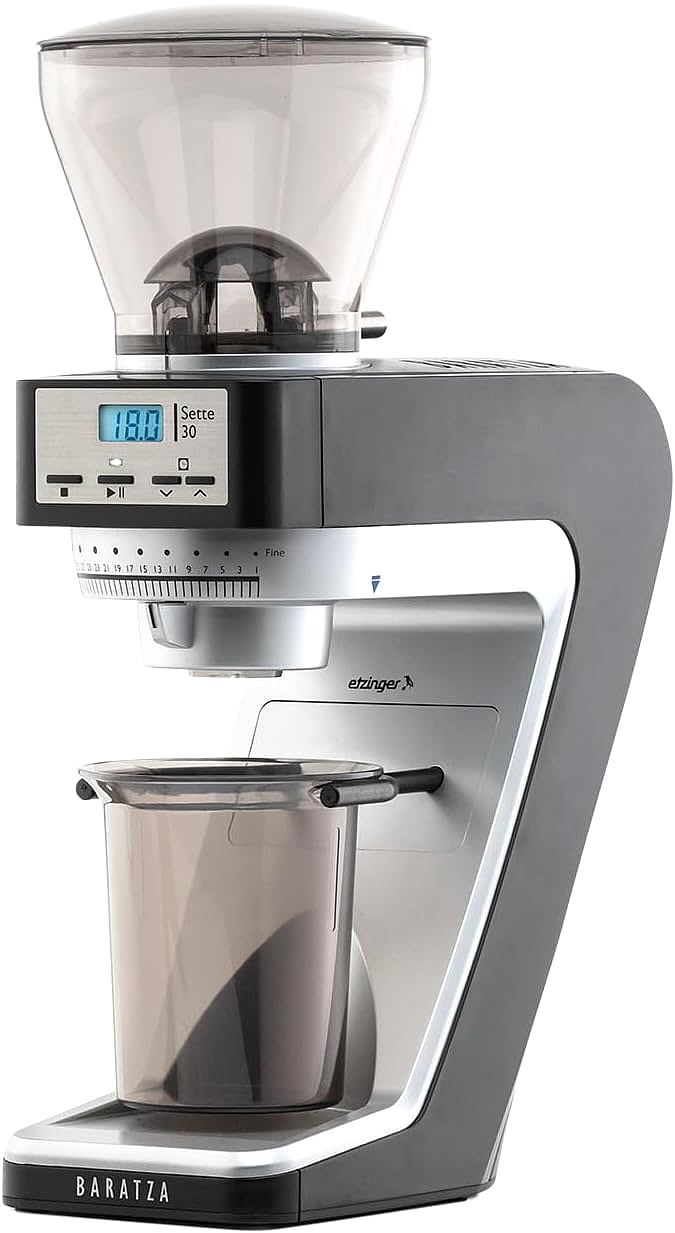
We’re going to use a machine like the Baratza Forte BG as our classroom example. Why? Because this $900 grinder isn’t just “better”—it’s a masterclass in the three key concepts that separate good coffee from truly exceptional coffee.

Concept 1: The Flavor Engine (Why Flat Burrs Change Everything)
This is the most important lesson. The “engine” of any grinder is its burr set. Your $150 grinder almost certainly has conical burrs.
Conical burrs are fantastic for entry-level coffee. They are cone-shaped and use a combination of crushing and cutting. They are efficient, generate less heat at low speeds, and are forgiving. But they have a “flaw” that is also a “feature”: they produce a bimodal or wide particle size distribution (PSD).
This means that even on one setting, you get your target-sized grounds, but also a significant amount of smaller particles (“fines”) and larger particles (“boulders”). These “fines” over-extract (adding bitterness) while the “boulders” under-extract (adding sourness). Forgiving? Yes. But the final cup is “muddled,” with the flavors all blended together.
Now, let’s look at the engine in our prosumer example. The Forte BG uses 54mm Ditting flat steel burrs.
Flat burrs, especially high-quality steel ones, don’t crush. They shave. Imagine two precision-engineered, razor-sharp discs spinning against each other, “slicing” the bean into particles of incredibly similar size. This creates a unimodal particle size distribution.
This is the entire game.
When all your coffee particles are (mostly) the same size, they all extract at (mostly) the same rate. The bitterness from “fines” disappears. The sourness from “boulders” vanishes.
What’s left? Clarity.
For the first time, you will be able to taste the separation of flavors. The “blueberry” is no longer just a hint; it’s a distinct note. The “jasmine” isn’t a vague idea; it’s the clear aroma. This is what you are paying for: the ability to finally taste the coffee bean for what it truly is.
Concept 2: The Workflow Revolution (Grind-by-Weight vs. Timers)
What’s the most annoying part of your morning ritual? It’s “dosing.”
You weigh your 20g of beans, dump them in the grinder, grind, and then… you weigh the grounds that came out. It’s 19.8g. Where did the 0.2g go? Or maybe you use a timer. You set it for 12.5 seconds. One day it gives you 20g, the next day (with a different, denser bean) it gives you 21.5g.
This is shot-to-shot inconsistency, and it’s maddening.
Prosumer grinders like the Forte BG solve this with built-in, weight-based grinding.
This isn’t just a timer. It’s an integrated Acaia digital scale. You tell the machine, “I want 20.0 grams,” and you can program that to a preset button. It grinds exactly 20.0g and then stops. Every. Single. Time.
This is a revolution for two reasons:
1. Repeatability: You have eliminated a key variable. You know your dose is identical, so you can confidently adjust other variables, like your grind size.
2. Workflow: It is fast. No more pre-weighing beans. No more weighing your portafilter after the fact. You just press a button and get the perfect dose.
This feature seems like a “luxury” until you use it. Then it becomes a “necessity” for anyone who values their time and their consistency.

Concept 3: The Secret Killer of Consistency (Micro-Adjustments & Low Retention)
This final concept is a two-part lesson on total control.
Part A: The “In-Between” Setting
Your current grinder might have 40 settings. You’re trying to dial in an espresso shot. Setting #8 is too coarse (shot pulls in 15 seconds). Setting #7 is too fine (shot chokes the machine). You are stuck. There is no “#7.5.”
The Forte BG has 260 distinct settings. It does this with a 10-step “Macro” adjustment and a 26-step “Micro” adjustment. That “Micro” lever is your secret weapon. It allows you to make vanishingly small changes to the grind size.
This is what “dialing in” truly means. It gives you the precision to find not just a good setting, but the perfect setting for that specific bean on that specific day.
Part B: The “Stale Coffee” Problem (Retention)
Here’s the concept from our keyword data: retention.
Retention is the amount of ground coffee left inside the grinder after it finishes. In many consumer grinders, this can be 1, 2, or even 3 grams.
Why is this a disaster?
You weigh out 20g of fresh, amazing beans. You grind them. But what comes out is 18g of your fresh beans mixed with 2g of stale, oxidized beans from yesterday. You have just ruined your $25/bag Geisha beans.
The Forte BG is built as a “commercial level” grinder, meaning it’s designed for “single-dosing” or high throughput. It’s engineered for low retention. Its internal pathways are direct, and its all-metal construction minimizes static. When you put 20g in, you get extremely close to 20g out.
This means every cup is pure. You are tasting only the beans you just ground. This, combined with the flat burrs, is what delivers that ultimate clarity you’ve been chasing.

Your Send-Off: It’s Not an “Appliance,” It’s “Equipment”
So, why does a grinder cost $900?
You are not buying an appliance. You are buying a piece of equipment. The Forte BG has a polished metal body, a powerful DC motor, and a commercial-grade capacity of 5lbs/day. It is not a plastic machine designed to be thrown away.
Baratza’s entire philosophy is “Don’t Dump it, Fix it!” It’s designed to be repaired, maintained, and used for decades. You can replace the burrs. You can get any part you need.
You’ve hit a plateau with your $150 grinder because it is, at its heart, a disposable appliance. To get to the next level, you need to invest in a true piece of scientific equipment.
You’re not paying for a brand name. You are paying for clarity (unimodal flat burrs), repeatability (grind-by-weight), and control (micro-adjustments and low retention). You are paying to finally get off that plateau.