How an Electric Burr Coffee Grinder Transforms Bean into Brew: The Complete T...

Urbanic 080 Electric Coffee Grinder
Most coffee equipment discussions begin and end with the brewing device. The espresso machine gets a dedicated countertop corner. The pour-over dripper earns a spot on the shelf. The French press sits proudly by the stove. But the device that arguably determines more about what ends up in your cup than any of these remains the electric burr coffee grinder. It is the first mechanical contact between a roasted bean and the extraction process ahead of it. If that contact is imprecise, every subsequent step amplifies the error. If it is clean and uniform, even a modest brewing setup can produce a balanced cup. Understanding what happens inside the grinding chamber is not an academic exercise. It is the single highest-leverage knowledge any home brewer can acquire.
The Foundation: Why Particle Uniformity Defines Your Coffee
When hot water hits ground coffee, it begins dissolving soluble compounds. Acids extract first, followed by sugars, then bitter plant compounds. This sequence is not negotiable. Water does not pause to ask a particle how long it has been sitting in the path. It simply moves through the coffee bed at whatever speed the particle arrangement permits. This is where an electric burr coffee grinder proves its worth.
The problem emerges when particle sizes vary within the same dose. A fine particle releases everything it has within the first fifteen seconds of contact. A coarse particle may take forty-five seconds to give up the same compounds. If both are present in the same brew, you get a cup pulling in two directions at once, sour from the fines over-extracting and hollow from the boulders under-delivering. Coffee professionals call this uneven extraction, and it is the root cause of most disappointing home brews. An electric burr coffee grinder addresses this directly.
An electric burr coffee grinder addresses this at the source. Unlike a blade grinder that chops beans through high-speed impact, burrs crush each bean between two precisely machined surfaces. The distance between those surfaces determines the maximum particle size. Anything larger cannot pass through. This mechanical gating is what produces the narrow particle size distribution that defines a quality grind. Every subsequent pour, tamp, and bloom builds on this foundation. Get it right and the margin for error in the rest of your process widens considerably. Get it wrong and no amount of technique can fully recover the cup.
The relationship between uniformity and flavor is concrete. In controlled experiments, baristas use sieving equipment to separate grounds into size bands and brew each fraction separately. The coarse-only brew tastes weak and underdeveloped. The fines-only brew tastes harsh and astringent. The combined brew tastes balanced. The ratio of these fractions determines the flavor profile, and a consistent burr grinder keeps that ratio predictable from one dose to the next. An electric burr coffee grinder addresses this directly.
Inside the Burr Mechanism: Two Rotating Surfaces, One Goal
A burr set consists of two abrasive rings, one stationary and one motor-driven. Coffee beans enter through a central opening and are pulled outward by centrifugal force. As they travel from the center to the outer edge, the gap between the burrs gradually narrows. The beans are not cut in a single motion the way a blade would strike them. They are progressively crushed across a series of cutting edges arranged in concentric rings. This is where an electric burr coffee grinder proves its worth.
This progressive reduction matters for two reasons. First, it minimizes the force required at any single point of contact, which reduces friction and the heat that comes with it. Second, it creates a self-sorting effect. When a particle reaches the target size, it slips through the gap and exits the grinding path. Particles that remain too large continue outward, encountering finer teeth until they too pass. The result is a built-in quality filter: the burr geometry itself enforces the target particle size. This is where an electric burr coffee grinder proves its worth.
The cutting surfaces on a quality burr are not simple rough textures. They are engineered patterns of sharp edges, channels, and relief zones. The outermost ring typically carries the finest teeth and does the final sizing work. The inner rings break the beans into progressively smaller fragments. Between the teeth, channels direct the grounds outward and prevent clogging. A burr set that lacks adequate channel depth will pack with coffee oils and fines, reducing effective sharpness long before the metal itself dulls.
Motor torque interacts directly with this mechanical process. When beans are dense, lightly roasted, or fed in larger quantities, the resistance against the burrs increases. An underpowered motor will slow down under load, changing the effective cutting speed and potentially producing more fines as the burrs tear rather than cut. This is why the power rating of an electric burr coffee grinder matters more for dark roast enthusiasts than the marketing materials usually acknowledge: lighter roasts are physically harder and demand more torque per rotation.
Flat Burrs and Conical Burrs: A Study in Tradeoffs
The coffee world has debated flat versus conical burr geometry for decades, and the discussion often oversimplifies. Both designs produce quality grounds. Both can produce poor grounds when poorly executed. The differences are matters of tendency, not absolute superiority.
Flat burrs consist of two parallel disks with cutting faces oriented horizontally. Beans drop between them and are forced outward by centrifugal force across the grinding faces. Because the beans travel a longer horizontal path before exiting, flat burrs tend to produce a narrower particle distribution, fewer fines, and fewer oversized particles. The tradeoff is that flat burrs typically require more motor torque to maintain speed under load, and they tend to retain more ground coffee in the exit path because the horizontal layout creates more surface area for static adhesion.
Conical burrs use a cone-shaped inner burr rotating inside a ring-shaped outer burr. The grinding path is shorter and more vertical, relying partly on gravity to move beans through. This shorter path means conical burrs generally run cooler and retain less coffee residue. The particle distribution tends to be slightly wider, with a more pronounced fines peak. Some baristas prefer this wider distribution because the fines contribute body and mouthfeel, particularly in espresso and immersion brews where the long contact time can balance the extraction.
The choice between geometries for a burr grinder is not a question of which is universally better. It is a question of what the user prioritizes. Clean flavor separation tends to favor flat burrs. Body and workflow speed tend to favor conical burrs. Either geometry, when manufactured to tight tolerances with sharp cutting edges, will outperform a blade grinder by an enormous margin. The gap between good flat burrs and good conical burrs is measured in nuance. The gap between either and a blade is measured in a fundamentally different coffee experience.
Size also plays a role within each geometry. Larger burrs, whether 50mm, 60mm, or commercial 80mm diameters, grind more coffee per rotation. This means a given dose finishes faster, generating less cumulative heat and reducing the window for volatile aromatic loss. A 60mm flat burr set like the one in the Urbanic 080 can process 18 grams of beans in under ten seconds, a speed that would require noticeably more time from a smaller 38mm set common in entry-level models. The practical difference is not just the seconds saved. It is the thermal profile of the grounds as they leave the chute.
The Grind Spectrum: From Turkish Powder to French Press Pebbles
Coffee brewing methods span a wide range of optimal particle sizes. Turkish coffee demands a powder finer than confectioner's sugar, almost flour-like in consistency. Espresso requires a fine but granular texture, about the consistency of fine table salt, where each particle is distinguishable but small enough to create the hydraulic resistance needed for nine bars of pressure. Pour-over and automatic drip occupy the middle ground, roughly the texture of granulated sugar or coarse sand. French press and cold brew sit at the coarse end, with particle sizes closer to sea salt or breadcrumbs.
Each of these grind sizes corresponds to a specific extraction dynamic. Fine grinds expose enormous surface area to water, extracting quickly and thoroughly. Coarse grinds expose less surface area and extract slowly, making them suitable for methods where brewing time is long or agitation is low. A quality burr grinder bridges all of these requirements through its adjustment mechanism, which changes the distance between the two burr faces.
The adjustment range on a typical home grinder might span from roughly 200 microns at the finest setting to 1200 microns at the coarsest. Professional espresso typically targets a range of 200 to 400 microns. Pour-over methods work best between 500 and 800 microns. French press performs well from 800 to 1200 microns. These ranges overlap because bean density, roast level, and ambient humidity all shift the effective extraction rate. A light-roast Ethiopian coffee ground at 600 microns extracts very differently from a dark-roast Brazilian ground at the same setting.
Dialing in a new bean requires systematic adjustment. Start at a middle setting, brew a cup, and taste. If the cup tastes sour and thin, the grind was too coarse and water passed through too quickly without extracting enough. Tighten the grind by one or two steps. If the cup tastes bitter and drying, the grind was too fine and over-extraction occurred. Loosen the grind. Repeat until the cup tastes balanced, with sweetness present and acidity integrated rather than sharp. This calibration process is the daily ritual that turns a grinder from an appliance into a precision tool.
An electric burr coffee grinder simplifies this process because its settings are repeatable. Once you find the correct position for a given bean and brew method, you can return to it day after day with confidence. Manual grinders can offer similar repeatability, but without the motor, the physical effort of grinding fine espresso doses becomes a meaningful barrier to experimentation.
How a Motor Powers Precision: Torque, RPM, and Thermal Management
The motor in an electric burr coffee grinder is not simply a power source. It is a precision component that directly affects grind quality. Most home grinders use a brushed DC motor operating at speeds between 400 and 1600 RPM. The lower end of that range is generally preferred by specialty coffee enthusiasts. Slower rotation means each bean encounters the cutting edges fewer times per second, producing a cleaner shear with fewer impact fractures that create unwanted fines.
Gear reduction plays a critical role here. A DC motor's natural operating speed is typically much higher than the ideal grinding speed. A gearbox steps that speed down while multiplying torque. The quality of that gearbox determines whether the burrs spin smoothly or with micro-vibrations that introduce inconsistency. Cheap plastic gears wear quickly and develop play, causing the burr gap to fluctuate during grinding. Metal gears maintain their tolerances for years but add cost and weight.
Thermal management is inseparable from motor design. Grinding generates heat through two mechanisms: the friction of the burrs against the beans and the inherent heat production of the motor itself. A motor running at 200 watts for 20 seconds dissipates roughly 4000 joules of energy. Not all of that becomes heat in the coffee, but enough does to measurably warm the grounds. At temperatures above roughly 40 degrees Celsius, volatile aromatic compounds in roasted coffee begin to off-gas at accelerated rates. These are the same compounds that create the fragrance and complexity you paid for when you selected the beans.
Good grinder design addresses heat through several pathways. The motor housing should be thermally isolated from the grinding chamber so that motor heat does not conduct into the bean path. Airflow channels can direct cooling air past the motor windings. And as discussed earlier, larger burrs complete the grinding cycle faster, reducing the duration of heat exposure. A well-designed electric burr coffee grinder keeps the grounds temperature rise to under 5 degrees Celsius above ambient, well within the safe zone for flavor preservation.
Stepped, Stepless, and Everything Between: Fine-Tuning Your Settings
The adjustment mechanism on a burr grinder determines how precisely you can control particle size. There are three broad categories: stepped, stepless, and hybrid systems. Each reflects a different engineering philosophy about how users should interact with their equipment.
Stepped adjustment uses a notched collar or dial with discrete positions. Turn the collar, hear a click, and you have changed the grind setting by a fixed increment. This design is common in entry-level and mid-range home grinders because it is intuitive and repeatable. Count the clicks from zero and you know exactly where you are. The limitation is resolution. If each step changes the burr gap by 50 microns, and your ideal espresso setting falls between two steps, you cannot select it. You must choose between slightly too coarse and slightly too fine.
Stepless adjustment eliminates the notches entirely. A threaded collar or worm gear allows continuous rotation with no discrete stops. You can make adjustments as small as the mechanical precision of the threads permits. This is the standard in professional espresso grinders and increasingly common in high-end home equipment. The tradeoff is that stepless mechanisms make it harder to return to a known position after making a large change, such as switching from espresso to French press and back. Users often mark reference points on the dial with tape or a grease pencil.
Hybrid systems combine a stepped mechanism for coarse adjustment with micro-adjustment within each step. This provides the best of both approaches for users who switch between dramatically different brew methods. The coarse steps get you in the right neighborhood, and the fine adjustment dials in the last few microns of precision.
For the home user choosing a burr grinder, the adjustment question comes down to practical habits. If you brew the same method every morning, a stepped grinder with sufficient resolution for that method works perfectly. If you experiment across pour-over, Aeropress, espresso, and French press, a stepless or hybrid mechanism provides the flexibility to optimize for each method individually. The grinder should not be the bottleneck that limits which brewing techniques you can explore.
Material Choices in Burr Manufacturing: Steel, Ceramic, and Coatings
The material from which burrs are made determines not just their initial sharpness but their entire performance curve over years of use. Three families of materials dominate the market: hardened tool steel, ceramic, and coated steel variants.
Hardened tool steel is the industry workhorse. It can be machined to precise tolerances, holds an edge well under normal home use, and costs relatively little to manufacture. The typical lifespan of a steel burr set under home use conditions is three to five years before sharpness degradation becomes noticeable in the cup. Commercial environments with high daily volume see shorter intervals. The primary vulnerability of bare steel is corrosion from moisture. Coffee beans contain oils that can go rancid if left on the burrs, and residual moisture from humid environments or the Ross Droplet Technique can accelerate surface oxidation.
Ceramic burrs offer hardness that steel cannot match. They resist wear nearly indefinitely under home conditions and are chemically inert, so they will not impart metallic flavors or corrode. The tradeoff is brittleness. Ceramic burrs can chip or crack if a foreign object enters the grinding chamber. A stray pebble in a bag of coffee beans, which happens more often than most roasters would admit, can destroy a ceramic burr set instantly. Steel burrs may dent or dull but rarely fail catastrophically from a single impact.
Coated steel burrs represent a middle path that the specialty coffee industry has increasingly adopted. Titanium nitride and titanium aluminum nitride coatings are applied to steel burrs through physical vapor deposition. The resulting surface is harder than bare steel, approaching ceramic hardness, while retaining the toughness of the steel substrate beneath. The Urbanic 080 uses titanium-coated 60mm flat burrs, which combine the sharpness and precision of steel machining with the wear resistance of a ceramic-like surface. Practical testing by long-term users suggests these coated burrs maintain their effective sharpness for approximately twice the duty cycle of uncoated equivalents.
Beyond the base material, burr design includes considerations of tooth geometry and cutting edge angle. The leading edge of each tooth should present a sharp angle to the bean fragment. Over time, this edge rounds microscopically. A dull burr tears and crushes rather than shears, producing more fines and more heat. This is why the burr material choice in an electric burr coffee grinder directly affects not just how long the grinder lasts, but whether the coffee it produces in year three tastes as good as the coffee it produced in month one.
Dealing with Static: When Physics Works Against Your Coffee
Every coffee grinder user has encountered the same frustration. You grind a perfect dose, pull the catch cup from the chute, and find grounds clinging to every surface inside the exit path. Some stick to the chute walls. Some spray across the countertop. Some form stubborn clumps that refuse to break apart even under tamper pressure. This is the triboelectric effect, and understanding it is part of mastering any burr grinder.
The mechanism is straightforward. When two dissimilar materials rub together and separate, electrons transfer between them. One surface becomes positively charged, the other negatively. In a coffee grinder, the materials are coffee bean fragments, metal burrs, and plastic chute surfaces, all experiencing violent contact and separation hundreds of times per second. The result is a significant static charge buildup on the grounds particles, which then repel each other and attract to grounded or oppositely charged surfaces.
Ambient humidity is the strongest environmental factor affecting static severity. In dry winter air with relative humidity below 30 percent, static can be dramatic, with grounds visibly leaping from the catch cup. In humid summer conditions above 60 percent relative humidity, the moisture in the air provides enough conductivity for charges to dissipate naturally, and static may be barely noticeable. Coffee professionals in arid climates often run humidifiers in their workspace specifically to manage grinder static.
Roast level also matters. Dark roasts contain more surface oils, which act as natural anti-static agents. Light roasts are drier and produce significantly more static charge. This is one reason light-roast single-origin coffees are often messier to grind than dark-roast blends.
Grinder manufacturers address static through several design approaches. Metal exit chutes that are electrically grounded provide a path for charge dissipation. Anti-static screens or flaps in the exit path physically disrupt clump formation. Some commercial grinders incorporate ionizers that actively neutralize static charge with a stream of ions. Budget-oriented grinders rely primarily on material choices, using plastics with lower triboelectric affinity or adding carbon fillers to increase conductivity.
The home barista has an additional tool that costs nearly nothing and works surprisingly well. The Ross Droplet Technique involves adding a tiny amount of water to the whole beans before grinding. A single spray from a fine mist bottle, or even a wet spoon handle stirred through the beans, introduces enough surface moisture to dramatically reduce static. The water molecules provide a conductive pathway for charge dissipation without introducing enough moisture to harm the burrs or affect grind quality. This technique works with any burr grinder and requires no special equipment beyond what is already in most kitchens.
Keeping Your Grinder Running: The Maintenance Equation
A burr grinder is a mechanical device with close-tolerance moving parts operating in an environment of abrasive coffee dust and sticky coffee oils. It needs maintenance, and the maintenance it needs is far simpler than most users assume. The core routine consists of three activities: daily cleaning of accessible surfaces, periodic deep cleaning of the burr chamber, and burr replacement at end of life.
Daily maintenance takes under thirty seconds. After grinding, tap the chute and dosing cup to dislodge retained grounds. Brush stray particles from the exterior. This prevents the accumulation of stale coffee residue that would otherwise mix with tomorrow's fresh dose. Coffee oils begin oxidizing within hours of exposure to air, and oxidized oils contribute rancid notes to subsequent brews. A grinder that is never cleaned between uses is effectively seasoning every fresh dose with stale coffee residue from the previous session.
Periodic deep cleaning, typically every two to four weeks depending on usage volume, involves opening the grinder to access the burrs. Most home grinders are designed for user disassembly without special tools. The upper burr carrier unscrews by hand or with a simple twist mechanism. Once exposed, both burr faces can be brushed clean with the included cleaning brush or a soft pastry brush. Compressed air helps dislodge fines packed into the burr channels. Some users run grinder cleaning pellets, made from food-grade materials that absorb oils and scrub burr surfaces, through the grinder periodically. These are effective for maintenance between full disassemblies but should not replace mechanical cleaning entirely.
Burr replacement is the least frequent but most consequential maintenance event. A burr set that has lost its sharpness degrades grind quality gradually, often so slowly that the user adapts to the declining cup quality without noticing. The typical signal is a need to grind finer than before to achieve the same extraction, because dull burrs produce more fines that compact the coffee bed. If you find yourself at setting 3 for espresso when you used to be at setting 8, and cleaning does not resolve it, the burrs are likely due for replacement. For a home electric burr coffee grinder used once or twice daily, burr replacement intervals of three to five years are typical for steel burrs, longer for coated or ceramic variants.
The reward for consistent maintenance is not just longevity. It is quality stability. A clean, sharp grinder produces the same cup today that it produced last month, assuming the same beans and recipe. That repeatability is what transforms coffee brewing from a lottery into a craft.
Beyond the Grind: How Particle Quality Ripples Through Every Brew Method
The quality of your grind does not stay in the grinder. It propagates through every subsequent step of your brewing process, shaping the behavior of water, the resistance of the coffee bed, and the final extraction yield. Understanding these downstream effects turns grind knowledge into brewing mastery.
In espresso, grind quality determines whether the pump can build pressure at all. A grind that is too coarse offers insufficient resistance to water flow, and the shot blonds out in under fifteen seconds with no crema and no body. Too fine, and the pump chokes against a compacted puck, producing a thin, over-extracted trickle that takes sixty seconds to yield twenty grams of liquid. Between those extremes lies a narrow window where flow rate, pressure, and extraction yield all align. The width of that window is directly proportional to the uniformity of the grind. A narrow particle distribution widens the window. A wide distribution narrows it. This is why an electric burr coffee grinder with good particle uniformity makes espresso dramatically easier to dial in.
In pour-over brewing, grind quality affects drawdown time and bypass. Uneven particles create an uneven coffee bed. Fines migrate downward and pack between larger particles, forming a low-permeability layer at the filter surface. This slows drawdown at the end of the brew, extending contact time beyond the target and pulling bitter compounds into the cup. The gooseneck kettle, the pre-wet filter, the careful spiral pour, all of these techniques are attempts to manage what a uniform grind would make far more forgiving.
In immersion brewing, such as French press and cupping, grind quality manifests as sludge and astringency. Because the coffee and water remain in contact for four minutes or longer, fines over-extract throughout the entire steep. No technique can separate them from the brew. The only solution is to produce fewer fines in the first place, which brings us directly back to burr quality and alignment.
The common thread across every method is that grind quality is not an isolated variable to optimize in a vacuum. It is the foundation on which every other variable rests. Water temperature, ratio, agitation, contact time, all of these interact with particle size and distribution in ways that are predictable once you understand the underlying mechanics. An electric burr coffee grinder provides the consistency that makes those interactions reproducible. Without it, every brew is a fresh experiment with unknown input variables.
Urbanic 080 Electric Coffee Grinder
Related Essays

Burr Coffee Grinder vs Blade Grinder: Particle Consistency Matters
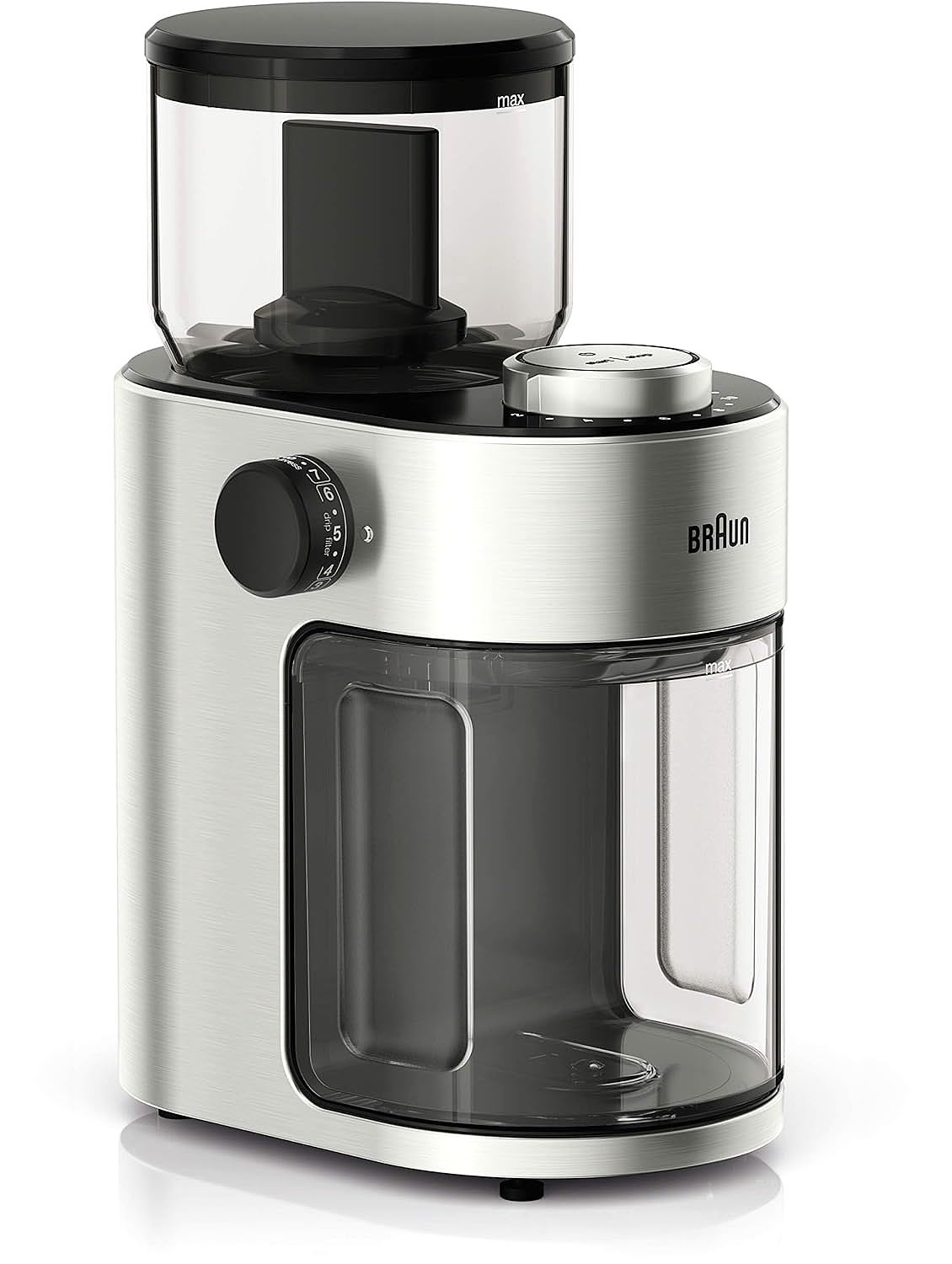
The Flat Burr Secret: Mastering the Braun KG7070 Coffee Grinder

Burr Coffee Grinder vs Blade Grinder: Particle Consistency Matters

How Conical Burr Geometry Controls Coffee Extraction
Burr Coffee Grinder vs Blade Grinder: Particle Consistency Matters
Burr Coffee Grinder vs Blade Grinder: Particle Consistency Matters

BRITA Large 10-Cup Water Filter Pitcher: Clean Water for Better Coffee

KitchenAid KCM1208DG Spiral Showerhead Coffee Maker: An Independent Deep Dive
BRITA Large 10-Cup Water Filter Pitcher: Clean Water for Better Coffee
