How Conical Burr Geometry Controls Coffee Extraction

OXO Brew Conical Burr Coffee Grinder
When Your Coffee Tastes Different Every Morning
You bought the same beans. Same roast date. Same water temperature. Same brewing time. Yet Monday's cup was bright and clean, Tuesday's was hollow, and Wednesday's had a bitter edge you could not place.
The variable you are overlooking sits between the whole bean and the brew basket. It is not the beans. It is not your technique. It is the particle size distribution created by your grinder -- and most grinders, especially the spinning-blade kind, do a poor job of controlling it.
A blade grinder does not grind. It smashes. A spinning propeller hits beans at random, shattering some into microscopic dust while leaving others as half-bean boulders. Those two particle types extract at wildly different rates: the dust over-extracts in seconds, leaching bitter tannins, while the boulders under-extract, contributing almost nothing but starch and hollowness. The result in your cup is a tug-of-war between bitterness and weakness -- the same beans, the same morning routine, a different cup each time.
The solution engineers settled on decades ago is the burr grinder. But not all burr grinders are equal. The difference between a good cup and a great one comes down to geometry, thermodynamics, and a concept called particle size distribution.
The Two Ways to Break a Coffee Bean
There are exactly two mechanical strategies for reducing a roasted coffee bean to brewable particles: impact fracturing and compressive fracturing.
Blade grinders rely on impact. A high-RPM propeller strikes beans with sharp edges. The fracture pattern is chaotic -- cracks propagate along random planes through the bean's cellular structure, producing an uncontrolled distribution of particle sizes. The physics here is direct: impact loading creates brittle fracture that follows the weakest paths through the material, not a predetermined size range. You get shards, dust, and chunks all mixed together.
Burr grinders rely on compression. Two abrasive surfaces -- the burrs -- rotate relative to each other, and beans are fed into the gap between them. As the gap narrows, beans experience progressive compressive failure: they crack, then the fragments are crushed further, and only particles small enough to pass through the final gap exit the grinding chamber. This two-stage process -- primary fracture followed by regrinding of oversized particles -- is what produces uniformity.
The conical burr geometry adds a third advantage that flat burr designs cannot match: gravity-assisted feeding. In a conical burr set, the inner cone rotates while the outer ring remains stationary. The angled surfaces create a natural downward path. Beans are pulled into the grinding zone by both gravity and the burr's rotational force. Flat burrs, by contrast, rely entirely on centrifugal force to move beans outward between two horizontal discs -- a less efficient pathway that can trap particles and generate more frictional heat.
Conical Burr Geometry: Why Shape Controls Extraction
The geometry of a conical burr set is deceptively simple. An inner cone rotates inside an outer ring. The gap between them starts wide at the top -- perhaps 3 to 4 millimeters -- and narrows to the target particle size at the bottom, typically between 150 and 600 microns depending on the setting. This continuously decreasing aperture is the mechanism behind uniform grinding.
Think of it as a funnel that also crushes. Each bean fragment must pass through every stage of the narrowing gap. If a particle is still too large at the final stage, it cannot exit -- it recirculates within the burr set until reduced to the target size. This self-regulating mechanism is absent in blade grinders and less effective in flat burr designs, where particles can sometimes escape sideways before reaching the final gap dimension.
Burr diameter also matters. A larger burr diameter -- 56 millimeters, for instance -- means more cutting surface per rotation, which means each rotation does more work at a lower RPM. Lower RPM means less frictional heating, and less frictional heating means the volatile aromatic compounds in the coffee -- the molecules that give your coffee its smell and flavor -- are less likely to vaporize before they reach your cup. A typical conical burr grinder operates at around 300 RPM. A blade grinder spins at 20,000 to 30,000 RPM. The difference in heat generation is not linear -- it is closer to exponential with speed.
Particle Size Distribution: The Mathematics of Uniformity
Coffee extraction is a diffusion process. Hot water penetrates each ground coffee particle and dissolves soluble compounds -- acids first, then sugars, then bitter tannins and plant fibers. The rate of diffusion depends on particle surface area to volume ratio, which is determined by particle size. Small particles extract fast. Large particles extract slow.
If every particle in your brew basket were exactly the same size, extraction would be perfectly uniform. Every particle would release its acids at the same moment, its sugars at the same moment, and its bitter compounds at the same moment. You could stop brewing at precisely the sweet spot and capture the optimal balance every time.
Real grinding is never perfect. The question is: how close to perfect can you get?
Engineers quantify this using the coefficient of variation, or CV -- the standard deviation of particle sizes divided by the mean, expressed as a percentage. A lower CV means tighter size control. The Specialty Coffee Association provides reference targets: French press brewing tolerates a CV below 20 percent, with particles in the 400 to 600 micron range; pour-over demands a CV below 15 percent, with particles at 300 to 400 microns; and espresso requires a CV below 12 percent, with particles at 150 to 250 microns. These are not arbitrary thresholds -- they come from decades of measuring extraction yields against trained taste panels.
Laboratory measurements tell a clear story. A blade grinder produces a CV of approximately 28 percent -- well outside the acceptable range for any brew method. A budget conical burr grinder achieves roughly 18 to 19 percent. A well-engineered conical burr grinder -- one with a properly machined burr set, adequate motor torque, and minimal shaft play -- can reach 12 to 15 percent. At CV values below 15 percent, extraction efficiency improves by an estimated 15 to 20 percent compared to CV values above 25 percent. That translates directly to more flavor extracted from the same dose of coffee, with fewer bitter or sour defects.
How Heat Changes Your Grind Without You Noticing
There is an invisible variable at work inside every electric coffee grinder: motor heat. Electric motors convert electrical energy into mechanical rotation, but no motor is perfectly efficient. A portion of the input energy becomes waste heat in the motor windings. Over multiple grinding cycles, this heat accumulates.
When a DC motor's windings exceed their rated temperature -- typically around 75 degrees Celsius for the enamel insulation used in small appliance motors -- two things happen. First, the electrical resistance of the copper windings increases, which reduces current flow and therefore torque. Lower torque means the burrs slow down under load, changing the effective grinding speed and potentially stalling on dense or lightly roasted beans. Second, and more damaging over time, the insulation on the windings begins to degrade microscopically. Each overheating cycle causes cumulative damage. After enough cycles, the motor develops internal short circuits and fails.
Most entry-level coffee grinders have no defense against this. The motor runs until you turn it off or it burns out. The engineering solution -- common in industrial machinery but unusual in consumer appliances at this price point -- is a thermal cutoff switch embedded in the motor housing. When the winding temperature reaches approximately 75 degrees Celsius, a bimetallic strip inside the switch deforms and breaks the circuit. The motor stops. Current cannot flow. The windings cool passively, and after roughly three minutes -- the time it takes for the aluminum housing to dissipate the stored heat -- the bimetallic strip returns to its original shape, the circuit closes, and the motor can run again.
This is not a convenience feature. It is a longevity mechanism. A grinder without thermal protection might survive a year of heavy use. A grinder with it might survive a decade. The physics is indifferent to marketing claims -- heat kills motors, and a switch that prevents overheating extends functional lifespan by preventing cumulative winding damage.
Matching Particle Size to Brewing Method
Once you have a grinder capable of producing a narrow particle size distribution, the next question is: what size should you target? The answer depends entirely on how long the water and coffee will be in contact.
French press brewing steeps coarse grounds in hot water for four to five minutes. The large particles -- 400 to 600 microns -- present less surface area per gram, so extraction proceeds slowly, which is exactly what you want for a long immersion. If you used espresso-fine powder in a French press, the coffee would over-extract into bitter, astringent territory within the first minute, and you would also end up with a mouthful of sludge since the metal mesh filter cannot trap particles below roughly 200 microns.
Pour-over brewing keeps water in contact with grounds for two to three minutes, moving continuously through a paper or metal filter. This demands a medium grind -- 300 to 400 microns. Too coarse and the water races through, under-extracting. Too fine and the filter clogs, extending contact time unpredictably and producing a muddy, bitter cup.
Espresso forces water through a compacted puck of coffee at nine bars of pressure for 25 to 30 seconds. This requires the finest grind -- 150 to 250 microns. At this scale, even small variations in particle size create large variations in flow resistance. A few oversized particles -- called boulders in the coffee industry -- create low-resistance channels through the puck, allowing water to rush through those paths while bypassing the rest of the coffee. This is called channeling, and it is the primary reason espresso from an inconsistent grinder tastes simultaneously sour and bitter.
A grinder's number of settings matters less than the quality of the burr set that defines those settings. Fifteen well-machined settings that produce distinct, narrow particle size distributions are more useful than sixty settings from a burr set with excessive shaft play that cannot hold a consistent gap.
Why Some Grinders Leave Yesterday's Coffee in the Morning Cup
After you finish grinding, not all the ground coffee exits the grinder. A certain amount -- called grind retention -- remains trapped in the burr chamber, the discharge chute, and any internal crevices. This residual coffee sits there, exposed to air, oxidizing and losing volatile aromatics by the hour. The next time you grind, fresh coffee pushes some of this stale material out, mixing it with your new dose.
Retention matters because coffee staling is fast. Ground coffee begins losing aromatic compounds within minutes and develops noticeable stale notes within hours. If your grinder retains 5 grams -- about a teaspoon -- and you dose 15 grams of fresh beans, one-quarter of what ends up in your brew basket is oxidized material from the previous session. You are seasoning every cup with stale coffee.
The engineering approach to minimizing retention involves shortening the particle exit path and eliminating dead spaces where grounds can accumulate. A straight, short chute from the burr chamber to the collection bin, combined with smooth interior surfaces that do not trap particles, can reduce retention to less than 1 gram. This is an order-of-magnitude improvement over grinders that retain 3 to 5 grams -- a difference you can taste, particularly when switching between different coffee beans.
The Sound of Precision: Decibels and Motor Design
Coffee grinders are loud. The sound comes from two sources: the motor itself and the fracturing of beans between the burrs. Blade grinders add a third source -- the propeller tip striking beans at high speed -- which is why they produce an ear-splitting whine that can wake an entire household.
A burr grinder operating at 300 RPM with a DC brushless motor and adequate sound damping produces approximately 55 decibels at one meter. For perspective: 55 dB is roughly the level of a normal conversation or background music. At 60 dB -- a common level for budget burr grinders -- the perceived loudness is approximately 40 percent greater due to the logarithmic nature of the decibel scale. The 5 dB difference between a quiet grinder and an average one is not subtle -- it is the difference between grinding coffee while someone sleeps in the next room and waking them up.
The motor type influences both noise and longevity. DC brushless motors use electronic commutation instead of mechanical brushes, which eliminates brush friction noise and the sparking that generates both electrical interference and ozone. They also run cooler and last longer -- an estimated 10,000 hours or more of continuous operation, compared to perhaps 2,000 to 3,000 hours for a brushed DC motor. In a grinder that runs for two minutes per day, that translates to decades of service versus a few years.
Where Engineering Principles Meet the Countertop
Take, as a concrete example, a grinder with a 56-millimeter stainless steel conical burr set, a 300 RPM DC brushless motor, 15 micrometric grind settings, a retention figure below 1 gram, and an operating noise level of approximately 55 decibels. These specifications -- drawn from the OXO Brew -- represent decisions driven by physics rather than marketing. They are not features listed to fill a comparison chart. They are solutions to the physical problems that make coffee taste inconsistent.
At its price point, a grinder built this way costs roughly twice what a blade grinder costs and half what an entry-level espresso-focused grinder commands. The value proposition is direct: for the cost of roughly 12 bags of specialty coffee, you eliminate the single largest source of unpredictability between the bean and the cup. The grinder becomes a constant -- something you calibrate once and trust thereafter -- rather than a variable you compensate for with every brew.
Temperature protection, in particular, changes how the tool can be used. Without it, grinding back-to-back batches for a dinner party or a large French press means racing against a motor that is slowly cooking itself. With a thermal cutoff, the system protects itself. If the windings reach 75 degrees Celsius, the motor pauses for three minutes and resumes. You lose a few minutes. You do not lose the motor.
The Pursuit of Uniformity
The history of coffee brewing is a history of chasing uniformity. The espresso machine was invented in 1884 by Angelo Moriondo as a way to brew coffee faster -- but it took decades before anyone realized that the real breakthrough was the consistent pressure and temperature it applied. The paper filter, patented by Melitta Bentz in 1908, was originally a solution to the problem of grounds in the cup -- but its lasting contribution was creating a standardized flow resistance that made extraction predictable. Every major innovation in coffee has followed this pattern: remove a variable, make the process repeatable, let the beans speak for themselves.
The burr grinder fits into this lineage. It does not make coffee more exciting by adding something. It makes coffee better by subtracting variability -- the particle size lottery that blade grinders impose on every dose. Good engineering in coffee, as in most fields, is not about complexity. It is about making one part of the process so reliable that you can stop thinking about it and focus on everything else.
The next time your morning coffee tastes exactly the way you expected it to, you might not think about why. But somewhere in the chain between the farm and your cup, someone solved a physics problem that made that consistency possible.
OXO Brew
OXO Brew Conical Burr Coffee Grinder
Related Essays

Burr Coffee Grinder vs Blade Grinder: Particle Consistency Matters

Burr Coffee Grinder vs Blade Grinder: Particle Consistency Matters

Burr vs Blade Coffee Grinder: The Physics of Consistent Grinding
Burr Coffee Grinder vs Blade Grinder: Particle Consistency Matters
Burr Coffee Grinder vs Blade Grinder: Particle Consistency Matters
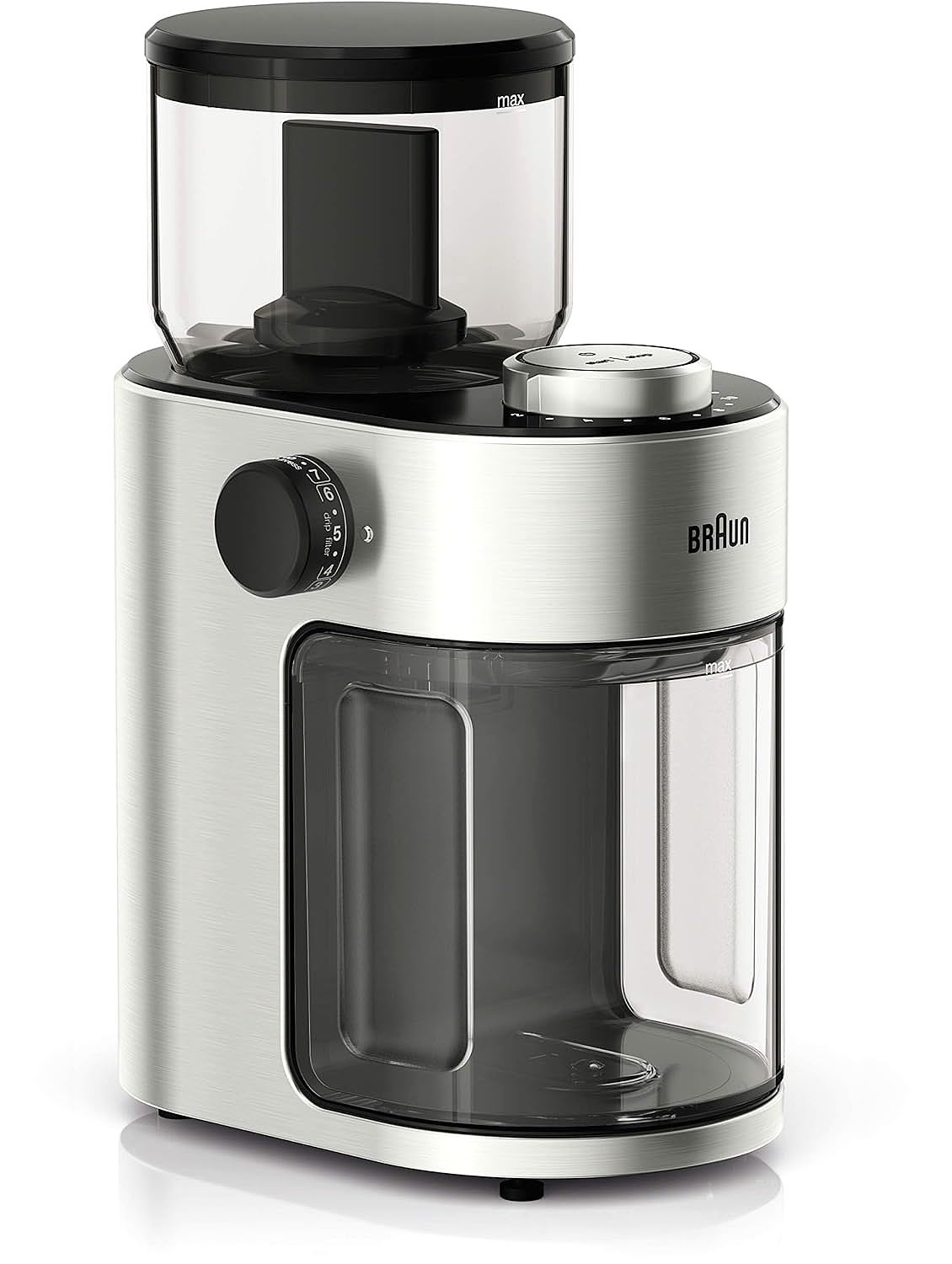
The Flat Burr Secret: Mastering the Braun KG7070 Coffee Grinder

Best Burr Coffee Grinder Under $50: 18 Settings & 16oz Hopper
Best Burr Coffee Grinder Under $50: 18 Settings & 16oz Hopper
Best Burr Coffee Grinder Under $50: 18 Settings & 16oz Hopper