Fracturing the Bean: Precision Kinetics in Coffee Grinding
Update on March 3, 2026, 6:22 p.m.
The transformation of a dense, roasted agricultural seed into a highly aromatic, polyphasic liquid requires the precise manipulation of extreme physical forces. While the brewing apparatus—often a high-pressure pump forcing heated solvent through a restrictive matrix—receives the bulk of consumer attention, the foundational prerequisite for any successful extraction is the physical reduction of the seed itself. This process is not merely a matter of making large objects small; it is an exercise in applied materials science, brittle fracture mechanics, and geometric engineering.
To bridge the gap between theoretical physics and daily application, we must look inside the machinery that facilitates this particulate generation. By examining the mechanical components and architectural philosophies of specific reduction mechanisms, we can observe the universal laws of thermodynamics, fluid dynamics, and environmental sustainability that govern the creation of a stable, soluble matrix.
From Mortar and Pestle to Automated Precision
For centuries, the human approach to accessing the soluble compounds within Coffea arabica relied on blunt force trauma. Early methods utilized stone mortars and heavy pestles to crush the roasted seeds. While this achieved the basic goal of breaching the seed’s exterior, it represented a catastrophic failure from a chemical engineering perspective.
The roasted coffee bean is a highly complex, fragile structure. During the roasting process, the application of intense thermal energy causes the internal moisture to vaporize, expanding the cellular walls and creating a highly porous, brittle, honeycomb-like cellulose matrix. Within these microscopic chambers reside the target compounds: organic fruit acids, complex caramelized sugars, heavy alkaloids, and thousands of highly volatile aromatic lipids.
To extract these compounds uniformly, the solvent (water) requires equal access to the internal chambers of every resulting particle. Blunt force crushing produces an entirely chaotic physical output. A single strike creates massive, unbroken shards alongside microscopic, pulverized dust. This historical lack of structural control meant that the resulting beverage was always an unpredictable amalgamation of sharply sour under-extraction and aggressively bitter over-extraction.
The industrial revolution introduced the rotary blade, which merely mechanized the chaos. Spinning at thousands of revolutions per minute, a flat metal blade strikes the beans arbitrarily in a confined chamber. The aerodynamic turbulence ensures that some particles are struck hundreds of times, while others are barely cleaved in half. The evolutionary leap from random shattering to controlled shearing marked the birth of the modern burr mechanism—a shift from agricultural processing to precision machining.

The Microscopic Obstacle Course in Your Filter Basket
When hot water is introduced to a tightly compacted bed of finely ground particulate matter, it encounters a massive physical barrier. Fluid dynamics dictates that water, acting under the influence of pressure and gravity, will relentlessly seek the path of least hydraulic resistance. The behavior of the solvent as it navigates this porous medium determines the chemical viability of the final liquid.
In a high-pressure extraction environment, such as a 9-bar espresso system, the uniformity of the coffee particles—known as the Particle Size Distribution (PSD)—is the single most critical variable. If the particulate matrix contains a high percentage of “boulders” (abnormally large particles), these pieces will interlock awkwardly, creating large interstitial voids. The pressurized solvent will violently rush through these voids, bypassing the dense inner cores of the large particles. This phenomenon, known as channeling, extracts only the highly soluble, lightweight surface acids, yielding a thin, sour, and structurally weak fluid.
Conversely, if the matrix is choked with “fines” (microscopic dust particles), these tiny fragments will migrate downward under the pressure of the fluid flow, clogging the microscopic pores of the metal filter screen. The fines themselves possess an immense surface-to-volume ratio, causing the water to instantly strip away their heaviest, most bitter compounds—the tannins and complex alkaloids. Furthermore, the clogged filter drastically increases the hydraulic resistance of the entire bed, prolonging the contact time between the hot solvent and the remaining grounds, leading to total systemic over-extraction.
To mitigate this, the engineering goal is a unimodal particle size distribution—a steep, narrow bell curve where the vast majority of particles share an identical physical dimension. Conical burr geometries achieve this through sequential shearing. As the beans are pulled downward by gravity and rotational friction between a stationary outer ring and a rotating inner cone, they are forced through progressively narrower channels. The sharp, helical cutting teeth do not crush; they slice the brittle cellulose along its natural fault lines until the fragment is precisely small enough to drop through the terminal gap. By manipulating the vertical distance between the two burrs, the operator dictates the absolute maximum size of the resulting particle, creating a uniform, predictable hydraulic obstacle course for the solvent to navigate.
Is Heat the Invisible Enemy of Extraction Chemistry?
While mechanical uniformity is paramount, the act of fracturing a dense organic material requires immense energy, and the first law of thermodynamics dictates that energy cannot be destroyed. The kinetic energy applied by an electric motor to shear the beans is ultimately converted into two outputs: the physical fracturing of the cellulose matrix, and heat.
Friction is the silent adversary of botanical preservation. As the steel teeth tear through the roasted beans, the localized temperature within the grinding chamber rapidly elevates. If this thermal buildup is not strictly managed, it triggers a catastrophic chemical degradation before the coffee is ever subjected to the brewing process.
The most desirable flavor notes in high-quality coffee are derived from Volatile Organic Compounds (VOCs). These extremely lightweight molecules provide the floral, fruity, and complex aromatic signatures that define specialty agriculture. By their very nature, VOCs exist in a precarious state of equilibrium. If the ambient temperature of the ground coffee rises by even 15 to 20 degrees Celsius during the milling process, the thermal kinetic energy imparted to these molecules causes them to sublimate. They rapidly transition into a gaseous state and escape into the atmosphere, completely vacating the coffee grounds.
Once these aromatic lipids have vaporized, they cannot be recovered. The resulting extraction will be chemically hollow, tasting flat, stale, and dominated only by the heavier, heat-resistant bitter compounds. This physical reality forces engineers to triangulate three opposing variables: motor torque, rotational velocity (RPM), and thermal dissipation. High-velocity systems risk scorching the beans, while massively heavy, low-RPM commercial systems rely on the vast thermal mass of thick steel and brass to absorb the heat, requiring a footprint and power draw that is incompatible with domestic environments.

Bypassing the Staleness Trap with Vertical Gravity
Beyond thermal degradation, the most persistent failure mode in traditional particulate reduction is geometric retention. In a standard automated mill, the rotating lower burr relies on centrifugal force to fling the fractured coffee outward into a horizontal or angled exit chute. This chute creates a severe logistical bottleneck.
Because coffee beans are heavily laden with natural oils, the pulverized dust becomes highly cohesive. As the grounds are pushed through the chute, they adhere to the walls, the anti-static flaps, and the internal crevices of the burr chamber. This accumulation is known as “exchange retention.” If a machine retains three grams of coffee in its internal pathways, the first three grams of coffee expelled during the next operation will be entirely composed of stale, oxidized grounds from the previous session.
When exposed to atmospheric oxygen, the fragile lipids in the retained coffee undergo rapid lipid oxidation. The fat molecules fracture into short-chain aldehydes and ketones, which the human palate perceives as rancid, cardboard-like, and aggressively bitter. Pushing fresh, expensive coffee through a gauntlet of rancid, retained dust completely nullifies the precision of the burrs.
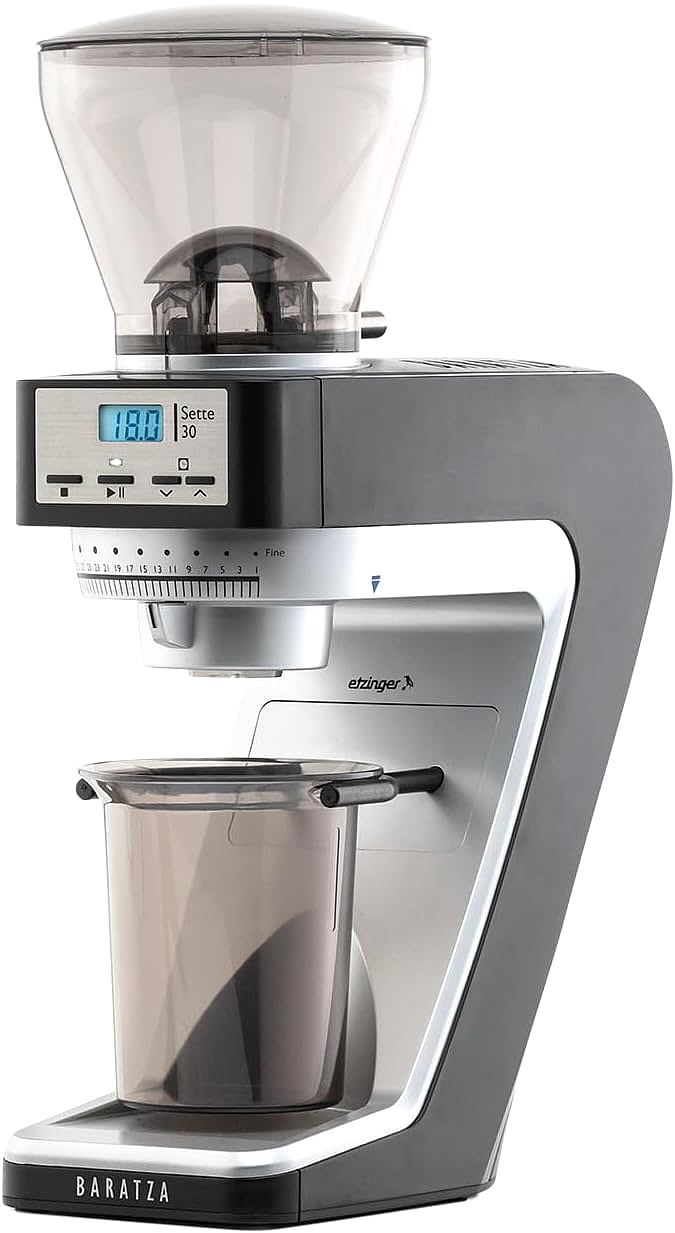
Overcoming this requires a radical reimagining of the drivetrain and the gravitational path of the particulate. The Baratza Sette 30 Conical Burr Grinder serves as a prime mechanical case study in solving the retention crisis through architectural inversion.
In a traditional setup, the inner cone rotates while the outer ring remains stationary. The Sette architecture inverts this entirely. The central conical burr is fixed in place, while a specialized gearbox drives the outer ring burr in a planetary rotation. This seemingly simple inversion profoundly alters the fluid dynamics of the falling grounds.
Because the outer ring is spinning, it does not rely on a horizontal sweeping motion to expel the coffee into a chute. Instead, the ground particles fall straight downward, aided by gravity, passing directly through the center of the mechanism without navigating any lateral pathways. This “straight-thru” geometry results in near-zero retention. What goes into the hopper emerges instantly into the collection bin below. By eliminating the horizontal exit chute, the machine neutralizes the staleness trap, ensuring that every microscopic particle subjected to the solvent is chemically fresh and structurally intact.
Furthermore, this direct vertical path vastly accelerates the output volume. Without the frictional bottleneck of an exit chute, the mechanism can process up to 5 grams of coffee per second. This rapid throughput is not merely a matter of convenience; it minimizes the total duration the beans are subjected to the frictional environment of the burrs, actively mitigating the thermal buildup that threatens the volatile organic compounds.

Trading Acoustic Comfort for Sustainable Architecture
The implementation of high-velocity, zero-retention architecture introduces severe, unavoidable compromises in other areas of the user experience. When you strip away the internal baffles, the dense winding chutes, and the heavy metal isolation chambers required to redirect coffee grounds laterally, you simultaneously strip away the acoustic dampening that prevents a high-torque electric motor from deafening the operator.
The lack of acoustic insulation is a direct, mathematical trade-off for mechanical efficiency. When a device like the Sette 30 processes a dense, light-roast coffee bean, the physical fracturing of the cellulose matrix generates intense acoustic resonance. Because the burrs sit directly above an open, vertical drop, there is no physical mass to absorb the sound waves. The decibel output is inherently high, characterized by a sharp, aggressive mechanical roar.
Consumers frequently misinterpret this acoustic violence as a symptom of poor manufacturing or inferior components. In reality, it is the raw, unfiltered sound of rapid kinetic reduction. To silence the machine would require encasing the motor and burr set in heavy, dense alloys, massively increasing the manufacturing cost, the physical footprint, and inevitably reintroducing the convoluted exit pathways that cause retention.
This tension between consumer expectation and engineering reality extends into the material science of the drivetrain itself. To deliver 40mm European-manufactured steel burrs, a digital timer capable of 0.1-second chronometric dosing resolution, and a sophisticated planetary gearbox at an entry-level price point, manufacturers must allocate structural costs meticulously.
This often necessitates the utilization of advanced polymers (plastics) in the exterior housing and internal gear assemblies. While metallic gears offer superior theoretical longevity, they require expensive precision machining and heavy lubrication, which poses a contamination risk in a food-safe environment. High-density polymers offer a self-lubricating, cost-effective alternative that can withstand the torque requirements of domestic use.
However, polymers are subject to material fatigue over thousands of thermal and kinetic cycles. A plastic gear assembly will eventually strip or fracture. It is at this critical juncture of mechanical failure that the underlying philosophy of the manufacturer is tested against the modern crisis of electronic waste.
The prevailing trend in consumer appliances is monolithic, glued-together architecture. When a single internal plastic component fails, the entire unit is rendered unserviceable and is destined for a landfill. This planned obsolescence relies on the economic assumption that replacing the entire unit is cheaper than paying a technician to disassemble it.
Countering this environmental catastrophe requires a return to modular, user-serviceable engineering. The architecture must be designed with the assumption of eventual component failure. Devices adhering to a “Don’t Dump It, Fix It” philosophy—a stance publicly championed by Baratza—are assembled using standard screws and accessible clips. When the polymer gearbox ultimately reaches the end of its fatigue life, the operator is not forced to discard the expensive steel burrs, the digital display, or the electric motor.
By isolating the sacrificial failure points and making replacement modules widely available and easily installable with basic hand tools, the lifespan of the appliance is extended indefinitely. This paradigm shifts the appliance from a disposable consumer good to a permanent, maintainable tool.

The science of particulate reduction is a constant negotiation with the laws of physics. Achieving a unimodal particle distribution without inducing thermal sublimation, and delivering it instantly without chemical contamination from retained grounds, requires highly specific geometric interventions. By understanding the mechanical realities behind the acoustic output, the necessity of chronometric dosing, and the profound environmental importance of modular repairability, the operator ceases to be a passive consumer of a beverage. Instead, they become an active participant in a highly calibrated chain of chemical and physical reactions, manipulating the fundamental building blocks of extraction to unlock the absolute potential of the roasted seed.