Nespresso Arpeggio Intensity 9 Explained: Reading Coffee Pod Labels Like a Pro
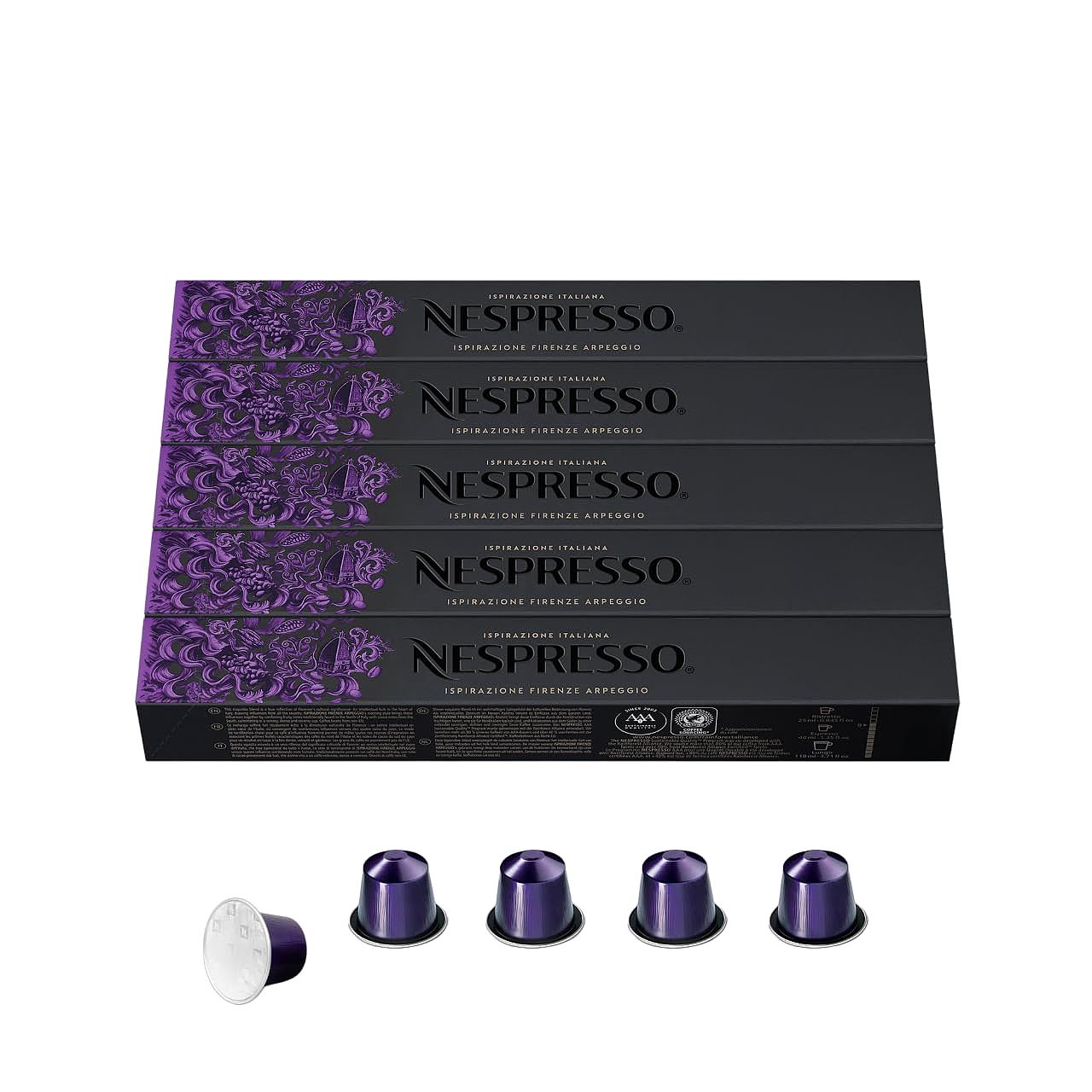
Nespresso Ispirazione Arpeggio Intenso Coffee Capsules
Nespresso Arpeggio Intensity 9 Explained. You pick up a sleeve of Nespresso pods and see a collection of signals. A number, bold and centered: 9. A name wrapped in Italian: Ispirazione Firenze Arpeggio. A string of tasting notes: cocoa, woody, grilled. Most people register these as design, not data. The number gets assumed to mean caffeine strength. The name gets skipped as marketing poetry. The tasting notes get filed under creative writing. Each of those assumptions is wrong. And each one means you are navigating an entire coffee system with a broken instrument. This is a repair manual for that instrument. Using one specific dark-roast capsule as a reference point, we will walk through how to read intensity numbers, decode pod names, understand the chemistry behind tasting notes, and recognize why the aluminum shell matters more than it seems. By the end, you will not need a website or a salesperson to tell you what a coffee pod tastes like. You will know how to figure it out yourself. ## What Nespresso Arpeggio Intensity 9 Actually Means (and the Caffeine Myth) The number printed on a Nespresso OriginalLine pod ranges from 1 to 13. Walk down the coffee aisle and you will see Volluto at 4, Cosi at 3, Genova Livanto at 6, Roma at 8, Ristretto Italiano at 10, Dharkan at 11, and Kazaar at 12. It looks like a straightforward linear scale. The single biggest mistake people make is assuming it measures caffeine. It does not. A pod rated Intensity 4 made from Robusta beans can deliver significantly more caffeine than an Intensity 12 pod made from Arabica. The National Coffee Association confirms that Robusta contains 50 to 60 percent more caffeine than Arabica by weight. The intensity number has nothing to do with stimulant dosage. It never did. So what does the Nespresso Arpeggio Intensity 9 Explained. 1 through 13 scale actually measure? Three sensory inputs, combined into one proprietary rating. Roast level carries the heaviest weight. A higher number almost always indicates beans roasted longer and darker, pushing the flavor toward deeper, smokier territory. Body, also called mouthfeel, refers to the physical weight of the coffee on your tongue. Think skim milk versus heavy cream. A high-intensity pod feels dense and coating. A low-intensity pod registers as thin and tea-like. Bitterness rounds out the third component. In coffee, bitterness is not a defect. It is a desired characteristic of dark roasts, comparable to the bitterness you expect from dark chocolate or a negroni. These three factors map onto three rough bands across the 1 to 13 spectrum. Low intensity, spanning 1 through 4, covers light-bodied pods with bright acidity and fruit-forward profiles. Volluto at 4 and Cosi at 3 occupy this space. The experience is closer to a delicate filter coffee than a punchy espresso. Mid intensity, 5 through 7, represents balance. Genova Livanto at 6 exemplifies this zone: caramelized sweetness, moderate body, no single element dominating. High intensity, 8 through 13, is the bold territory. Dark roasts dominate here. The body is weighty. The bitterness is present and deliberate. Ristretto Italiano at 10 pushes further into compact intensity. Kazaar at 12, a Robusta-Arabica blend, adds peppery sharpness to the heaviest body in the lineup. Dharkan at 11 brings a smoother expression through slow-roasted Arabica. A pod at Intensity 9 sits cleanly inside this high band, signaling a bold, dark-roasted, full-bodied espresso with noticeable but controlled bitterness. When you see Nespresso Arpeggio Intensity 9 on the box, the message is about the flavor experience waiting in the cup, not the caffeine entering your bloodstream. An interesting footnote from coffee chemistry reinforces this point. The dark roasting Nespresso Arpeggio Intensity 9 Explained. that creates a high intensity number actually destroys a small fraction of caffeine. A lighter roast retains marginally more. So that fierce Intensity 12 pod, for all its heavy body and aggressive character, probably delivers less caffeine than an unassuming Intensity 4 Robusta pod. The number describes flavor architecture, not pharmacology.  ## The Poetry of Pod Names: Ispirazione, Firenze, and the Language of Blends Nespresso organizes its OriginalLine pod names into two distinct categories. Learn to recognize the pattern, and you can identify a coffee's fundamental structure before brewing a single drop. The first category uses abstract, poetic words: Volluto, Capriccio, Cosi. These names carry no geographic information. That absence of a place name is itself a signal. It means the coffee inside is a blend. Multiple bean types, sometimes spanning several growing regions, combined by a roaster functioning like an orchestra conductor. Each component bean contributes something specific, body from one origin, aromatic lift from another, a structural backbone from a third. The blending goal is consistency and harmony across harvests and seasons. The second category uses geographic names: Ethiopia, Colombia, India. These are single-origin coffees. The name points to one specific place, and the intent is to express the flavor signature of that place. Think of the wine parallel. A bottle labeled with a fantasy name is typically a blend engineered for reliable character. A bottle labeled with a specific region is about that region speaking for itself. Now the Italian prefix. Ispirazione Firenze, which Nespresso added when it rebranded many OriginalLine capsules, translates to "Inspiration of Florence." Why Florence? Among Italian cities, Florence is most strongly associated with artistic synthesis, with creators who absorbed multiple influences and produced something original from the combination. The city's identity is built on the Nespresso Arpeggio Intensity 9 Explained. art of blending traditions. For a coffee blend, the association is precise: this is about combining elements with intention, producing a result that exceeds the sum of its inputs. The musical term in the capsule name adds another structural clue. In music, the named pattern describes playing the notes of a chord in sequence, one after another, rather than striking them simultaneously. The effect conveys unfolding complexity and underlying unity. The coffee parallel is straightforward: individual bean origins playing out across the palate in sequence, each distinguishable but contributing to one integrated experience. This is not a single-origin coffee presenting one flavor story. It is a blend conducting multiple stories into a single performance. Put the full name together and you get, in plain language, something close to: a harmonious blend of coffee beans from multiple origins, constructed with the compositional care that Florence represents. The words on the sleeve are not decoration. They are documentation, once you learn the vocabulary. This naming pattern repeats reliably across the OriginalLine catalog. Poetic names signal blends. Geographic names signal single origins. The Italian city prefix signals the artistic tradition Nespresso wants the blend associated with. Napoli for darker, more intense profiles. Venezia for lighter, more delicate ones. Roma for classic balance. Each city choice was made with intent.
  ## Inside the Capsule: Arabica Beans, Dark Roast Chemistry, and Flavor Origins The official description of this capsule lists three tasting notes: intense and creamy body, subtle cocoa, and woody hints. If those words sound like a sommelier straining for descriptors, it is worth understanding that every single one maps to a specific chemical process. Nothing on the label is invented. Everything is produced. The capsule contains 100 percent Coffea arabica, sourced from South and Central Nespresso Arpeggio Intensity 9 Explained. America. Arabica accounts for roughly 62 percent of global coffee production according to the National Coffee Association. Its cousin, Coffea canephora, known as Robusta, makes up most of the remaining share. The distinction matters for flavor architecture. Arabica grows at higher altitudes, between 2,000 and 6,000 feet, in stable temperatures with well-distributed rainfall. These conditions slow the maturation of the coffee cherry, allowing more complex flavor precursors to accumulate inside the bean. South and Central American growing regions contribute volcanic soils and varied microclimates that further concentrate these precursors. Before roasting, South and Central American Arabicas in their green state carry what Nespresso describes as fruity or malted profiles. But the brewed cup does not taste fruity or malty. That is intentional and it is what the dark roast was designed to erase. The roasting process for this coffee pushes internal bean temperatures past 400 degrees Fahrenheit, placing it firmly in dark roast territory. Two chemical reactions drive the transformation from grassy green seed to dark, aromatic bean. The Maillard reaction, named for the French chemist Louis Camille Maillard who first described it in 1912, begins around 300 to 350 degrees Fahrenheit. Amino acids react with reducing sugars in a cascade that generates hundreds of new flavor compounds. This is the identical chemical pathway responsible for the browning of bread crust, the sear on a steak, the savory depth of roasted vegetables. In coffee, the Maillard reaction directly produces what the label calls grilled notes. Those notes are not seasoning. They are evidence of amino acids and sugars colliding under controlled heat. Caramelization takes over as the temperature continues to climb. Sugars inside the bean begin to brown and fragment independently of amino acids. At lighter roast levels, this produces simple sweetness. Pushed into dark roast territory, caramelization shifts toward Nespresso Arpeggio Intensity 9 Explained. bittersweet territory, generating compounds the palate reads as toffee, dark caramel, and cocoa. The cocoa note on the label traces to specific pyrazines, a class of aromatic compounds created during roasting that are strongly associated with roasted, nutty, and chocolate-like aromas. Simultaneously, the bean's structural lignin breaks down at high temperatures, releasing compounds perceived as woody or subtly spicy. The woody note on the label is decomposing plant cell walls, not an added flavor. Three tasting notes on the label. Three chemical processes in the roaster. Maillard for grilled. Caramelization and pyrazine formation for cocoa. Lignin breakdown for woody. None of it is marketing invention. All of it is heat plus time plus bean chemistry, controlled to produce a predictable sensory profile. The decision to use a blend rather than a single-origin coffee for this dark roast is deliberate engineering. A single high-quality bean roasted this dark would lose whatever made it distinctive. Its origin character would vanish into the roast. By blending, the roaster can select beans that each contribute something that survives the fire: body from one origin, malted sweetness that converts to cocoa from another, a structural acidity from a third that provides balance against the bitterness. The blend is not hiding anything. It is the only way to build complexity inside a dark roast. A final note on caffeine, because it connects to the intensity myth from earlier. The dark roast that produces all these flavor compounds does not produce caffeine. Caffeine is relatively heat-stable, and the small amount lost during extended roasting means a lighter roast retains slightly more. The NCA confirms this directly. If your goal is maximum caffeine per sip, choose a light roast made from Robusta. If your goal is the cocoa, woody, grilled flavor experience, the dark roast delivers it.
  ## The Physics of Freshness: Aluminum, Pressure, and the Cup Everything described so far, the bean selection, the roast chemistry, the blending strategy, becomes irrelevant if the ground coffee degrades before it meets hot water. Ground coffee is among the most fragile food products in a typical kitchen. It begins losing aromatic complexity within minutes of exposure to air. The four factors that destroy coffee freshness are oxygen, moisture, light, and heat. Coffee is hygroscopic, meaning it actively pulls moisture and ambient odors from its environment. The National Coffee Association notes that roasted whole beans retain peak flavor for one to three weeks at room temperature. Ground coffee lasts one to two weeks. Coffee that has absorbed humidity from the air brews flat and hollow. This is why the standard advice for quality coffee is to buy whole beans in small batches and grind immediately before brewing. A sealed aluminum capsule solves this problem by eliminating exposure entirely. Aluminum functions as a near-perfect barrier material. It is highly impermeable to gases, completely opaque to light, and forms an effective moisture seal. During manufacturing, the capsule interior is flushed with an inert protective atmosphere before the aluminum is crimped shut, creating a hermetic environment that isolates the coffee from all four degradation factors. The 800-plus volatile aromatic compounds that give coffee its sensory complexity remain locked inside, unchanged, from the moment the capsule leaves the production facility in Switzerland until the second the machine pierces the seal. When the brew cycle starts, the Nespresso OriginalLine machine forces water heated to between 195 and 205 degrees Fahrenheit through the compacted coffee bed at approximately 9 bars of pressure. Nine bars is roughly nine times atmospheric pressure at sea level. In more familiar units, that is Nespresso Arpeggio Intensity 9 Explained. about 130 pounds per square inch. This level of pressure is not arbitrary or decorative. High pressure emulsifies the coffee's natural oils, which would otherwise separate like oil from water. It rapidly dissolves soluble solids, sugars, acids, and the melanoidins created during the Maillard reaction into a small volume of water. The 1.35-ounce yield, known as an espresso normale, is the traditional Italian serving size calibrated for this extraction method. On top of the shot sits the crema, a reddish-brown foam whose presence indicates correct extraction. The crema consists of three components: microscopic carbon dioxide bubbles, emulsified coffee oils, and suspended coffee solids. The carbon dioxide forms inside beans during roasting and remains trapped in the cellular structure until grinding and extraction release it. The crema performs two functions. Structurally, it traps volatile aromatic compounds that would otherwise dissipate within seconds of brewing, preserving the aroma for the drinker. Texturally, it contributes a velvety mouthfeel that changes how the liquid registers on the palate. OriginalLine machines also support ristretto at 0.84 ounces, a shorter, more concentrated pull, and lungo at 3.7 ounces, a longer extraction with more volume. But the 1.35-ounce espresso is the calibration point for which most OriginalLine capsules are formulated. The entire system, from capsule material to extraction pressure to serving volume, operates as a single integrated design. Alter any one variable without adjusting the others, and the result shifts unpredictably. On the environmental side, used aluminum capsules are fully recyclable. Nespresso operates collection and recycling programs in numerous countries, and the coffee grounds can be composted after the aluminum is separated. On the sourcing side, the Nespresso AAA Sustainable Quality Program, launched in 2003 in partnership with the Rainforest Alliance, works directly with over 120,000 farmers across 15 countries. Program data indicates that 93 percent of Nespresso Arpeggio Intensity 9 Explained. Nespresso coffee now comes from AAA participating farms. Farmers receive above-market prices for quality coffee and training in water conservation, biodiversity management, and sustainable agricultural practices. According to Rainforest Alliance data, certified coffee farms in East Africa earn 179 percent more income than non-certified farms, a figure that speaks to the economic impact of structured sustainability programs in coffee-growing communities. The next time you face a shelf of Nespresso pods, you are carrying three tools that replace guesswork with knowledge. Check the intensity number first. A low number between 1 and 4 means a lighter roast, tea-like body, and brightness. A mid-range number between 5 and 7 means balance. A high number between 8 and 13 means dark roast, full body, and deliberate bitterness. None of these numbers have anything to do with how much caffeine reaches your bloodstream. Read the name second. Poetic, abstract words like Volluto, Capriccio, and Cosi signal blends, coffees built for harmony and consistency across batches. Geographic names like Ethiopia, Colombia, and India signal single origins, coffees expressing the character of one place. The Italian city prefix, Firenze, Napoli, Venezia, Roma, adds the cultural association the roaster wants you to carry into the cup. Take the tasting notes seriously third. When a dark roast lists cocoa, woody, or grilled notes, those are not creative writing. They describe the known chemical outputs of the Maillard reaction, caramelization, and lignin breakdown at specific temperature ranges. You can learn to distinguish these signatures the same way you learned to tell a poached egg from a fried one. Same raw material. Different heat treatment. Predictably different result. That shelf of capsules stops being a wall and becomes something simpler: a menu you can actually read.
Nespresso Ispirazione Arpeggio Intenso Coffee Capsules
Related Essays

How a Single Cup Coffee Maker K Cup System Masters Brewing Science

Espresso Dark Roast Coffee Extraction Profile: A Technical Deep Dive

Why Pod-Sealed Coffee Stays Fresh: An Engineering and Chemistry Perspective

Best Burr Coffee Grinder Under $50: 18 Settings & 16oz Hopper
L'OR Barista Review: Technical Analysis of Single-Serve Espresso
Bonavita BVC2201GS Enthusiast: Brewing Science for a Perfect Cup
Mcilpoog Milk Jar for ws-203 & ES317 | Convenient Coffee Milk Storage
Mcilpoog ES317 : The Science of Great Espresso at Home, Automatically

Automated Morning: Integrating the Atomi AT1536 into Your Smart Home