The Physics of Extraction: Redefining the Standard of Home Espresso through Pressure and Precision
Update on Jan. 6, 2026, 7:12 a.m.
For over a century, the pursuit of the perfect espresso shot has been a delicate balancing act between human intuition and mechanical engineering. Born in the cafes of Milan, espresso was defined not just by the bean, but by the application of intense physical forces—specifically, the rapid movement of hot water through a tightly compacted “puck” of finely ground coffee. For generations, achieving this at home was considered an elusive craft, requiring expensive, temperamental machinery and years of training. However, the evolution of domestic coffee technology has entered a new phase. We are moving away from the era of “approximation” and into the era of “precision,” where the fundamental laws of fluid dynamics and thermodynamics are harnessed to ensure that the professional standard—once reserved for the high-end espresso bar—is now an achievable reality in the home kitchen.
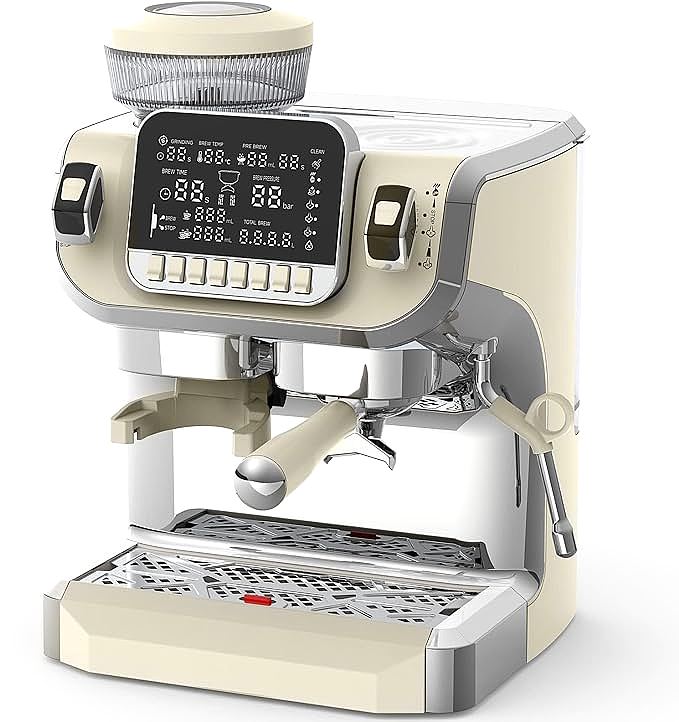
This shift is best embodied by the latest generation of semi-automatic machines, such as the TENKER CM5380 20 Bar Espresso Machine. These devices represent a convergence of industrial-grade power and user-centric automation. By analyzing the core physical variables involved—pressure, temperature stability, and pre-infusion dynamics—we can understand how the landscape of home brewing has been permanently elevated. This is not merely a story about an appliance; it is a deep dive into the science of how we extract flavor, aroma, and texture from a roasted seed, transforming it into the “liquid gold” that defines the modern morning ritual.

The Fluid Dynamics of 20-Bar Pressure: Beyond the Industry Standard
In the coffee industry, the number “9” has long been sacrosanct. Nine bars of pressure—roughly 130 pounds per square inch—is the pressure required to emulsify coffee oils and create the signature “crema” that crowns a well-pulled shot. However, the introduction of 20-bar pumps in machines like the TENKER CM5380 raises a fascinating scientific question: why go beyond the traditional standard? The answer lies in the concept of “pressure overhead” and the physics of flow resistance within a porous medium.
Understanding Hydraulic Resistance
The coffee puck in your portafilter acts as a hydraulic resistor. When the pump engages, water is pushed against this barrier. The pressure we measure is actually the resistance provided by the coffee itself. If the grind is too coarse, water rushes through, resulting in a thin, sour, under-extracted brew. If the grind is too fine, the pump may “choke,” leading to a bitter, over-extracted mess. A 20-bar professional Italian pump provides significant mechanical headroom. It ensures that even when using a very fine grind—which is essential for maximizing the surface area of the coffee and unlocking complex flavor compounds—the machine can maintain a stable, consistent flow without strain. This higher capacity effectively broadens the “sweet spot” for extraction, allowing for a richer, thicker crema that remains stable long after the shot is pulled.
The Role of Crema Emulsification
Crema is a complex colloidal dispersion—a mixture of carbon dioxide gas bubbles suspended in a liquid emulsion of coffee oils and water. The intensity of the pressure directly impacts the quality of this emulsion. Under the 20-bar force of the TENKER CM5380, these oils are broken down into much finer droplets, creating a denser, more velvety texture that coats the palate and traps volatile aromatic compounds. This is why a high-pressure extraction often smells more intense; the pressure is physically forcing the aromatics out of the bean and into the foam, where they are gradually released as the crema dissipates.
Thermodynamics and the PID Variable: The Quest for Thermal Stability
If pressure is the “heart” of espresso, then temperature is its “soul.” Coffee extraction is essentially a chemical reaction governed by heat. Different organic compounds—acids, sugars, and plant fibers—dissolve at different temperatures and rates. According to the Specialty Coffee Association (SCA), the ideal brewing window is narrow, typically between 195°F and 205°F (90°C to 96°C). Even a fluctuation of two or three degrees can fundamentally shift the flavor profile from bright and fruity to unpleasantly ashy.
The PID Algorithm Explained
Maintaining this stability in a compact home machine is a significant engineering challenge. Traditional thermostats often work on a simple “on/off” cycle, which leads to “temperature surfing” where the water is either too hot or too cold. The TENKER CM5380 addresses this with PID (Proportional-Integral-Derivative) intelligent control. Think of PID as a sophisticated cruise control for your water temperature. It doesn’t just turn the heater on when it’s cold; it calculates the rate of temperature loss and applies precisely the amount of energy needed to keep the water at a flat line. This eliminates the variables that lead to “burnt” or “thin” tasting coffee, ensuring that every shot extracted—whether it’s the first cup of the morning or the fifth—is chemically consistent.
Pre-Infusion: The “Soft Start” of Extraction
Before the full 20 bars of pressure hit the coffee, the science of pre-infusion comes into play. The TENKER CM5380 utilizes a “pre-soak” technology. This involves introducing a small amount of hot water at low pressure to gently saturate the coffee puck for a few seconds.
Scientifically, this serves two purposes. First, it allows the coffee to “degas,” releasing trapped carbon dioxide that could otherwise create channels (paths of least resistance) through the coffee. Second, it causes the coffee grounds to swell, creating a more uniform density. When the main pump kicks in, the water permeates the entire puck evenly, ensuring that no part of the coffee is under-extracted while other parts are over-extracted. This “blooming” phase is what separates a professional shot from a generic domestic one.

Human-Machine Interaction: The Ergonomics of the Daily Ritual
The transition from a manual “art” to a digital “science” is most visible in how we interact with the machine. The introduction of touchscreen interfaces in home espresso makers is not just a cosmetic trend; it is a fundamental shift in user experience design (UX).
Visual Feedback and Control
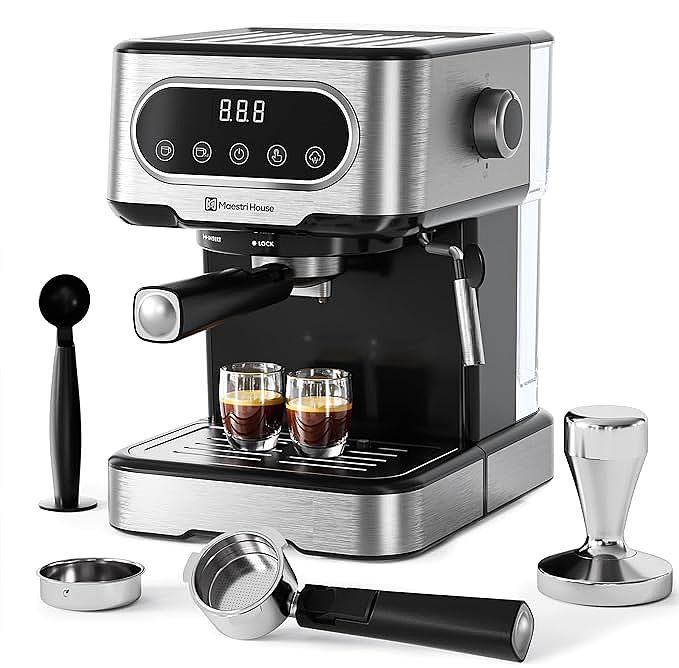
Historically, a home barista had to listen to the pump or watch the color of the stream to judge a shot. The TENKER CM5380 moves this data to a clear, intuitive control panel. With one-touch settings for single shots, double shots, cappuccinos, and lattes, the machine acts as an onboard computer, managing the complex ratios of water to coffee and steam to milk. This reduces the “cognitive load” of making coffee, allowing the user to enjoy the ritual without the stress of manual calibration.
However, the machine retains the element of “craft” by allowing manual adjustments to milk foam density. This hybrid approach—automatic for consistency, manual for personalization—respects the user’s desire to be an active participant in their own coffee journey. It provides the tools of a professional barista but packages them in a way that is accessible to a novice.
Material Integrity and Durability
The use of stainless steel in the construction of the TENKER CM5380 is a choice rooted in both aesthetics and thermodynamics. Stainless steel is resistant to the corrosive effects of mineral buildup and provides a stable thermal mass that helps maintain the temperature of the internal plumbing. From a design standpoint, it reflects the “stainless steel kitchen” aesthetic that has dominated modern interior design for decades, ensuring that the machine is a long-term fixture rather than a disposable gadget.
Conclusion: The New Domestic Coffee Frontier
As we look toward the future of home entertaining and lifestyle design, the boundaries between the professional café and the private home will continue to blur. The TENKER CM5380 20 Bar Espresso Machine is a testament to this convergence. By integrating high-pressure fluid dynamics, precise PID thermal control, and a sophisticated pre-infusion system, it demonstrates that the “God Shot”—that rare, perfect extraction of sweetness and body—is no longer an accident of fate.
Ultimately, great espresso is about the control of variables. When the machine handles the complex physics of pressure and temperature, it frees the human to focus on the sensory pleasure of the results. Whether it’s the rich, lingering taste of a pure espresso or the creamy indulgence of a latte, the home barista experience is being redefined by machines that treat coffee with the scientific respect it deserves. In this mastery of variables, we find a more rewarding, consistent, and luxurious daily ritual.