Thermal Shock and Saturated Matrices: Engineering Cold Infusions
Update on March 3, 2026, 5:30 p.m.
The intersection of extreme heat and rapid cooling presents one of the most volatile thermodynamic environments in the culinary world. Creating a chilled botanical infusion—whether from the roasted seeds of Coffea arabica or the dried leaves of Camellia sinensis—requires fundamentally contradictory physical states. High thermal energy is mandatory to act as a solvent and dissolve complex organic compounds, yet the final product must be consumed at a temperature near freezing without suffering from catastrophic dilution or chemical degradation. Solving this paradox requires moving beyond simple recipes and understanding the rigid laws of thermodynamics, fluid mechanics, and polymer science.

From Tudor’s Ice Blocks to Rapid Temperature Deltas
To understand the engineering behind modern rapid-chilled beverages, one must first look at the historical constraints of temperature manipulation. Prior to the 19th century, the concept of a sub-ambient infused beverage was an extreme luxury, restricted entirely by geographic proximity to frozen water. The global paradigm shifted when Frederic Tudor, the “Ice King,” utilized insulated ships to transport massive blocks of New England winter ice across the equator to the Caribbean and India. This logistical triumph introduced the concept of rapid thermal quenching to the global beverage lexicon.
However, the defining moment for cold botanical infusions occurred during the 1904 St. Louis World’s Fair. Faced with an oppressive heatwave, merchants realized that hot steeped tea—the standard of the era—was entirely unmarketable. The immediate solution was to pour the boiling infusion directly over large blocks of ice. While historically romanticized as a moment of pure inspiration, this act was essentially a brute-force application of thermodynamic quenching.
The underlying problem with this historical method, which persisted for over a century, is a profound lack of calibration. When a liquid at 200°F (93°C) is violently introduced to a solid at 32°F (0°C), the resulting phase change of the ice requires massive amounts of energy, known as the latent heat of fusion. While the liquid cools rapidly, the uncontrolled melting introduces excessive, unpredictable volumes of water, obliterating the carefully structured concentration of dissolved flavor compounds.
Why Does Ambient Cooling Destroy Delicate Aromatics?
A common, intuitive failure mode in domestic kitchens is the attempt to circumvent rapid ice dilution by brewing a standard hot beverage and allowing it to cool slowly in an ambient environment or a refrigerator. From a chemical perspective, this is the most destructive process a botanical infusion can undergo.
The flavor profile of coffee and tea relies on highly volatile organic compounds (VOCs). These lightweight molecules provide the floral, fruity, and complex aromatic notes that define premium ingredients. When a hot liquid is left exposed to the atmosphere for extended periods, these VOCs possess enough kinetic energy to continuously evaporate, literally vanishing into thin air.
Simultaneously, a slow cooling process invites severe oxidation. In tea, catechins slowly oxidize into theaflavins and thearubigins, mutating the flavor profile from bright and astringent to heavy and stale. As the temperature drops gradually, caffeine and complex plant tannins bind together, falling out of the solution to create a highly visible, muddy suspension known as “tea clouding.” In coffee, chlorogenic acids slowly decompose into quinic and caffeic acids, creating the harsh, sour, and aggressively bitter flavors universally associated with old, room-temperature coffee.
Rapid thermal quenching—or flash chilling—is therefore not merely a matter of temperature preference; it is a chemical necessity. By dropping the temperature of the liquid from 200°F to 40°F in a matter of seconds, the kinetic energy of the VOCs is instantly arrested, trapping them in the solution, while the rapid drop prevents the gradual binding of tannins that leads to clouding and stale acidity.

The Gentle Rainstorm Over the Cellulose Bed
Achieving a highly concentrated brew capable of surviving rapid ice dilution requires absolute mastery over the extraction mechanics. The primary antagonist in any percolation-based brewing system is a fluid dynamics phenomenon known as channeling.
When hot water is introduced to a dry bed of particulate matter (such as ground coffee or tea leaves), it encounters hydraulic resistance. Water, acting under the influence of gravity, will inherently seek the path of least resistance. If a brewer introduces a single, heavy stream of water into the center of the bed, the kinetic force of the stream displaces the particles, creating a vertical void or “channel.” Once this channel forms, the vast majority of the subsequent water volume will bypass the surrounding dry particulate, flowing exclusively through the newly bored hole.
The result of channeling is a disastrous dual-state extraction. The particles lining the channel are subjected to massive volumes of solvent, resulting in extreme over-extraction that strips bitter alkaloids and harsh tannins from the plant cellulose. Meanwhile, the surrounding bed remains under-extracted, contributing only sharp, sour surface acids.
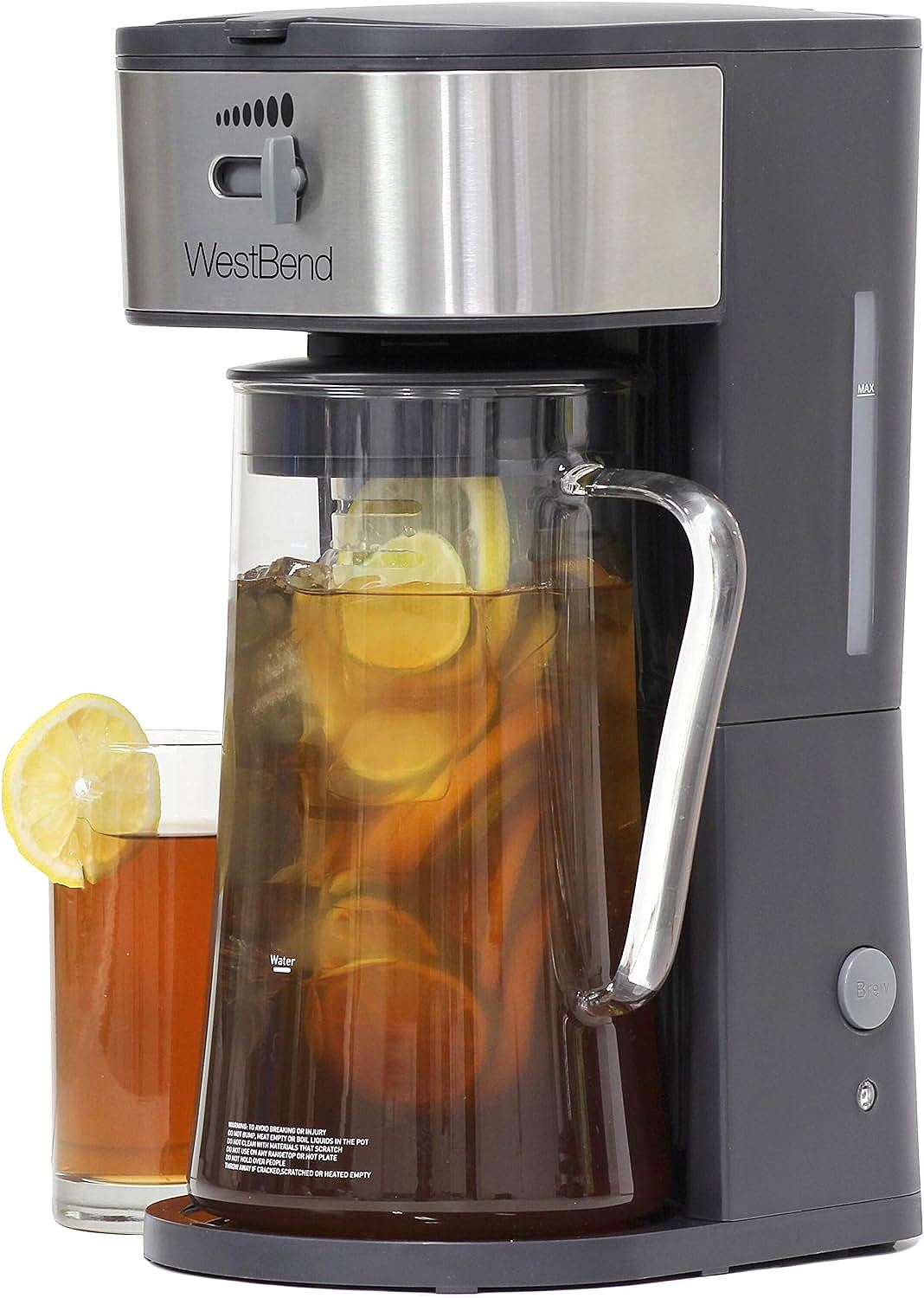
To engineer around this physical limitation, modern rapid-chilling devices implement wide-dispersion arrays. The OVENTE CMT215B utilizes a specialized showerhead mechanism to address this exact fluid dynamic challenge. Instead of a centralized spout, the showerhead fractures the incoming water volume into dozens of distinct, low-velocity droplets. By mimicking a gentle rainstorm, the apparatus ensures that the water saturates the entire surface area of the botanical bed simultaneously. This equalization of pressure across the particulate matrix prevents localized dry pockets and forces a uniform, laminar flow of solvent through the material, ensuring a balanced dissolution of compounds.
Dilution is a Feature, Not a Critical Bug
Mastering the rapid chill requires a counter-intuitive shift in mathematical thinking: the ice in the pitcher is not merely a cooling agent; it is exactly half of your brewing water.
To prevent the final beverage from tasting weak and watery, the initial hot extraction must be engineered as a hyper-concentrate. This is governed by managing the Total Dissolved Solids (TDS). A standard cup of hot coffee typically registers a TDS of around 1.25% to 1.45%. If this standard liquid is poured over ice, the latent heat required to melt the ice will add enough water to drop the TDS well below 0.8%, resulting in an unpalatable, watery fluid.
In a controlled flash-brew system, the operator restricts the input volume of hot solvent. By passing only half the standard volume of water through the showerhead and into the saturated bed, the resulting output liquid boasts a staggering TDS of nearly 3.0%. This dark, heavy concentrate is chemically too intense to consume hot. However, when it cascades directly out of the filter basket and impacts the solid ice waiting in the collection reservoir below, the mathematical equation balances itself perfectly. The heat energy of the 3.0% concentrate is entirely consumed in the act of melting the ice, instantly dropping the temperature to a stable 38°F (3°C) while diluting the TDS precisely back to the optimal 1.4% target.

Manipulating Contact Time for Variable Solutes
The complexity of a multi-beverage system lies in the fact that Camellia sinensis (tea) and Coffea arabica (coffee) feature wildly different biological architectures and dissolution rates.
Coffee grounds are rigid, fractured fragments of a roasted seed. The cellular walls are shattered, leaving the internal oils and acids exposed. Water passing over these jagged fragments extracts soluble material relatively quickly.
Conversely, loose-leaf tea consists of rolled, dehydrated, but largely intact leaves. When hot water impacts the tea, the leaves must first undergo osmotic hydration—they must absorb water, unroll, and expand before the internal flavor compounds can efficiently diffuse into the surrounding solvent. This biological reality dictates that tea generally requires a significantly longer contact time with the water than coffee to achieve a balanced extraction.
To accommodate both materials within a single apparatus, mechanical flow restriction is required. Devices utilize physical apertures to throttle the flow rate. In the OVENTE CMT215B, this is managed via a manual strength selector push lever. By sliding the lever, the operator physically reduces the diameter of the exit valve at the base of the filter basket.
Restricting the aperture alters the fundamental nature of the brew. A fully open valve allows for rapid percolation, ideal for coffee grounds that require swift extraction to prevent the over-dissolution of bitter tannins. A restricted valve shifts the environment toward a semi-immersion dynamic, causing the hot water to pool and stall within the basket. This extended dwell time provides the crucial minutes required for tightly rolled Oolong or dense herbal particulates to fully hydrate and release their heavier flavor molecules before the liquid escapes into the chilling reservoir.
When the Polycarbonate Pitcher Survives the Freeze
The final, and perhaps most critical, engineering hurdle in rapid-chill systems is the structural integrity of the collection vessel. Subjecting a container to the extreme thermal delta of holding 32°F (0°C) ice, followed immediately by an influx of 200°F (93°C) liquid, introduces severe mechanical stress.
Materials expand when heated and contract when cooled. This metric is known as the coefficient of thermal expansion. Standard silicate glass possesses a relatively high coefficient. When boiling liquid hits cold glass, the interior surface of the glass rapidly expands while the exterior surface, still exposed to the cold ambient air and ice, remains contracted. This differential expansion creates immense internal shear stress within the crystalline structure of the glass, leading to instantaneous and violent catastrophic failure—thermal shock shattering.
While specialized borosilicate glass mitigates this risk by utilizing boron to lower the coefficient of thermal expansion, it remains brittle and susceptible to impact damage. For large-capacity domestic applications, such as a 3-quart reservoir designed for frequent handling and refrigerator storage, modern polymer science provides a superior structural solution.
The implementation of high-grade, BPA-free plastics completely circumvents the failure mode of thermal shock. Amorphous polymers possess a high degree of molecular elasticity. When subjected to an extreme, localized temperature delta, the polymer chains are capable of flexing and absorbing the kinetic energy without fracturing. Furthermore, plastic acts as a superior thermal insulator compared to glass. It drastically slows the rate at which ambient heat from the room penetrates the vessel, preserving the integrity of the ice longer and ensuring the chilled beverage remains at a food-safe, refreshing temperature for hours after the brewing cycle has concluded.

The Intersection of Biology and Fluid Engineering
The production of a flawless iced botanical beverage is the culmination of precise environmental controls. It requires overriding the natural degradation pathways of volatile organic compounds through immediate kinetic arrest, mathematically calculating the exact phase-change dilution ratios of solid ice, and utilizing fluid dynamics to guarantee uniform cellular saturation.

By viewing the kitchen countertop not merely as a space for food preparation, but as a controlled laboratory environment, the operator transcends basic recipes. Whether manipulating the flow restriction to accommodate the osmotic expansion of tea leaves or utilizing showerhead arrays to prevent hydraulic channeling in coffee beds, the application of these physical principles ensures that every extraction yields a chemically stable, structurally sound, and perfectly chilled liquid matrix.