The Physics of Pressure: Decoding the "20 Bar" Standard in Modern Home Espresso
Update on Jan. 5, 2026, 7:32 p.m.
In the lexicon of coffee, few numbers are as debated, marketed, and misunderstood as the “bar.” Walk into a high-end specialty coffee shop, and you will likely find a machine set to a precise 9 bars of pressure. Browse the aisles of a home appliance store or an online marketplace, and you will be greeted by machines boasting “15 bars” or, increasingly, “20 bars” of professional pressure. This numerical discrepancy creates a chasm of confusion for the aspiring home barista. Is more better? Is the professional standard outdated? Or is there a fundamental difference in the engineering architecture of these machines?
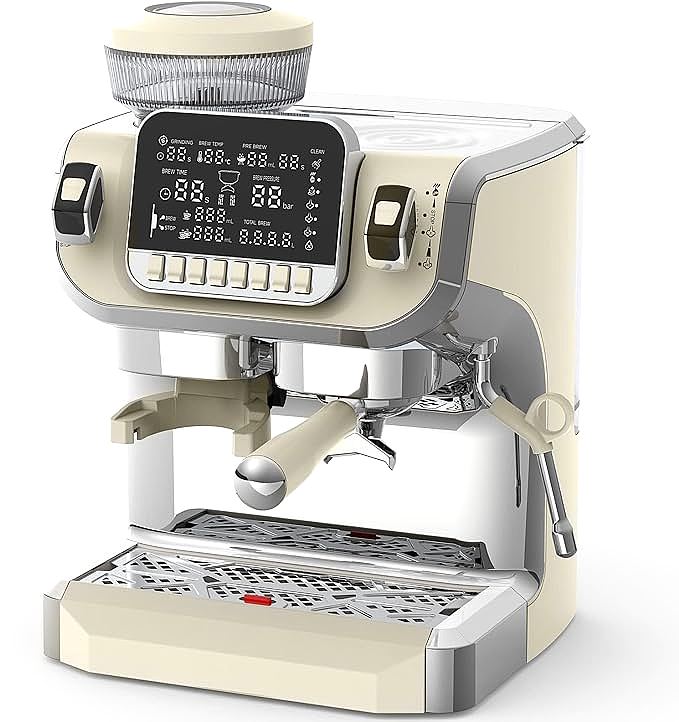
To answer these questions, we must look beyond the marketing brochures and delve into the principles of fluid dynamics and mechanical engineering. The Pokk 20 Bar Espresso Machine serves as an ideal case study for this exploration. By analyzing its specifications—a 20-bar pump, a 1350-watt heating system, and a pressurized brewing environment—we can uncover the distinct physical realities of consumer-grade espresso technology versus commercial equipment. This analysis is not just about one machine; it is about understanding the evolution of high-pressure extraction and how modern engineering has democratized the ability to create concentrated coffee emulsions at home.
The Historical Trajectory: From Steam to Springs to Vibration Pumps
The definition of espresso has always been tied to pressure. The earliest “espresso” machines in the early 20th century were essentially steam pressure cookers, generating only about 1.5 bars of pressure. The result was a brew that resembled strong, burnt drip coffee, lacking the signature crema. The paradigm shifted in 1948 when Achille Gaggia introduced the lever-piston machine. By pulling a spring-loaded lever, the barista could force water through the coffee puck at 8 to 10 bars. This quantum leap in pressure emulsified the insoluble oils in the coffee, creating the rich, golden foam we now know as crema.
Since then, “9 bars” became the industry benchmark. It was the sweet spot—enough force to extract oils and solids efficiently, but not so much that it compacted the coffee into an impermeable brick. Commercial machines achieve this using rotary pumps, which are large, expensive motors that deliver constant pressure regardless of flow rate.
The Rise of the Vibration Pump
The home revolution began with the miniaturization of this pressure source. Enter the vibration pump (or vibratory pump). Unlike the continuous rotation of a rotary pump, a vibration pump uses a piston that oscillates back and forth inside a coil, driven by an electromagnetic field. * The “Max Pressure” Rating: Vibration pumps are typically rated by their maximum static pressure—the pressure they can generate when the water flow is completely blocked (zero flow). For many ULKA-style pumps used in home machines, this theoretical maximum is often 15 or 20 bars. * The Characteristic Curve: However, pumps do not operate at zero flow. As soon as you open the valve and water starts flowing through the coffee, the pressure drops. The faster the flow, the lower the pressure.
Therefore, when a machine like the Pokk is labeled as a “20 Bar Espresso Machine,” it refers to the potential capability of the pump at its limit, not necessarily the constant pressure applied to the coffee during a standard extraction. This high ceiling is an engineering choice designed to ensure that, even with the inevitable pressure loss through the tubing, heating element, and puck resistance, there is always sufficient force to drive extraction. It provides a massive reservoir of potential energy to overcome the resistance of the coffee bed.

Fluid Dynamics in the Portafilter: Resistance and Flow
Understanding the pump is only half the equation. The other half is the resistance it meets. In fluid dynamics, pressure is created only when flow meets resistance. In an espresso machine, that resistance is the coffee puck.
$$P = Q \times R$$
(Where P is Pressure, Q is Flow Rate, and R is Resistance)
In a commercial setting with a professional grinder, the barista creates resistance by grinding the coffee incredibly fine and tamping it perfectly. The 9-bar rotary pump pushes against this precise resistance.
In a home setting, users often face challenges: grinders that produce inconsistent particle sizes, stale beans that offer less resistance, or imperfect tamping techniques. This is where the 20-bar pump architecture often pairs with pressurized portafilters (or dual-wall baskets) to create a fail-safe system.
The Mechanism of Artificial Resistance
While the Pokk machine includes standard filters, many machines in this category utilize a basket design that helps generate pressure mechanically. Even if the grind is too coarse (low natural resistance), the pump’s immense power forces the water through a tiny restricted exit hole in the basket. This restriction creates the necessary back-pressure to simulate a proper espresso extraction.
The 20-bar capability is crucial here. It ensures that the machine has enough muscle to push water through any restriction—whether it’s a tightly packed puck of fine coffee or a mechanical restrictor valve. It essentially brute-forces the extraction, guaranteeing a result that looks like espresso (with crema) even if the inputs (grind size, tamp) are less than perfect. This is a feature of forgiveness. It prioritizes the user’s success rate over the absolute purity of the traditional 9-bar parameter.
Crema Mechanics: High-Pressure Emulsification
One of the most immediate visual indicators of espresso quality is crema. Physically, crema is a foam of CO2 bubbles surrounded by water and emulsified coffee oils. The formation of this foam is directly related to pressure.
According to Henry’s Law, the solubility of a gas in a liquid is directly proportional to the pressure of that gas above the liquid.
1. High-Pressure Solution: Under the intense 15-20 bar pressure generated by the vibration pump, the carbon dioxide trapped in the roasted coffee beans dissolves into the water much more effectively than it would at lower pressures.
2. Depressurization: As the coffee exits the portafilter basket and falls into the cup, it returns to atmospheric pressure (1 bar).
3. Nucleation: The dissolved CO2 suddenly comes out of solution, forming millions of microscopic bubbles. These bubbles trap the suspended coffee oils, creating the thick, hazelnut-colored foam.
A 20-bar system is a crema generator. Because the initial pressure is so high, it forces a higher degree of gas saturation. This explains why users of machines like the Pokk often report “rich oil” or “thick crema” even when using pre-ground coffee (which typically has lost much of its CO2). The high pressure extracts every last bit of gas and oil, amplifying the visual appeal of the shot. While purists might argue that this “forced” crema is different from “natural” crema, for the home enthusiast, it provides the satisfying visual and textural experience of a café-quality drink without requiring a $2,000 grinder.

Thermodynamics of the 1350W Boiler
Pressure requires energy, but so does heat. The Pokk is equipped with a 1350-watt heating system. In the context of compact espresso machines, this typically indicates a thermoblock or thermocoil design rather than a traditional reservoir boiler.
Traditional boilers work like a kettle: they heat a large volume of water and keep it hot. This takes time (15-30 minutes) and energy.
Thermoblocks are on-demand water heaters. They consist of a metal block (usually aluminum or stainless steel) with a spiral water pipe embedded inside, alongside a powerful heating element.
* Power Density: 1350 watts is a significant amount of power for a small heating block. This high power-to-mass ratio allows the machine to heat cold water to brewing temperature (approx. 93°C) in seconds as it travels through the spiral pipe.
* Thermal Transfer Efficiency: The design relies on maximizing the surface area of the water pipe in contact with the heated metal. The turbulent flow of water inside the narrow pipe ensures rapid heat transfer.
This technology aligns perfectly with the modern “instant-on” lifestyle. Users do not want to wait 20 minutes for a boiler to soak. The trade-off, historically, has been temperature stability. However, with 1350 watts of headroom, the system can react quickly to the cooling effect of incoming cold water, maintaining a relatively stable brew temperature during the 25-40 second extraction window. This high wattage also translates to steam power. To produce dry steam for milk texturing, the system must vaporize water instantly. 1350 watts provides the thermal inertia needed to sustain a continuous jet of steam, essential for breaking down milk proteins and creating microfoam.
The Role of the Pressure Gauge: Visualizing the Invisible
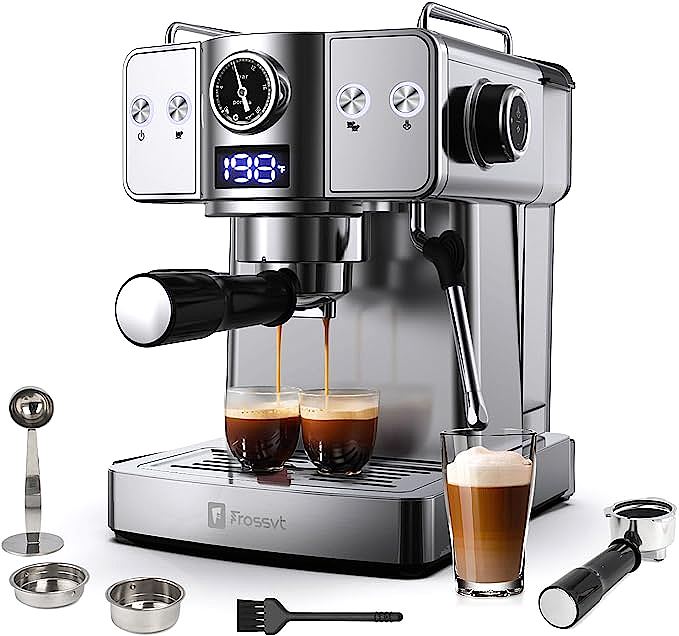
One of the standout features of the Pokk 20 Bar Espresso Machine is its built-in pressure gauge. In the world of professional coffee, this is a standard instrument; in the world of entry-level appliances, it is a rarity.
The pressure gauge is the dashboard of the extraction. It makes the invisible forces of fluid dynamics visible to the user.
* Diagnostics: If the needle barely moves, the resistance is too low (grind too coarse). If the needle spikes to the max and the coffee drips slowly, the resistance is too high (grind too fine).
* The Learning Loop: This visual feedback loop is critical for education. It transforms the user from a button-pusher into a barista. It allows them to understand the correlation between their inputs (tamp force, grind size) and the machine’s output.
Even if the machine is capable of 20 bars, the gauge might show that the actual extraction is happening at 10 or 12 bars. This transparency is valuable. It validates the physics we discussed earlier: the pump can do 20 bars, but the actual pressure is determined by the resistance of the coffee. Seeing this interplay helps demystify the process.
Conclusion: Engineering for the Home Environment
The Pokk 20 Bar Espresso Machine represents a specific philosophy of engineering designed for the home environment. It does not try to be a miniature replica of a commercial La Marzocco; instead, it adapts the principles of espresso to the constraints and needs of a domestic kitchen.
The use of a 20-bar vibration pump is not a gimmick; it is a solution to the problem of variable input quality. It provides the hydraulic headroom to ensure extraction happens under a wide range of conditions. The 1350W thermoblock solves the problem of time, offering convenience without sacrificing too much stability. And the inclusion of a pressure gauge bridges the gap between appliance and instrument.
By understanding the physics behind these numbers—why 20 bars is a capacity, not a constant; how resistance defines flow; and how high pressure aids emulsification—users can stop being intimidated by the specifications and start using the machine to its full potential. Espresso is science in a cup, and machines like the Pokk make that science accessible, forgiving, and ultimately, delicious.