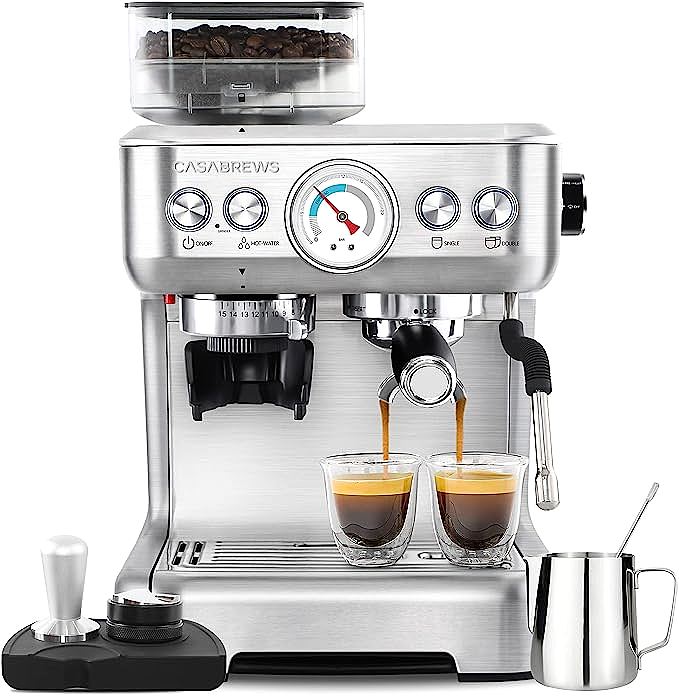
Engineering the Espresso Extraction: Thermodynamics and Fluid Mechanics at 15 Bars
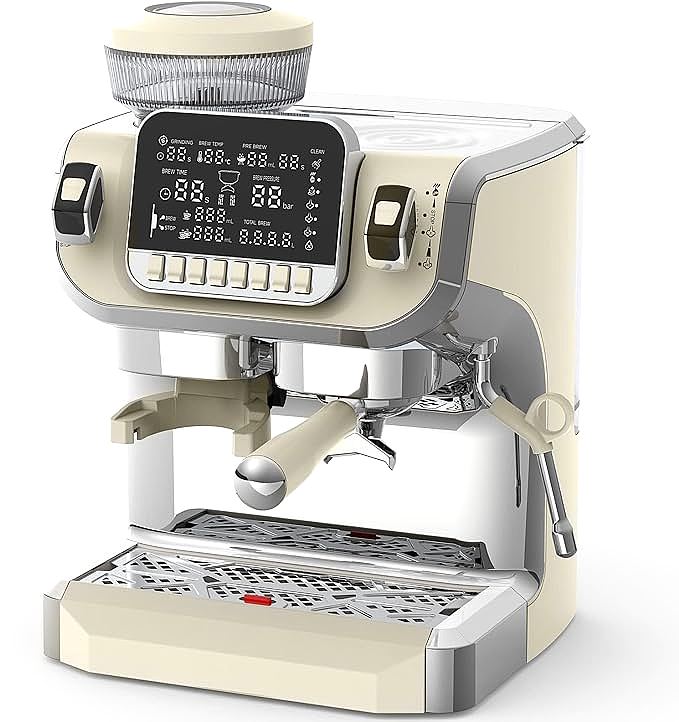
Mcilpoog TC520 15 bar Espresso Coffee Machine
The transformation of a roasted seed into a highly concentrated, polyphasic liquid is rarely recognized as an exercise in advanced fluid dynamics and thermodynamics. Yet, the creation of espresso is defined by the precise manipulation of heat, pressure, and particle geometry. When water at a specific thermal state is forced through a densely packed matrix of cellular structures, it triggers a cascade of chemical dissolutions and physical emulsions. When these variables are strictly controlled, the result is a stable, aromatic fluid. When they are not, the entire chemical architecture collapses.
This analysis deconstructs the mechanical systems required to achieve consistent extraction. By examining the integrated architecture of semi-automatic platforms—utilizing the Mcilpoog TC520 as a structural example—we can isolate the physical laws that dictate the success or failure of pressurized botanical extraction.

Why Rotary Blades Fail the Permeability Test
The foundational prerequisite for high-pressure extraction is not the water pump, but the physical reduction of the coffee bean. To extract soluble compounds uniformly, the solvent (water) requires uniform access to the internal chambers of the roasted cellulose.
A common, critical failure mode in domestic brewing occurs when users employ rotary blade grinders. A spinning blade induces blunt-force trauma, shattering the beans chaotically. The resulting particulate matrix is a random distribution of massive shards (boulders) and microscopic dust (fines). When placed under pressure, fluid mechanics dictate that water will seek the path of least hydraulic resistance. The water violently channels through the voids created by the boulders, entirely bypassing the dense internal cores, resulting in severe under-extraction. Simultaneously, the microscopic fines migrate downward, clogging the filter screen and causing the localized over-extraction of bitter tannins.
To prevent this hydraulic failure, the particulate must achieve a unimodal particle size distribution. The Mcilpoog TC520 integrates a conical burr mechanism to achieve this geometric uniformity. Instead of crushing, the conical burrs utilize sequential shearing. As the beans are pulled downward between a stationary outer ring and a rotating inner cone, the sharp teeth slice the brittle cellulose along natural fault lines. By adjusting the vertical distance between the burrs across 15 distinct settings, the operator dictates the absolute maximum size of the resulting particle. This creates a uniform, predictable porous medium, ensuring that the subsequent fluid flow permeates the entire bed evenly, rather than channeling through localized structural weaknesses.
The Mathematics of Proportional-Integral-Derivative Control
Once the physical matrix is established, the application of thermal energy determines which chemical compounds are dissolved. The solubility of organic fruit acids, complex sugars, and heavy alkaloids varies drastically with temperature. The scientifically established target window for optimal solid-liquid extraction is remarkably narrow: between 195°F and 205°F (90°C to 96°C).
Traditional domestic boilers rely on simple bi-metallic thermostats. These components operate on a binary logic loop: when the temperature drops below a threshold, the heating element fires at 100% capacity; when it exceeds the threshold, the element shuts off entirely. This binary approach creates a massive thermal sine wave. If an extraction is initiated at the trough of the wave, the solvent lacks the activation energy to dissolve complex carbohydrates, yielding a sour fluid. If initiated at the peak, the excess kinetic energy destroys the delicate volatile aromatic compounds (VOCs) and extracts harsh, dry tannins.
To flatten this thermal wave, advanced extraction platforms implement a Proportional-Integral-Derivative (PID) controller. A PID algorithm does not operate on binary logic. Instead, it continuously samples the water temperature via thermistors and calculates the exact amount of energy required to maintain a perfectly flat thermal plateau.
- Proportional: Calculates the current error (how far the temperature is from the target) and applies a proportional amount of power.
- Integral: Examines historical data, calculating the accumulation of past errors to eliminate residual, steady-state drift.
- Derivative: Predicts future temperature trends based on the current rate of change, reducing power before the target is reached to prevent overshooting.
By utilizing a PID controller, devices like the TC520 lock the solvent temperature within fractions of a degree of the target. This ensures that the water striking the coffee matrix possesses the exact kinetic energy required to dissolve the desirable sugars and lipids, while leaving the heavier, bitter alkaloids locked within the cellulose structure.

Beating the Hydraulic Wall with 15 Bars of Force
The introduction of hot water to a tightly compacted, uniform bed of coffee creates a massive physical barrier. The flow of fluid through this porous medium is governed by Darcy's Law. To achieve the specific volumetric flow rate necessary for an optimal 25-to-30-second extraction, the pressure drop across the bed must be massive.
The industry standard for this pressure differential is 9 bars (approximately 130 psi). However, the internal architecture of domestic vibratory pumps is engineered with significant overhead. The "15-bar" specification commonly found on machines like the Mcilpoog TC520 refers to the absolute maximum static pressure the pump can generate in a completely blocked system.
This overhead is a mechanical necessity. When the electromagnetic coil within the pump cycles, driving the piston and forcing water into the piping, the fluid encounters immediate resistance. Friction within the internal valves, the thermal block, and the dispersion screen all cause a drop in dynamic pressure. By engineering the pump to output a maximum of 15 bars, the system ensures it possesses enough kinetic overhead to push through the internal resistance and deliver a stable, continuous 9 bars of force directly to the surface of the coffee puck.
This extreme pressure is responsible for the creation of crema. During roasting, massive volumes of carbon dioxide ($CO_2$) are trapped within the bean. Under 9 bars of force, Henry's Law dictates that this $CO_2$ is violently forced into an aqueous solution with the brewing water. As the liquid exits the 58mm commercial-style portafilter and drops into standard atmospheric pressure, it becomes supersaturated. The $CO_2$ rapidly exsolves, nucleating into millions of microscopic bubbles. The high pressure simultaneously shears the coffee's insoluble lipids into tiny droplets, which migrate to the gas-liquid interface, coating the bubbles and stabilizing them into a complex, polyphasic emulsion.
Avoiding Thermal Collapse During Steam Production
The physical demands of liquid extraction and vapor production are diametrically opposed. Brewing requires water stabilized perfectly at 200°F (93°C). Steaming milk requires water superheated well beyond its boiling point, typically around 260°F (126°C), to generate sustained, high-velocity vapor.
In single-boiler architectures, these contradictory requirements create a severe workflow bottleneck. After brewing espresso, the operator must wait for the boiler to superheat before steam can be generated. Once steaming is complete, the entire thermal block must be artificially cooled (purged) before another espresso can be extracted, lest the superheated water scorch the next batch of grounds.
To bypass this thermal traffic jam, complex systems utilize parallel infrastructure. The dual water pump and dual boiler architecture found in the TC520 physically separates the two processes. One dedicated thermoblock and pump are algorithmically locked to the 200°F brewing parameter via the PID controller. A completely separate, parallel heating circuit and pump are dedicated exclusively to generating the 260°F steam necessary for the frothing wand. This parallel engineering allows the operator to subject the coffee matrix to high-pressure solvent simultaneously while initiating the thermodynamic phase change required to denature milk proteins, eliminating thermal lag and preserving the integrity of the VOCs in the extracted espresso.

The Unseen Danger of Mineral Calcification
Regardless of the sophistication of the PID algorithms or the maximum output of the vibratory pumps, all extraction systems share a common, catastrophic vulnerability: geological accumulation.
The solvent used in domestic brewing—municipal tap water—carries a payload of dissolved minerals, primarily calcium and magnesium bicarbonates. When this fluid is subjected to the intense, localized heat of the internal boilers, a chemical precipitation reaction is forced. The soluble bicarbonates break down and precipitate out of the liquid as insoluble calcium carbonate ($CaCO_3$), manifesting as a hard, chalky crust known as limescale.
Limescale is a formidable thermal insulator. As it coats the interior walls of the thermoblocks, it drastically reduces the coefficient of heat transfer. The 1000-watt heating elements will continue to draw power, but the thermal energy cannot efficiently penetrate the scale barrier. The PID thermistors, now insulated by the scale, misread the fluid temperature, causing the system to continuously under-heat the solvent. Left unchecked, the scaling will constrict internal tubing, artificially raising back-pressure, and eventually causing the vibratory pump to stall and burn out.
Preventing this failure mode requires regular chemical intervention. The automated descaling reminders integrated into modern digital displays are not mere suggestions; they are critical maintenance alerts. The introduction of weak acids—such as citric acid or specialized commercial descalers—is required to chemically dissolve the calcium carbonate matrix. This scheduled chemical flushing is the only method to ensure that the delicate fluid dynamics and strict thermal profiles engineered into the device remain uncompromised by the inevitable accumulation of geological deposits.

Mastering the extraction process requires abandoning the illusion of simple automation. By understanding the precise mathematical relationships between particulate geometry, PID thermal regulation, and high-pressure fluid dynamics, the operator ceases to be a passive consumer of a beverage. Instead, they become an active manager of a highly complex, beautifully tuned chemical reaction, capable of manipulating the fundamental building blocks of the botanical matrix.
Mcilpoog TC520 15 bar Espresso Coffee Machine
Related Essays
Vaundra EM3105: Your Compact 20-Bar Espresso Machine for Cafe-Quality Coffee at Home

Extracting Solubles Under Force: The Thermodynamics of Domestic Brewing
CASABREWS 3700 ESSENTIAL 20 Bar Espresso Coffee Machine: A Compact and Powerful Espresso Machine for Home Baristas
GE Profile Espresso Machine: Brewing Smart, Brewing Better Coffee at Home

MR MIRYE RZ2-EM01-US Espresso Machine: Unlock the Science of Perfect Espresso
Laekerrt CMEP01 20 Bar Espresso Machine: Barista-Quality Coffee at Home

CASABREWS CM7036E Espresso Machine: Brewing Science in Every Cup
SHARDOR CJ-265EB Espresso Machine: Your Gateway to Barista-Quality Coffee at Home
ICUIRE CM3080 Espresso Machine: The Science of 20 Bar Pressure for Home Baristas