WOLF GOURMET WGCM100S Programmable Coffee Maker: Brewing Science for the Perfect Cup
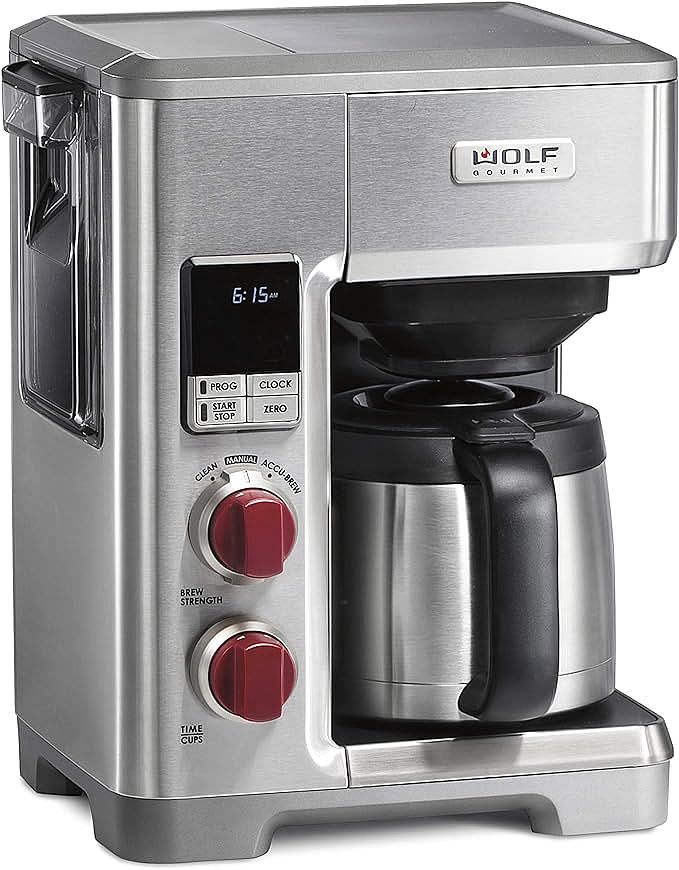
WOLF GOURMET WGCM100S Programmable Coffee Maker
There’s a ghost that haunts our kitchens. It’s a fickle, capricious spirit, and it lives in the space between the coffee scoop and the cup. One morning, it blesses you with a sublime brew—a cup so perfectly balanced, so rich with nuanced notes of chocolate, citrus, and caramel, that it recalibrates your entire day. You take a mental snapshot, memorizing every step, vowing to replicate it.
The next day, following the exact same ritual, you are met with a thin, sour imposter. Or worse, a bitter, astringent brute. The ghost has vanished. Perfection, it seems, is fleeting; a beautiful accident you can’t recreate on command.
But what if it isn’t an accident? What if that perfect cup wasn’t the result of luck, but the fleeting moment when, by sheer chance, you satisfied a series of exacting chemical and physical laws? The inconsistency that plagues our morning ritual isn’t the work of a ghost, but a battle against the fundamental forces of the universe. And winning that battle, consistently, is one of the most fascinating challenges in everyday science.

The Flavor Code Locked Within the Bean
To understand the challenge, we must first appreciate the prize. A roasted coffee bean is a miracle of complexity, a tiny, fragrant capsule holding hundreds of flavor and aroma compounds. It’s a chemical library storing the story of its soil, its altitude, and the transformative fire of the roaster. The act of brewing is not simply adding water; it is a delicate process of chemical extraction. Water, the universal solvent, is the key, sent in to unlock this library and carry its stories to your cup.
This process is a conversation between molecules. The water molecules, energized by heat, knock against the solid coffee grounds, persuading soluble compounds to leap out and dissolve. But not all compounds are equally willing.
The first to dissolve are the bright, fruity acids and some salts. Next come the sugars and oils, which contribute to sweetness, body, and those deep, caramelized notes. Finally, if the conversation goes on for too long, the water starts to extract the heavy, unpleasant-tasting plant fibers and bitter organic compounds.
The perfect cup is a perfectly timed conversation. It’s a brew that extracts enough of the acids and a generous amount of the sugars and oils to create a balanced, complex flavor, but stops just before the undesirable bitters come out to play. This is what baristas call the “sweet spot” of extraction. And achieving it depends on taming a handful of tyrannical variables.
The Tyranny of Imprecision and the Weight of Truth
The first and most common culprit for our inconsistent coffee is the teaspoon or scoop. We treat it as a reliable unit of measurement, but in the world of coffee, it’s a tool of chaos. Coffee beans are not uniform. Their density varies dramatically depending on the bean’s origin, its varietal, and most importantly, its roast level. A dark, oily roast is significantly less dense than a light, bright one. A scoop of dark roast might weigh 6 grams, while the same volume of light roast could be 9 grams—a 50% difference in the actual amount of coffee substance.
This is the difference between a balanced brew and a weak, sour one. In science, and in coffee, consistency begins with accurate measurement. The only reliable way to measure a solid is by its mass, not its volume. This is why you see serious baristas using digital scales, weighing their beans to a tenth of a gram. They are not being pretentious; they are being scientific. They are controlling their first, most critical variable.
This principle is so fundamental that modern engineering has begun to build the solution directly into the machine. Consider an appliance like the Wolf Gourmet coffee system. Its most significant feature isn’t a fancy setting, but something far more elemental: an integrated gravimetric scale in the brew drawer. The machine doesn’t ask you for scoops; it asks for a specific number of cups and a desired strength. It then guides you to add coffee grounds until a precise, calculated weight is reached. This isn't just a convenience; it's a fundamental shift from volumetric guesswork to gravimetric certainty. It’s the first step in banishing the ghost from the machine.
The Crucible of Temperature
Once you have the right amount of coffee, you must engage it with water at the right temperature. This is the second tyrant. According to the Specialty Coffee Association (SCA), the ideal temperature window for coffee extraction is remarkably narrow: 195°F to 205°F (90.5°C to 96°C).
Why so specific? It comes down to the physics of solubility. Temperature is a measure of kinetic energy—how fast molecules are moving. Hotter water has more energetic molecules, which are more effective at breaking apart the bonds holding the flavor compounds within the coffee grounds.
If the water is too cool (below 195°F), it lacks the energy to properly dissolve the desirable sugars and oils. It will mostly pull out the easily-dissolved acids, resulting in a cup that is disappointingly thin and sour. This is "under-extraction."
If the water is too hot (above 205°F), it becomes too aggressive. It extracts everything too quickly, including those undesirable bitter compounds from the plant fibers. It can even cause delicate aromatic oils to vaporize before they ever reach the cup, leading to a flat, harsh brew. This is "over-extraction."
Most basic home coffee makers fail this test spectacularly. They often use a simple "boil and drip" mechanism with poor insulation, causing the water temperature to swing wildly throughout the brew cycle. The machine may start too hot and finish too cool. This is why a precision-engineered coffee maker is built around its heating element, designed to rapidly reach and, more importantly, sustain the water temperature within that sacred ten-degree window from the first drop to the last.
Cheating Thermodynamics: The Battle Against Cold
Let's say you've done everything right. You've weighed your beans and brewed with water at the perfect temperature. You have captured lightning in a bottle—a carafe of perfect coffee. Now, a new enemy emerges: time, and its accomplice, thermodynamics.
The second law of thermodynamics dictates that heat will always move from a hotter object to a cooler one until thermal equilibrium is reached. In other words, your coffee will get cold. The most common "solution" to this problem—the glass carafe on a hot plate—is a travesty against coffee chemistry. That hot plate isn't just keeping your coffee warm; it's continuously cooking it. It subjects the delicate, balanced brew to a prolonged, low-grade heat that degrades the very compounds you worked so hard to extract. Sugars caramelize further into bitterness, and delicate acids break down, leaving you with that familiar burnt, stewed taste.
The elegant solution to this problem was invented not for coffee, but for cryogenics. In the 1890s, the Scottish physicist Sir James Dewar developed the vacuum flask (now often called a Dewar flask) to store super-cooled liquid gases for his experiments. He created a bottle with an inner and outer wall, and in the space between, he pumped out the air to create a vacuum.
This simple design was a masterpiece of physics, designed to thwart the three ways heat is transferred:
- Conduction: Heat transfer through direct contact. The vacuum largely prevents this, as there are very few molecules to pass the heat along.
- Convection: Heat transfer through the movement of fluids (like air). The vacuum eliminates this entirely.
- Radiation: Heat transfer via electromagnetic waves (like the heat from the sun). Dewar coated the inner surfaces with silver, creating a mirror that reflected thermal radiation back into the liquid.
The modern thermal carafe is a direct descendant of Dewar’s scientific instrument. By using this technology, you are not fighting the cooling process with more heat; you are simply slowing it down dramatically. It preserves the coffee's integrity, keeping it hot for hours without altering its chemical makeup. It's a testament to how a solution from a cold physics lab can perfectly preserve the warmth and soul of our morning cup.
Of course, engineering in the real world is about trade-offs. The complex lid mechanisms required to seal in that heat can sometimes, as reviewers of even high-end machines note, make for a slow or awkward pour. This isn't a simple flaw; it's a physical compromise—a negotiation between perfect heat retention and perfect fluid dynamics.
Capturing the Ghost
So, the ghost in our kitchen is real, but it is not a spirit. It is the embodiment of uncontrolled variables—in measurement, temperature, and time. To brew a consistently perfect cup of coffee is to perform a small, repeatable scientific experiment.
This is the beauty of a well-designed tool. It doesn't remove the art or the ritual; it removes the frustrating randomness. An appliance engineered with a deep understanding of the underlying science—one that weighs its inputs, controls its temperature, and preserves its output—is not a replacement for a skilled barista. It is, rather, a tool that allows any of us to become one in our own homes. It handles the unforgiving science, so we can focus on the art: selecting a beautiful, freshly roasted bean and anticipating the moment its story is finally unlocked.
This quest for repeatable perfection is not unique to coffee. It’s a fundamentally human endeavor, visible in the chef who codifies a recipe, the musician who practices scales, and the engineer who calibrates a machine. It is the desire to capture a fleeting moment of beauty and make it something we can return to, time and time again. And it is a wonderful thing that sometimes, this grand pursuit can be found in something as simple, and as essential, as the morning’s first cup.
WOLF GOURMET WGCM100S Programmable Coffee Maker
Related Essays
Capresso 465 CoffeeTeam TS: The Science of Fresh Coffee with a Burr Grinder & Thermal Carafe
Boly 8 Cup Coffee Maker: Programmable, Thermal Carafe, Perfect Brew Every Time

Mr. Coffee 2131962 Coffee Maker: Brewing Science and Delicious Coffee
Hamilton Beach 46899A Programmable Coffee Maker: Brew Perfect Coffee Every Time

KRUPS KM209D50: Keep Your Coffee Hotter for Longer with Thermal Technology
Hamilton Beach 46899R: Brewing Science for Your Perfect Cup
BLACK+DECKER CM2046S: Brewing Science for Your Perfect Cup
Capresso ST300 Coffee Maker: Brewing Science for the Perfect Cup
How a Programmable Drip Coffee Maker Thermal Carafe Delivers Better Coffee