The Metric of Consistency: Gravimetric Dosing and Control Engineering in the Baratza Forte AP
Update on Jan. 6, 2026, 5:50 a.m.
In the hierarchy of coffee variables, consistency is king. A perfect shot of espresso is a fleeting miracle; reproducing that shot ten times in a row is engineering. For the commercial barista, this reproducibility is a job requirement. For the home enthusiast, it is the ultimate pursuit.
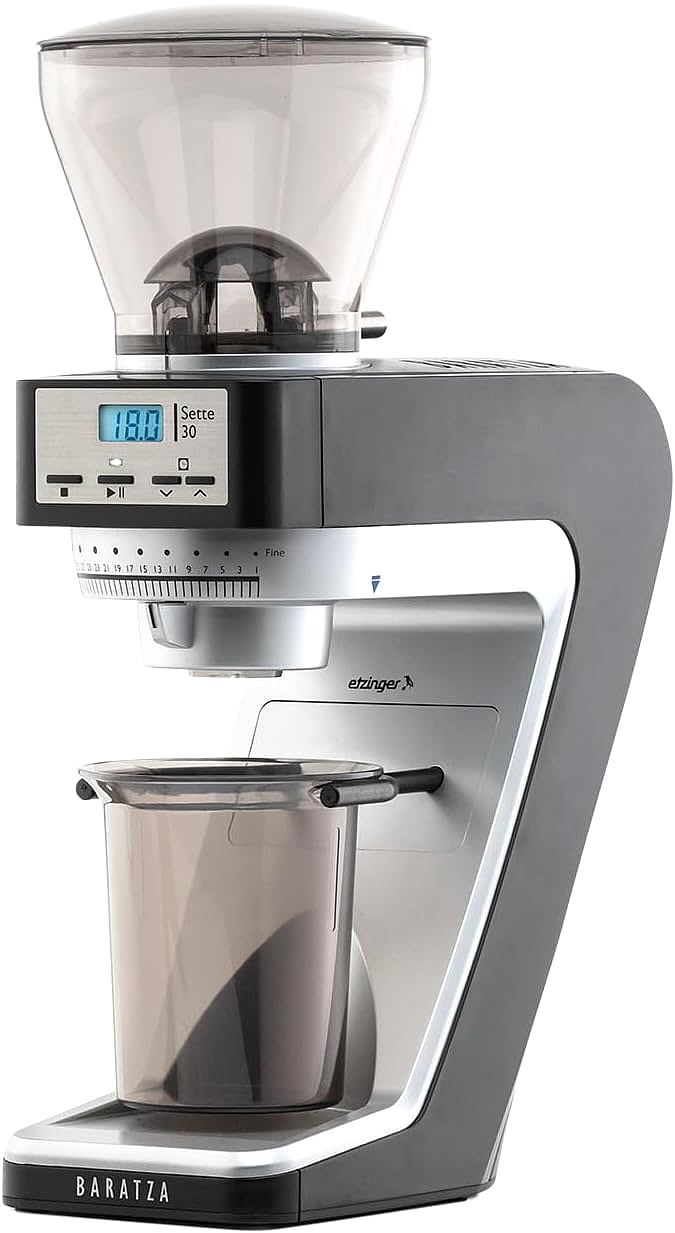
The Baratza Forte AP (All-Purpose) is designed to solve the variable of dosing through a technology that was once exclusive to high-end commercial weigh-batchers: Gravimetric Dosing (Grinding by Weight).
This article deconstructs the control engineering behind the Forte AP. We will explore why time-based grinding is inherently flawed, how the integration of Acaia scale technology creates a closed-loop control system, and how this machine bridges the gap between the art of espresso and the science of metrology.
The Flaw of Time: Why Seconds Don’t Equal Grams
Most grinders operate on a Time-Based system. You set the timer for 10 seconds, and the motor runs for 10 seconds.
However, this assumes that the Flow Rate of the beans through the burrs is constant. It is not.
* Bean Density: A light roast is denser and harder than a dark roast. It grinds slower. 10 seconds of light roast yields less coffee than 10 seconds of dark roast.
* Hopper Load: When the hopper is full, the weight of the beans pushes down on the burrs (head pressure), increasing the feed rate. As the hopper empties, the pressure drops, and the grind rate slows down.
* Grind Setting: Finer settings restrict flow; coarser settings accelerate it.
Because of these variables, a timer can never guarantee a consistent Dose Weight. And since the brew ratio (coffee weight to water weight) is the fundamental formula of espresso, a variable dose leads to a variable taste.
Gravimetric Dosing: The Closed-Loop Solution
The Forte AP solves this by ignoring time and focusing on mass. It features a built-in electronic load cell (scale).
This creates a Closed-Loop Control System:
1. Input: User sets target weight (e.g., 18.0g).
2. Process: Motor spins, grinding beans into the bin sitting on the load cell.
3. Feedback: The load cell sends real-time weight data to the controller at a high frequency (likely 20-50Hz).
4. Correction: The controller monitors the rate of change ($dWeight/dt$). As the weight approaches the target, the controller predicts the motor’s stopping distance (inertia) and cuts power at the precise moment to land on 18.0g.
This technology allows the Forte AP to achieve a dosing accuracy of +/- 0.2g, regardless of bean density, hopper level, or grind setting. It transforms the grinder from a dumb mechanical device into a smart, adaptive instrument. * Workflow Implication: You no longer need to weigh your portafilter before and after grinding. You simply trust the machine. This streamlines the workflow significantly, especially in a busy environment.

The Touch Interface: Digital Precision
The interface of the Forte AP is a Touchscreen. In an industrial environment, touchscreens can be controversial (wet hands, durability). However, Baratza uses a high-quality capacitive screen that is responsive and intuitive. * Programmability: The machine allows you to save three presets for Weight and three presets for Time. This is crucial for the “All-Purpose” designation. You can have Preset 1 for Espresso (18g), Preset 2 for V60 (20g), and Preset 3 for Batch Brew (60g). * The “Smart” Calibration: The software includes a “learning” algorithm. If the grinder overshoots the target weight (e.g., hits 18.5g instead of 18.0g) due to a change in beans, it registers this error. On the next grind, it adjusts the motor cutoff point earlier to compensate. This adaptive logic ensures that the machine gets more accurate the more you use it.
The Portafilter Holder vs. The Bin
The Forte AP comes with two receptacles: a Grounds Bin and a Portafilter Holder.
* The Bin: This sits on the load cell. It is used for weight-based grinding. It is ideal for brew methods like pour-over or batch brew where you need a larger quantity of coffee.
* The Portafilter Holder: This replaces the bin. Crucially, you cannot grind by weight directly into the portafilter on the standard AP model (unlike the Forte BG or Sette 270Wi). The load cell is in the base, not the fork. Therefore, for espresso, the user typically switches to Time-Based Grinding.
* Workflow Hack: Many users grind by weight into the bin (for accuracy) and then transfer to the portafilter. Or, they “dial in” the time needed to get 18g and use the time setting for speed.
This distinction is important. The “Weight” feature is primarily for the bin, making the AP a hybrid master: weight-accurate for filter coffee, time-efficient for espresso.

Conclusion: The Data-Driven Kitchen
The Baratza Forte AP brings the rigor of the laboratory into the kitchen. By integrating metrology (the science of measurement) with mechanics, it removes the guesswork from dosing.
For the user who keeps a brewing log, who measures TDS (Total Dissolved Solids), and who pursues the “God Shot,” the Forte AP is the ultimate tool. It doesn’t just grind coffee; it quantifies it.