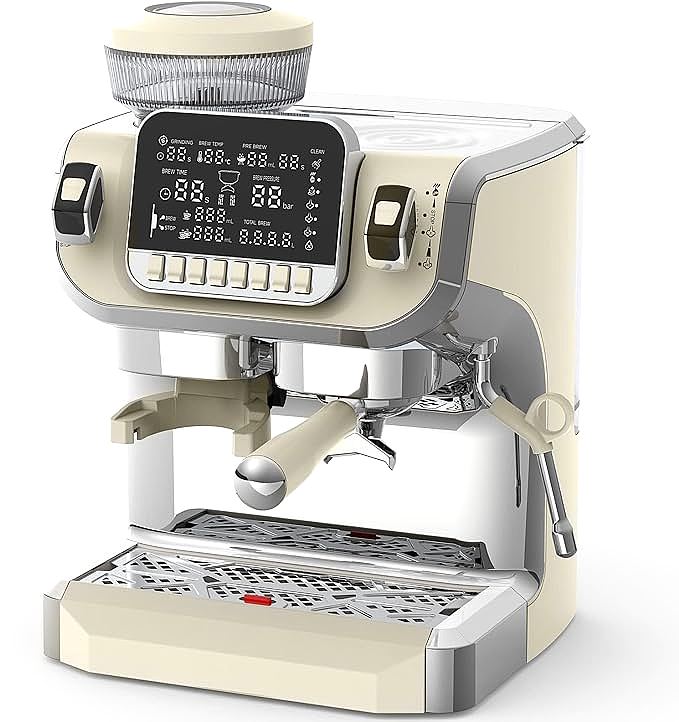
The Espresso Simulator: Hacking Café Quality with the Gevi GECME403L-U
Update on Nov. 25, 2025, 5:25 p.m.
There is a common misconception in the world of home coffee: that you need to spend thousands of dollars to get a “real” espresso. While high-end machines offer consistency and automation, the fundamental physics of coffee extraction remain the same whether you spend $100 or $10,000.
You need heat. You need pressure. And most importantly, you need technique.
The Gevi GECME403L-U is often categorized simply as a “budget-friendly” appliance. As your mentor in coffee science, I want you to reframe that view. Think of this machine not as a compromise, but as a Simulator. Because it relies on you to manage the variables, it is the perfect laboratory to learn the craft.
Today, we aren’t just going to review features; we are going to reverse-engineer them to teach you the science of the barista.

The Physics of Pressure: 15 Bars vs. The “Sweet Spot”
You will see “15 Bar Pump” plastered on the box of almost every entry-level machine, including the Gevi. But here is the industry secret: Espresso is best brewed at 9 Bars.
So, why the extra power?
Think of the Gevi’s 15-bar pump like a car engine capable of high speeds. It provides the potential force. However, the actual pressure in the brew basket is determined by Resistance.
* The Variable You Control: Resistance is created by your coffee grounds. If you use a coarse grind, the water rushes through (low pressure, sour taste). If you use a fine grind and tamp hard, you create resistance.
* The Lesson: The Gevi gives you the headroom to experiment. Your goal is to dial in your grind size so that the machine has to work against the puck, bringing that 15-bar potential down to a steady, syrupy 9-bar extraction. Don’t just press the button; watch the flow. It should look like warm honey, not rushing water.
Thermal Management: Mastering “Temperature Surfing”
The Gevi GECME403L-U features a Dual Temperature Control system. This is crucial because espresso and steam require vastly different thermal energy states. * Brewing: Needs approx. 195°F - 205°F. * Steaming: Needs approx. 250°F+.
Here is where the “Simulator” aspect kicks in. Single-boiler machines like this can hold heat, but they can’t cool down instantly.
* The Challenge: If you steam your milk first, the boiler gets superheated. If you immediately try to pull a shot, you will burn the coffee with boiling water/steam, resulting in a bitter, ashy taste.
* The Pro Hack (Temperature Surfing): The manual might mention “flashing lights,” but let’s decode that. If the lights flash rapidly after steaming, the machine is telling you “I’m too hot!”
* The Solution: Turn the knob to the hot water setting or run a “blank shot” (water only) through the group head. This purges the superheated water and introduces fresh, cool water from the tank, bringing the temperature back down to the brewing sweet spot. Mastering this thermal cycle is what separates a novice from a home barista.

Fluid Dynamics: The Art of Microfoam
Many beginners struggle with the steam wand, producing large, soapy bubbles instead of the silky microfoam needed for latte art.
The Gevi uses a steam wand that rotates 360 degrees. This isn’t just for ergonomics; it’s for Vortex Creation.
To get café-quality milk, you need to create a whirlpool inside your pitcher.
1. The “Chirp”: Start with the tip of the wand just breaking the surface of the milk. You should hear a paper-tearing sound (tsst-tsst). This injects air. Do this for only 5-10 seconds.
2. The “Roll”: Submerge the wand slightly and tilt the pitcher. The goal is to get the milk spinning rapidly. This fluid dynamic force crushes the big bubbles into tiny, invisible micro-bubbles.
Crucial Tip: The Gevi’s steam is generated by a heating block. Before you put the wand in your milk, always purge it (turn it on into a damp cloth) for 3 seconds. This ejects any condensation (water) that would otherwise dilute your milk.

Materiality and Hygiene: The Stainless Steel Advantage
In the budget category, materials matter. The Gevi highlights its SUS304 Stainless Steel Nipple (the outlet where coffee exits).
Why does this specific alloy matter?
* Thermal Stability: Metal holds heat better than plastic. A hot outlet ensures your espresso doesn’t lose temperature as it falls into the cup.
* Flavor Purity: Plastic components, especially when heated, can sometimes impart a subtle chemical taste over time. Stainless steel is inert. It ensures that the only thing you taste is the bean.
Maintenance Note: Because this machine uses a smaller boiler/heating block, scale buildup (calcium from water) is its enemy. Scale acts as an insulator, confusing the temperature sensors. Regular descaling isn’t just cleaning; it’s calibrating your machine’s thermal accuracy.
Conclusion: Your Hands, Not the Machine
The Gevi GECME403L-U is a capable tool, but it is passive. It waits for your input.
It won’t grind the beans for you. It won’t tamp the puck for you. And that is its greatest strength.
By forcing you to manage the grind for pressure, manage the flush for temperature, and manage the vortex for texture, it teaches you the actual skills of coffee making. When you finally pull that perfect shot—rich, balanced, with a tiger-striped crema—you will know it wasn’t a microchip that did it. It was you.