When Your Kitchen Learns to Listen: The Hidden Engineering Behind Voice-Contr...

404
The alarm rings at 6:15 a.m. Your eyes are barely open. You shuffle toward the kitchen, muscle memory guiding you through the dark hallway, and speak a phrase into the silence: "Alexa, start the coffee maker." Somewhere between your nightstand and the counter, a chain of events unfolds that most people never think about. A microphone captures sound waves. A cloud server thousands of miles away deciphers intent. A Wi-Fi signal instructs a heating element to warm water. And within minutes, the aroma of brewed coffee fills the room.
This moment, repeated in households around the world every single morning, rests on a foundation of distributed computing, natural language processing, radio-frequency engineering, and interface design that most users never see. The Hamilton Beach 49350R Works with Alexa Smart Coffee Maker is one appliance that makes this possible, but the story here is not about a single product. It is about the invisible infrastructure that turns spoken words into boiling water, and why that matters for anyone trying to understand where home technology is headed.

The Distance Between a Voice Command and a Cup of Coffee
When you issue a voice command to a kitchen appliance, the process seems instantaneous. It is not. The path from speech to action involves at least four distinct computational stages, each with its own latency and failure points.
First, a microphone array in an Echo device or similar smart speaker samples ambient sound at approximately 16,000 times per second. This digital audio stream is compressed and sent over your home network to Amazon's Alexa Voice Service (AVS), hosted in data centers distributed across multiple geographic regions. AVS runs the audio through an automatic speech recognition (ASR) model that converts sound patterns into text. Then a natural language understanding (NLU) engine parses that text to identify two things: the user's intent ("turn on") and the target entity ("coffee maker").
Once intent and entity are resolved, AVS consults a device registry to determine which smart home endpoint corresponds to "coffee maker" in your account. It then sends a directive, a structured JSON payload, through an application programming interface (API) defined by the Alexa Skills Kit. This directive travels from the cloud back to your home network, where the coffee maker's Wi-Fi module receives it and triggers the relay that powers the heating element.
The total round-trip time, from voice capture to relay activation, typically falls between 1.5 and 3 seconds on a well-configured network. That feels fast. But within those seconds, data has traveled hundreds or thousands of miles, passed through speech models trained on billions of utterances, and been routed through at least three different software layers. The system works reliably precisely because each layer handles a narrow, well-defined responsibility.
Why 2.4 GHz Remains the Workhorse of Connected Appliances

If you have ever wondered why your smart coffee maker, smart plug, or connected thermometer connects to the 2.4 GHz Wi-Fi band rather than the faster 5 GHz band, the answer lies in physics, not cost-cutting.
Radio waves at lower frequencies have longer wavelengths, and longer wavelengths interact differently with physical obstacles. A 2.4 GHz signal (wavelength approximately 12.5 centimeters) penetrates drywall, wood, and glass far more effectively than a 5 GHz signal (wavelength approximately 6 centimeters). Kitchen appliances often sit in rooms with multiple walls between them and the nearest router, and they frequently operate near metal surfaces, microwaves, and refrigerators that reflect or absorb higher-frequency signals.
Additionally, most IoT devices transmit tiny amounts of data, a few kilobytes per command. The bandwidth advantage of 5 GHz (which can carry hundreds of megabits per second) provides no meaningful benefit for sending a JSON payload that reads {"command": "turnOn"}. What matters is range and reliability, and 2.4 GHz delivers both at a lower power draw, which matters for devices that spend most of their time idle and listening for a single instruction.
The trade-off is congestion. The 2.4 GHz band has only three non-overlapping channels in most regions, and it shares spectrum with Bluetooth, microwave ovens, and older cordless phones. Device manufacturers mitigate this through careful antenna design and firmware that scans for the least congested channel during initial setup.
What "Works with Alexa Certified" Actually Means
Amazon's "Works with Alexa" certification is not a marketing badge. It is a technical compliance program with measurable benchmarks. According to Amazon's developer documentation, certified devices must meet specific thresholds for command latency, command success rate, and offline behavior.
A certified coffee maker, for instance, must respond to a voice command within a defined time window. If AVS sends a "turn on" directive, the device must acknowledge receipt and execute the command within seconds, not minutes. The certification process also tests edge cases: what happens when the device loses Wi-Fi connectivity mid-command? Does it enter a safe state? Does it recover gracefully when the network returns?
This matters because the smart home market has no shortage of devices that claim Alexa compatibility but deliver erratic experiences. A non-certified device might respond to "turn on" but ignore "turn off," or it might work for three days and then require a factory reset. Certification exists to filter out those experiences. Amazon has a commercial incentive to do so: every frustrating smart home interaction erodes trust in the Alexa platform as a whole.

The certification also governs how the device describes itself to the Alexa platform. When you say "Alexa, discover devices," the coffee maker broadcasts a discovery payload that tells Alexa what it can do. This payload follows a standardized schema, known as an Alexa Smart Home Skill Interface, which defines capabilities like "powerController" (on/off) and "modeController" (brew strength). By conforming to this schema, the device becomes part of a shared language that thousands of other smart home devices also speak.
Routines: Where Voice Commands Become Behavioral Patterns
Single voice commands are useful. But the real architectural shift happens when you combine multiple commands into sequences triggered by a single event. Alexa Routines implement a logic model that software engineers will recognize: event-driven programming.
A routine consists of a trigger and one or more actions. The trigger can be a voice phrase ("Alexa, good morning"), a scheduled time (every weekday at 6:30 a.m.), a device state change (when the front door unlocks), or even a geographic condition (when you arrive home). The actions can include turning on devices, reading news briefings, adjusting thermostat settings, or sending notifications.
In the context of a connected kitchen, this means your morning coffee can become part of a larger sequence. You might configure a routine that, when triggered by the phrase "Alexa, start my day," turns on the coffee maker, reads the weather forecast, adjusts the kitchen lights to a warm setting, and begins playing a podcast. Each of these actions is an independent API call routed to a different device or service, but the routine orchestrator bundles them into a single user experience.
This architecture has implications that reach beyond the kitchen. The same event-driven model underpins industrial automation, server monitoring, and financial trading systems. The difference is that in a smart home, the "events" are human behaviors, spoken phrases, door openings, departures, arrivals, and the "actions" are physical changes to the environment. The kitchen becomes a small-scale programmable system, with the coffee maker as one of many addressable endpoints.
The Ergonomics of a Connected Appliance

Adding connectivity to an appliance changes the physical design problem in ways that are easy to overlook. A traditional coffee maker can be deep, because the user reaches over the top to pour water and load grounds. A connected coffee maker, however, often sits under kitchen cabinets. If the water reservoir is on the back, the user must pull the entire machine forward to fill it, negating the convenience that voice control was supposed to provide.
The front-fill water reservoir addresses this directly. By moving the water inlet to the front face of the machine, the user can fill the reservoir without moving the appliance or reaching behind it. Similarly, a swing-out brew basket allows the user to load coffee grounds from the front, without sliding the machine out from under the cabinets.
These are not glamorous design features. They are solutions to a spatial constraint that becomes apparent only when you think about how people actually use kitchen counters. Most kitchen counters are 25 inches deep. Upper cabinets hang 18 inches above the counter surface. A coffee maker that is 14 inches tall leaves only 4 inches of clearance between the top of the machine and the cabinet above. That is not enough space to comfortably pour water into a rear-mounted reservoir.
The design decision to front-load the reservoir and swing out the basket is, in engineering terms, a constraint-driven optimization. The constraints are: limited vertical clearance, fixed counter depth, and a user who may be operating the machine while half-awake. The solution prioritizes reachability over aesthetics, and in doing so, it illustrates a principle that applies to all connected devices: the physical interface must not work against the digital interface.
Certified for Humans: The Friction Hypothesis
Amazon's "Certified for Humans" program addresses a problem that the technology industry has struggled with for decades: the gap between what a device can do and what a typical user can figure out how to make it do.
The program's criteria focus on three attributes: struggle-free setup, tinker-free operation, and stress-free interaction. In practical terms, this means the device should connect to Wi-Fi without requiring the user to switch networks manually, it should maintain its connection without periodic re-pairing, and it should provide clear feedback when something goes wrong.
The Hamilton Beach 49350R carries this certification, which is relevant not because of the product itself but because of what the certification represents about technology adoption curves. Historically, complex devices required knowledgeable users. Early automobiles needed drivers who could adjust carburetors and change spark plugs. Early computers required users who understood command-line syntax. The smart home is undergoing a similar transition: the first wave of connected devices required users comfortable with port forwarding, static IP addresses, and firmware updates. The current wave, represented by programs like Certified for Humans, aims to make that expertise unnecessary.

This is a design philosophy with roots in cognitive psychology. The concept of "cognitive load," introduced by John Sweller in the 1980s, describes the amount of working memory required to complete a task. Every unnecessary step in a setup process, every ambiguous error message, every settings menu buried three layers deep, adds to that load. The Certified for Humans program is, at its core, an attempt to reduce cognitive load at the moment of first interaction with a device, because that is the moment when users decide whether a technology is worth the effort.
The Dependency You Do Not See
There is a trade-off inherent in cloud-dependent appliances that receives far less attention than it deserves. When your coffee maker requires a round-trip through Amazon's servers to execute a command, it depends on three things that you do not control: your internet connection, Amazon's service availability, and the continued support of the device's API integration.
If your internet goes down, voice commands stop working. The machine may still function manually, but the smart features become inert. If Amazon changes its smart home API, which has happened with platform updates, the manufacturer must issue a firmware update to maintain compatibility. If the manufacturer stops supporting the device, the cloud integration may degrade or disappear entirely.
This is not a hypothetical concern. The smart home industry has seen multiple instances of connected devices losing functionality after manufacturers discontinued support. The pattern is consistent: a company launches a connected product, supports it for a few years, then shifts resources to newer models, leaving older devices with diminishing capabilities.
For a coffee maker, the stakes are low. You lose voice control; you can still press a button. But the architectural pattern, cloud-dependent control with local fallback, is the same one used in smart locks, smart thermostats, and security cameras, where the consequences of lost connectivity are considerably higher. Understanding this pattern through a kitchen appliance provides a low-stakes way to think about it.
Where the Signal Meets the Stove
The voice-controlled coffee maker sits at the intersection of several disciplines that rarely share a classroom. Speech recognition draws on linguistics and statistical modeling. Wi-Fi connectivity depends on electromagnetic physics and network engineering. Routine automation applies event-driven programming from software architecture. Physical design solves ergonomic constraints from industrial engineering. And the Certified for Humans philosophy borrows from cognitive psychology's models of attention and task complexity.
None of these fields were developed with coffee in mind. Speech recognition was pioneered for telephone networks and military applications. Wi-Fi grew out of spread-spectrum radio technology originally developed to resist jamming. Event-driven programming emerged from operating system design. Cognitive load theory was developed to improve educational materials. Yet here they converge, in a kitchen appliance that costs less than a pair of running shoes.
That convergence is worth paying attention to, because it signals something about how technology diffuses. The features that once required specialized knowledge and expensive hardware, natural language processing, distributed computing, wireless networking, have become budget-friendly enough and standardized enough to embed in everyday objects. The coffee maker is not the endpoint. It is an early indicator of a broader pattern: any device that can benefit from remote control, automation, or sensor feedback will eventually be connected. The question is not whether your kitchen will become programmable. The question is whether the systems that make it programmable will be designed with the same care as the physical objects they control.
404
Related Essays
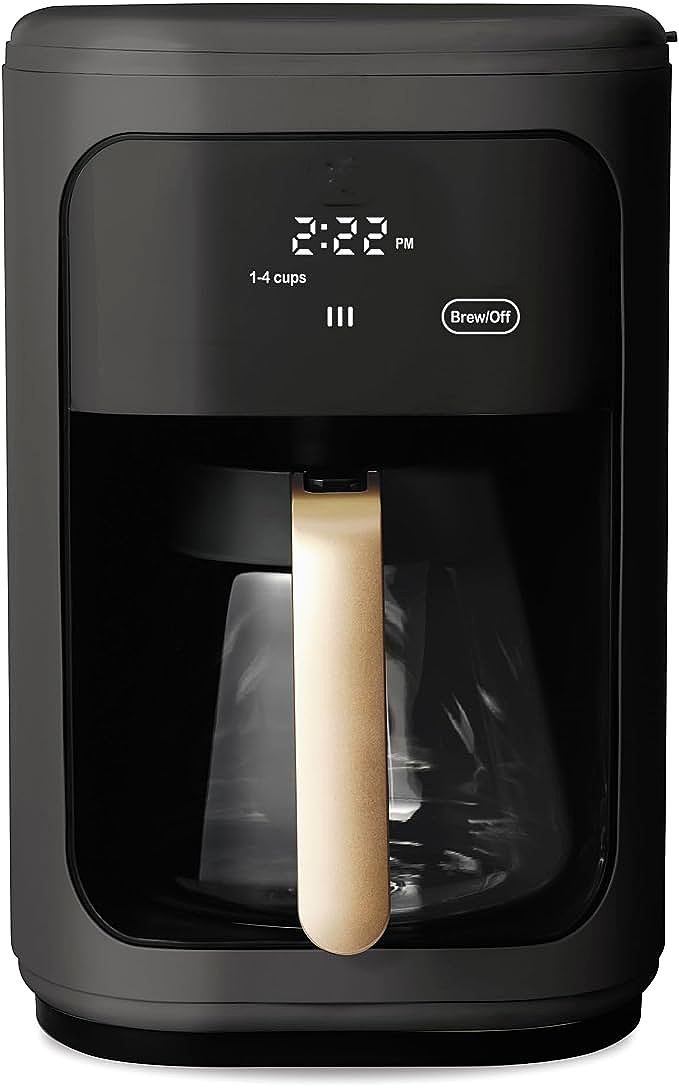
ArmOq Programmable Coffee Maker: Touchscreen Brewing Guide

Pour Over Coffee Maker: A Beginner's Path to a Better Cup at Home

The Physics of Fast Coffee Brewing: How 350 Watts Achieves Sub-90-Second Extr...

Burr Coffee Grinder vs Blade Grinder: Particle Consistency Matters

The Science of Coffee Grinding: Why Burr Geometry Determines Your Cup's Destiny

BRITA Large 10-Cup Water Filter Pitcher: Clean Water for Better Coffee
The Italian Love Affair with Moka Pot Coffee: A Tradition Steeped in Flavor
The Enigmatic Charm of the Moka Pot: Unveiling the Art of Stovetop Espresso
)
The Physics of Fast Coffee: How Thermal Storage and Water Displacement Cut Brew
