Burr vs Blade Coffee Grinder: The Physics of Consistent Grinding

Cuisinart Coffee Grinder, Electric One-Touch Automatic Burr Coffee Grinder with 18-Position Grind Selector, Cup Size Selector for 4 – 18 Cups, DBM-8P1, Black Stainless
The Chopping Dilemma
You pour fresh beans into your kitchen appliance and press start. The machine rumbles for a moment before stopping. You scoop grounds into your filter basket, add water, and brew. The cup tastes... off. Not terrible, just wrong. Maybe too weak, maybe bitter in an odd way. You shrug it off. After all, you used quality beans and followed the recipe exactly.
The truth is simpler than most home roasters admit. Your extraction result depends on something happening inside the grinder long before water ever touches the coffee. And if you are using a blade grinder, you are not controlling that variable at all.
Blade grinders do not produce a uniform particle size. They chop beans through sheer mechanical violence, producing a wild mix of fine dust, coarse chunks, and everything in between. When these particles meet hot water during brewing, some extract far more quickly than others. Fine particles dissolve fast and can over-extract. Coarse particles resist extraction and under-extract. The result is a cup where different particles contribute different flavors simultaneously, and the final taste emerges from their average—which is almost never balanced.
A burr grinder changes this fundamentally. Instead of chopping, burrs crush beans between two abrasive surfaces. The gap between those surfaces defines particle size. Set the gap, and nearly every particle falls within a narrow range around that diameter. Brewing becomes predictable because extraction happens across similar-sized particles rather than against a distribution curve.
This is not marketing language. This is physics.
How Blades Lie
To understand why blade grinders fail, consider what actually happens when metal blades spin inside a container. Each blade acts like a tiny hatchet, flinging bean fragments against the walls and each other. There is no mechanism enforcing consistency. Some beans get hit once and shatter into powder. Others survive multiple passes and remain whole or break into large pieces by chance alone.
The resulting distribution looks nothing like a normal curve. It has peaks at multiple sizes and broad tails extending toward both extremes. Particle size distribution (PSD) is the technical term. For espresso, PSD must be tight enough that the smallest particles make up less than ten percent of total mass. For French press, the bottom quarter should contain minimal fines. Blade grinders routinely violate both thresholds.
Conical burr grinders address this by replacing random impact with controlled crushing. Two serrated disks rotate at different speeds—the upper stationary plate and the lower rotating one. Beans enter the gap, get crushed, and exit. Because the gap width is fixed and the grinding surface area is consistent, particles settle near the set diameter. Flat burr grinders work similarly but use parallel plates instead of conical shapes. Both achieve much tighter PSD than any blade design possible without redesigning the entire mechanism.
What Consistency Changes in Your Cup
Extraction theory tells us that flavor compounds move from ground coffee into water at rates governed by particle size, temperature, contact time, and agitation. Larger particles expose less surface area per unit mass, so extraction proceeds slowly. Smaller particles dissolve faster. If your bed contains a wide spread of sizes, you get uneven extraction across the vertical axis during pour-over brewing. Water flowing through the center hits finer particles first while water moving through the edges encounters coarser ones. The result is channeling and uneven saturation.
With tightly matched particle sizes, water contacts particles more uniformly throughout the bed. Extraction becomes more even horizontally and vertically. Flavor balance improves because sweetness, acidity, and body arrive together rather than staggered across the tasting experience.
This matters even with inexpensive equipment. A cheap burr grinder still produces better PSD than an expensive blade model. The difference is not cost-driven; it is mechanical. One system controls variables. The other does not.
From Theory to Decision
Home brewers face three practical questions when choosing between burr and blade systems.
First, budget constraints matter. Blade grinders under fifty dollars exist. A basic conical burr grinder sits closer to one hundred dollars. That price jump reflects engineering complexity, not brand markup. The motor in a burr grinder must apply steady pressure without stalling under load. Bearings must stay aligned under repeated stress. Housing materials must damp vibration. All of these add cost. A blade assembly needs only a simple motor and plastic housing. The savings come from reduced material and manufacturing requirements.
Second, brewing method determines whether blade performance crosses an acceptable threshold. Espresso demands ultra-fine uniformity. Turkish coffee requires extremely coarse grinding. Neither works well with blade technology regardless of price point. Drip, pour-over, and French press tolerate wider PSD ranges. Even then, blade-ground coffee often produces noticeably harsh notes from over-extracted fines mixed with under-extracted slugs.
Third, maintenance frequency scales differently. Blade grinders accumulate oils and loose debris in crevices. Cleaning requires disassembly and scrubbing. Burr grinders separate cleanly: remove the hopper, pull out the chamber, rinse components. Most designs make access straightforward. Neglect leads to rancid oil retention which transfers into subsequent batches. Clean weekly if you brew daily. Every two weeks is reasonable for moderate use.
For beginners entering specialty coffee, the entry point should be a conical burr grinder with eighteen or more settings. Settings allow matching particle size to method. Coarse for French press, medium for drip, fine for espresso. Price points under one hundred dollars include the Cuisinart DBM-8P1, a conical burr with eighteen settings that gives beginners precise control over particle size without requiring advanced technique knowledge. These machines solve the primary problem—uneven extraction—before the user wastes money on exotic beans or advanced technique.
Engineering Simplicity
Good design minimizes uncontrolled variables. A well-constructed burr grinder makes particle size predictable. The operator sets the gap, trusts the mechanics, and adjusts extraction based on sensory feedback rather than guesswork. This mirrors how engineers approach complex problems: identify the dominant variable, constrain it, measure the outcome, iterate.
Coffee extraction follows the same pattern. Taste is the feedback loop. Grind size is the control parameter. Equipment choice determines how much faith the process requires. A blade grinder forces reliance on subjective judgment. A burr grinder reduces uncertainty and moves confidence from feeling to measurement.
That shift matters beyond coffee. Precision instruments exist because humans learned that repeatability beats intuition when stakes rise. A laboratory balance measures mass to micrograms because chemists cannot rely on eyeball estimates. Engineers calibrate sensors because real systems respond consistently only when inputs match known conditions. Coffee preparation simply applies the same discipline at domestic scale.
The next time you notice your brew lacks clarity, check your grinder before blaming the beans.
Cuisinart Coffee Grinder, Electric One-Touch Automatic Burr Coffee Grinder with 18-Position Grind Selector, Cup Size Selector for 4 – 18 Cups, DBM-8P1, Black Stainless
Related Essays

Burr Coffee Grinder vs Blade Grinder: Particle Consistency Matters

Burr Coffee Grinder vs Blade Grinder: Particle Consistency Matters

How Conical Burr Geometry Controls Coffee Extraction
Burr Coffee Grinder vs Blade Grinder: Particle Consistency Matters
Burr Coffee Grinder vs Blade Grinder: Particle Consistency Matters

Breville BES870XL Barista Express: Mastering Espresso Extraction at Home
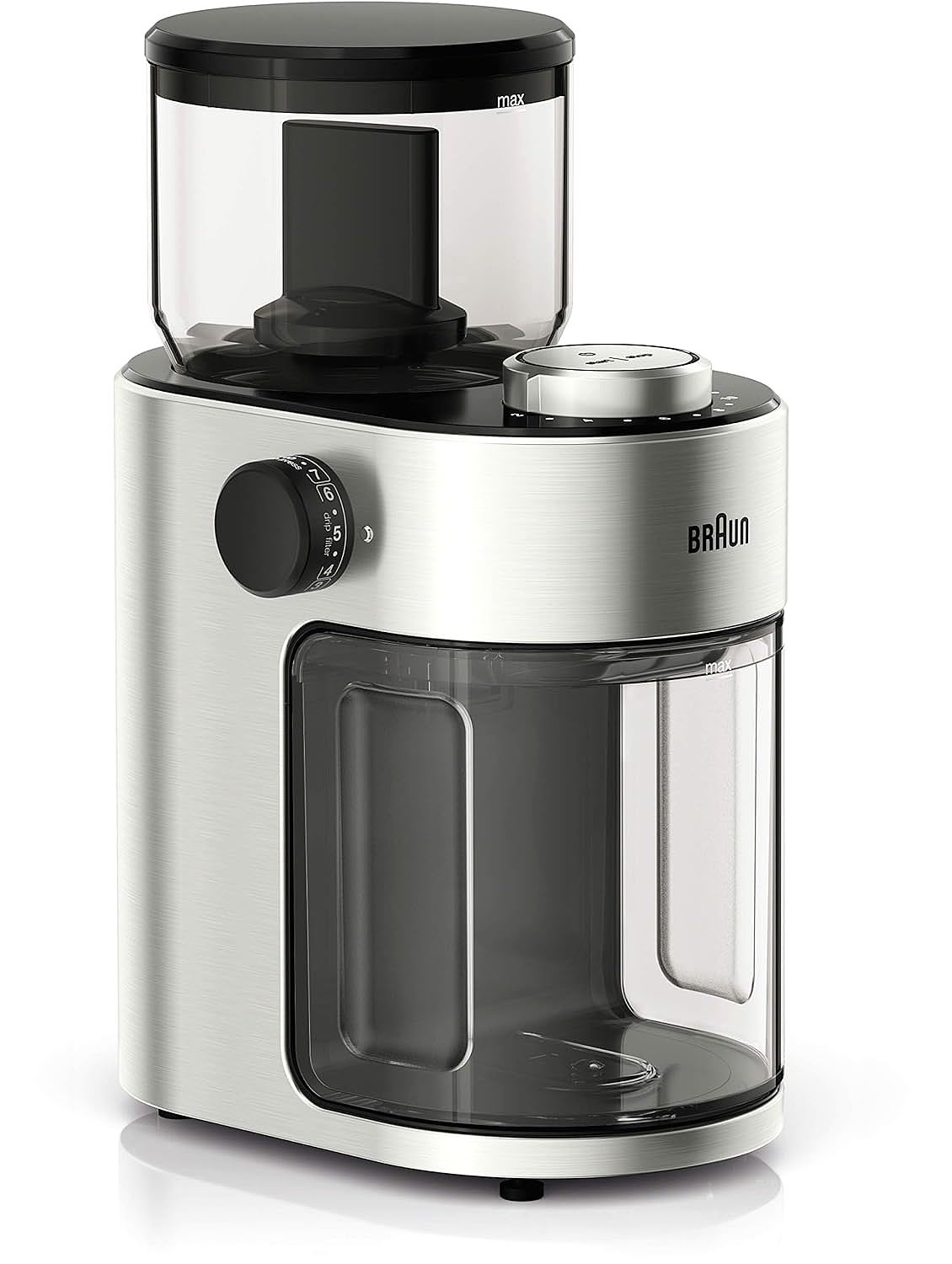
The Flat Burr Secret: Mastering the Braun KG7070 Coffee Grinder

Best Burr Coffee Grinder Under $50: 18 Settings & 16oz Hopper
Best Burr Coffee Grinder Under $50: 18 Settings & 16oz Hopper